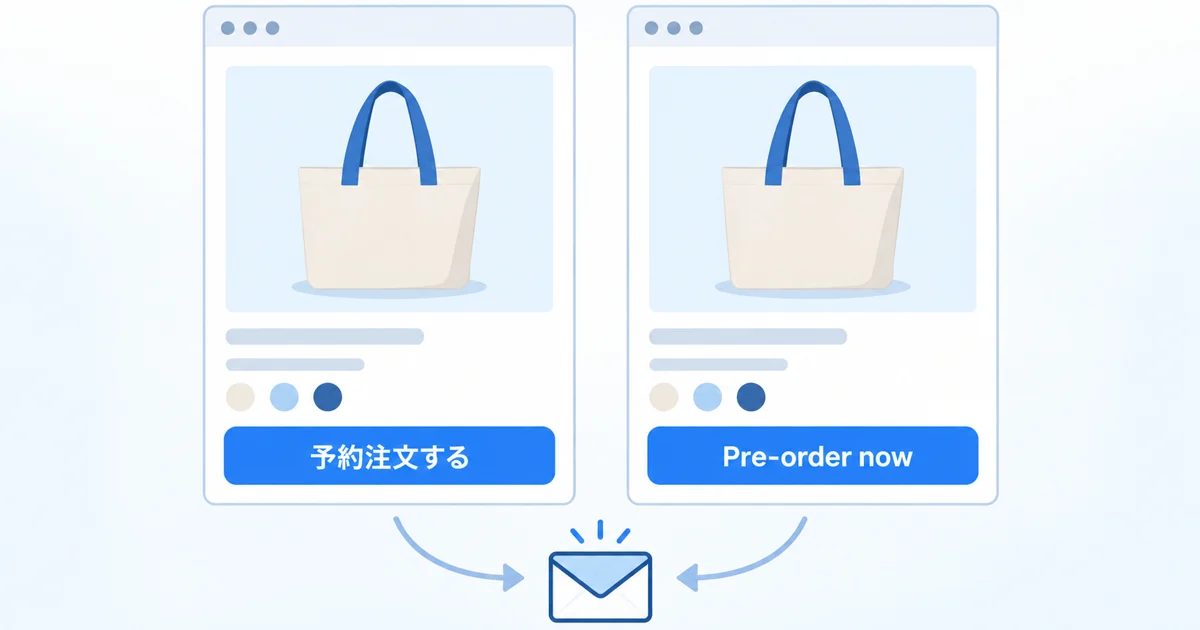
You carefully wrote the shipping estimate and cancellation policy on the Japanese product page — but if the English page doesn't say the same thing, the effort loses its point. When selling pre-orders to customers in multiple languages, the work is this: check the languages you publish in Shopify, align the wording so payment, shipping and cancellation terms come through in every language, and finally switch languages to test with the customer's eyes.
In SellRules, the wording customers see on buttons and forms is built in for 9 languages, and notification emails are stored per language. However, "the wording the app outputs automatically" and "the product-page copy you write yourself" are managed in different places, so let's start by sorting out what lives where.
| What customers see | Where it's managed | How its language is decided |
|---|---|---|
| Buttons, badges, signup form, line-item labels | SellRules "Storefront wording" | Built-in for 9 languages. Empty fields auto-show in the customer's language |
| Product names, descriptions, terms you wrote | Shopify-side content (translation app, etc.) | Without a translation, the store's primary language is shown |
| Notification emails such as pre-order and restock | SellRules "Email templates" | Saved per language. Unedited languages use built-in translations |
First, check which languages customers see
The languages customers see are exactly the languages you publish under "Settings → Languages" in Shopify. SellRules has nowhere to add a language; the app's language tabs simply list your published languages.
When you publish a language, language-specific URLs such as example.com/fr are created, and customers can browse, check out and receive notifications in that language. Parts without translations are shown in the store's primary language. See Shopify's language management help for details.
What you want to check here is how your published languages map to SellRules' built-in languages. The built-in wording covers 9 languages (Japanese, English, German, French, Dutch, Portuguese, Italian, Spanish and Swedish), stated both in the official guide and the App Store listing. Whether your published languages all fall inside these 9 or include languages outside them changes the work ahead.
For example, imagine a store publishing Japanese, English and German and taking pre-orders for a limited-edition bag due to ship next month. All 3 languages are within the built-in range, so buttons and forms basically work as-is. What remains is reviewing the translated product descriptions and the email copy. If you wanted to add Korean here, it would count as a language without built-in wording and need separate preparation — see the section "Check how languages without built-in wording are displayed" below.
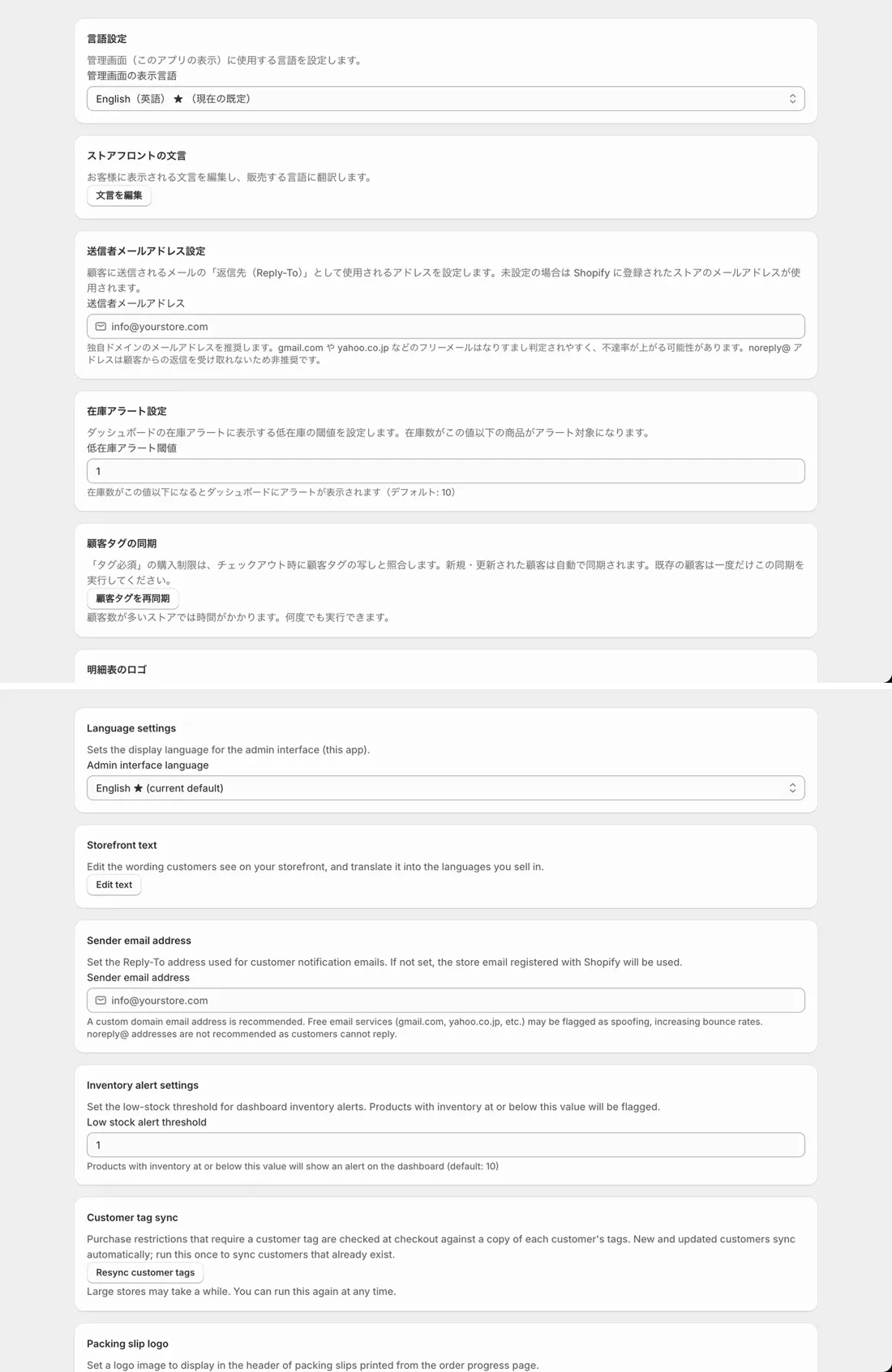
Note that the app's admin display language ("Settings → Language settings") is a separate setting from the wording customers see. You can keep the admin in Japanese while showing customers wording in 9 languages.
Align the product-page wording per language
The app's wording is edited under "Settings → Storefront wording". It covers product card badges, product page buttons, the signup form, cart and checkout line-item labels, and the sales-ended message.
Leave a field empty and the built-in wording matching the customer's language is shown automatically. Rewriting one language leaves the others on automatic, so it's fine to fix only the parts you want to change.
There is one pitfall. Wording entered in the default language tab is also used for languages with no translation. You might enter "ships mid-next-month" in the Japanese tab, intending it for Japanese customers, and have that Japanese text shown to customers whose language has no translation. To return to automatic, empty the field. "Reset everything to automatic" at the bottom of the screen resets all languages at once.
The product-page content itself — the product name, description, and the copy where you write shipping and payment terms — is not app wording but store-side content. You translate it per language with tools such as the Translate & Adapt app. Important pre-order terms are often written on this side, so don't relax after aligning only the app's wording; check the description for translation gaps too.
Incidentally, the content you edit in "Storefront wording" is the same data as Shopify's translations. The default language is the metafield value itself, and other languages are saved as Shopify translations, so editing in the app's screen or in Translate & Adapt produces the same result. Edit from whichever screen you prefer.
Review notification emails per language
SellRules has 7 notification types: pre-order confirmation, made-to-order confirmation, launch notification, restock notification, delay notice, shipping confirmation and cancellation. Subject and body are saved separately per language, and languages you have not edited use the app's built-in translations. Notification emails do not ride on Shopify's translation system; the app stores them per language.
Review them under "Settings → Email templates". Switch the language tabs and read the pre-order confirmation and the cancellation first, since those are the notifications that should carry shipping and cancellation terms. Enter your own address in "Test send" and a mail with "[test]" prefixed to the subject arrives. You can also check there that variables such as {{deliveryDate}} are replaced with actual values.
The sending language follows the customer's language; when the customer's language is unknown, the language set in "Settings → Default email language" is used. Check as well that the default language is the language of your main market.
Check how languages without built-in wording are displayed
If you publish a language outside the 9 (Korean or Chinese, for example), the tab does appear in the wording settings, but there is no built-in wording. Left empty, the default language's wording is displayed as-is.
In other words, a customer browsing in Korean could see a Japanese pre-order button. The fix is to enter the wording yourself in that language's fields. Email templates work the same way — with no built-in translation, you prepare them yourself.
If filling every field in that language is difficult, reconsider publishing the language at all, or consider at least writing the payment, shipping and cancellation terms in the product-page body. Taking pre-orders in a language whose terms customers cannot read creates a heavier support burden later.
Switch languages and test with the customer's eyes
Once setup is done, check the actual display. Going through your published languages one at a time in the following order is reliable.
- Open the product page of a product in its pre-order phase via the store's language switcher or a language-specific URL.
- Check that the button, badges and signup form are displayed in that language. Also check how the shipping-estimate text you entered in the schedule is displayed.
- Read the payment, shipping and cancellation terms written in the description to confirm they exist in that language version.
- Place a test order and confirm the pre-order confirmation email arrives in that language. Open the relevant row in the "delivery log" to see the body that was actually sent.
- Check that the important terms are consistent across all languages. Use the following table as a starting point.
| Important terms | Where to check on the product page | Where to check in emails |
|---|---|---|
| Payment methods and timing | Each language version of the description and policies | Pre-order confirmation email |
| Shipping estimate | The shipping display near the button and the description | Pre-order confirmation, delay notice, shipping confirmation |
| Cancellation and refund terms | Each language version of the description and policies | Cancellation email |
When the displayed language differs from what you expected, causes split into two places. For product-page wording, check under "Settings → Storefront wording" whether that language's tab is empty, and whether the language is published in Shopify. For emails, check the "Settings → Default email language" setting.
Frequently asked questions
Isn't Shopify's translation feature enough?
Shopify's language settings and a translation app can make your theme, checkout and product-page content multilingual. However, wording that an app outputs, such as the pre-order button or the signup form, is managed in that app's own system. SellRules includes built-in wording in 9 languages and lets you override it per tab.
How do I sell in a language the app has no built-in wording for?
The wording settings show a tab for that language, so you can enter the wording yourself. Since there is no built-in wording, you will need to translate every field you use by hand. It is safer to add a language to your published languages only after considering whether you can explain your sales terms in it.
Which language are notification emails sent in?
Emails are sent in the customer's language, and when the customer's language is unknown, the language set in “Settings → Default email language” is used. Templates are saved separately per language, and languages you have not edited use the app's built-in translations.
If I rewrite the wording in English only, do other languages change too?
No. Only the language you rewrote changes; the others stay on automatic. However, wording entered in the default language tab is also used for languages with no translation, so “I only meant to fix the default language but it appeared elsewhere” can happen.
Deliver your sales terms in every language you sell in
For multilingual pre-order sales, the quality bar is not whether things are translated but whether "the important terms can be read in every language". Align the product-page wording, review the emails, and switch languages to confirm — starting with a single product and expanding from there is reliable.
For preparing the pre-order flow itself, see the article on getting started with pre-orders; for sorting out missing emails, the article on what to check when notification emails don't arrive. If the button itself doesn't appear, see the article on what to check when the pre-order button doesn't show.
The SellRules Launch plan is US$7.99 per month and includes a 10-day free trial. Check the price and trial terms on the signup screen as well.
Features and pricing checked: September 18, 2026. Based on the Shopify App Store listing and the official guide. Shopify-side behavior is confirmed in the help pages for managing languages and Translate & Adapt.
Related articles: Deciding on early-access and limited sales