When a customer messages you saying "I never got the restock email," or a notification you signed up for yourself during testing never arrives, it is natural to worry that something in the setup is wrong.
A restock notification that fails to arrive has stopped at one of four points: signup, conditions, sending, or receipt. This article walks through checking each screen in order to isolate where it stopped, and how to decide whether a resend is needed, whether the problem is on the receiving side, or whether to contact support.

Note that this article assumes a store that has already set up restock notifications and is running them. For placing the signup form and the initial setup, see how to start restock notifications. What this article covers is the "restock notification" sent when stock comes back. Signups made before a launch receive a different "pre-order start" notification, so for pre-launch signups see the article on pre-launch notification signups.
Check whether the signup is still in the Waitlist
When a customer says nothing arrived, first check whether their email address is still in the Waitlist. This tells you whether it was already sent, is excluded, or is still waiting to send.
- Open the app's Waitlist and filter by the address that reported the problem or by the product
- Check the status of the signup row
- Open the row to see the send history (how many times it was sent across restock cycles)
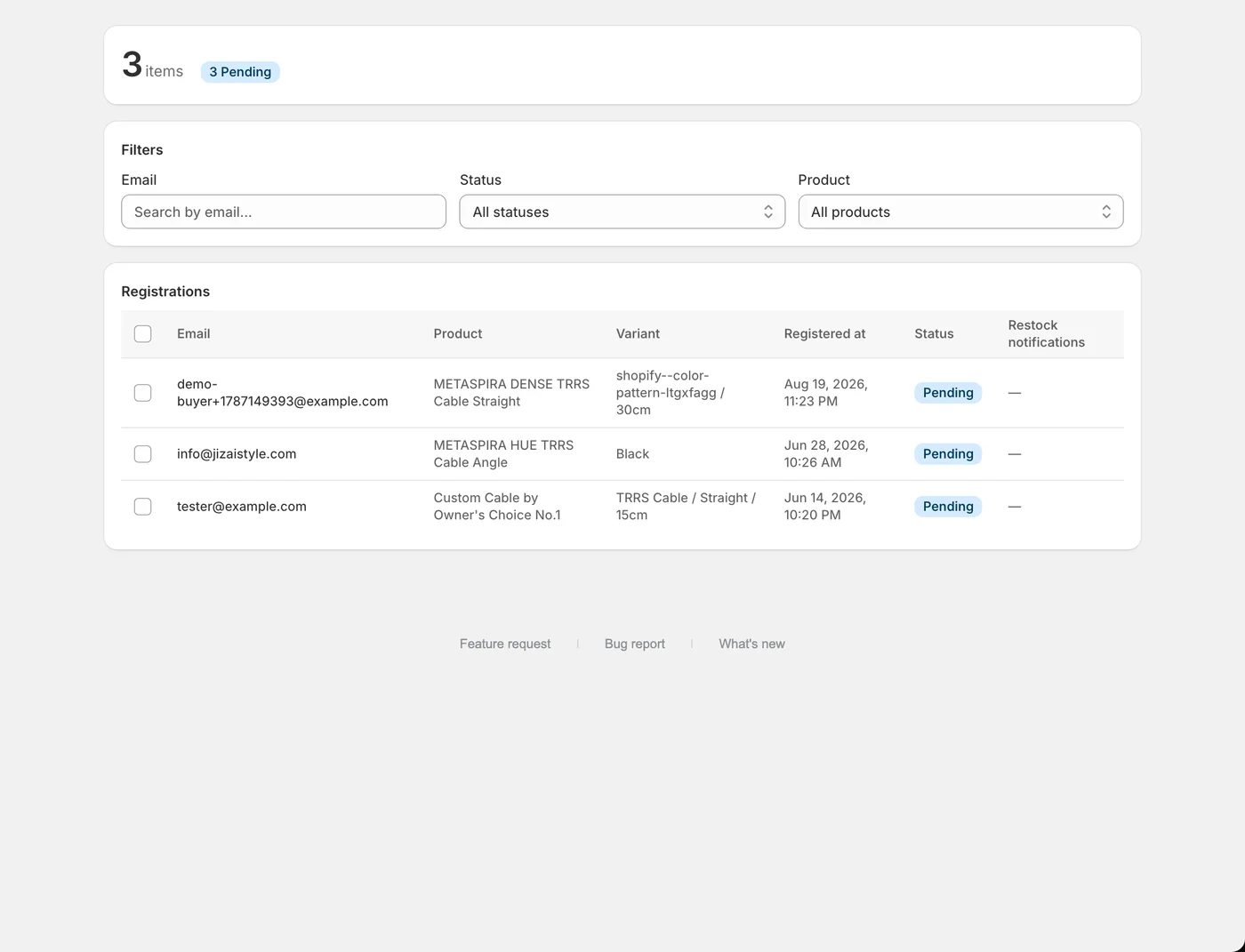
A signup has one of five statuses: Pending, Sent, Excluded, Unsubscribed by customer, or Excluded by merchant.
- "Pending": the notification has not been sent yet. The conditions may not be met, or the entry may be excluded from sending
- "Sent": there is a record of the notification being sent. The sending side has finished, so check the receiving side next
- "Excluded" and "Excluded by merchant": a signup the store has set not to send to. Confirm that this was intentional
- "Unsubscribed by customer": the customer opted out via the stop link in an email. This address is not sent to automatically, and you must not send to it from the store side either
For restock notifications, the reliable check is opening the signup row and looking at its send history. You can see not just the current state but how many times it was sent per restock cycle.
If you cannot find the signup at all, check whether a filter is still applied, and whether the customer registered on a different variant (color or size). A deleted signup cannot be restored. And if no signup field appears on the product page at all, signups were never accepted — in that case, check that the theme's "app embed" is switched on.
Match inventory and rules to the conditions that trigger the notification
If the signup is still Pending, the conditions for sending are probably not met yet. A restock notification is sent when stock returns to 1 or more for people who signed up through the stock-out rule "restock alert only".
For example, on a T-shirt in sizes S, M, and L, if only M came back, customers who signed up for S or L are not notified yet. Restocking and the notification actually going out do not always line up, so match the conditions first.
Check the following in order:
- Did the stock actually come back? If a different variant was restocked, no notification is generated for this signup
- Is inventory tracked in Shopify for that product? A product that is not tracked is treated as quantity 0, so the "stock is back" change never happens
- Under "Rules → Stock-out rules", is that rule Enabled?
- Is there a manual schedule (covering the whole product)? A manual setting takes priority over the automatic stock-out switch
- Has enough time passed since you restocked? Stock changes are picked up via notifications from Shopify, and the phase switch runs about every 5 minutes. Right after restocking, wait a little and check the status again
Note that products whose switch target is Pre-order or Made-to-order accept orders, not signups. Only products set to "restock alert only" collect signups waiting for a notification. How to combine the conditions is also covered in the stock-out rules section of the user guide.
Check the Delivery log to see whether sending actually happened
If the signup shows Sent but nothing arrived — or the conditions look met but it never leaves Pending — check the actual send result in the Delivery log.
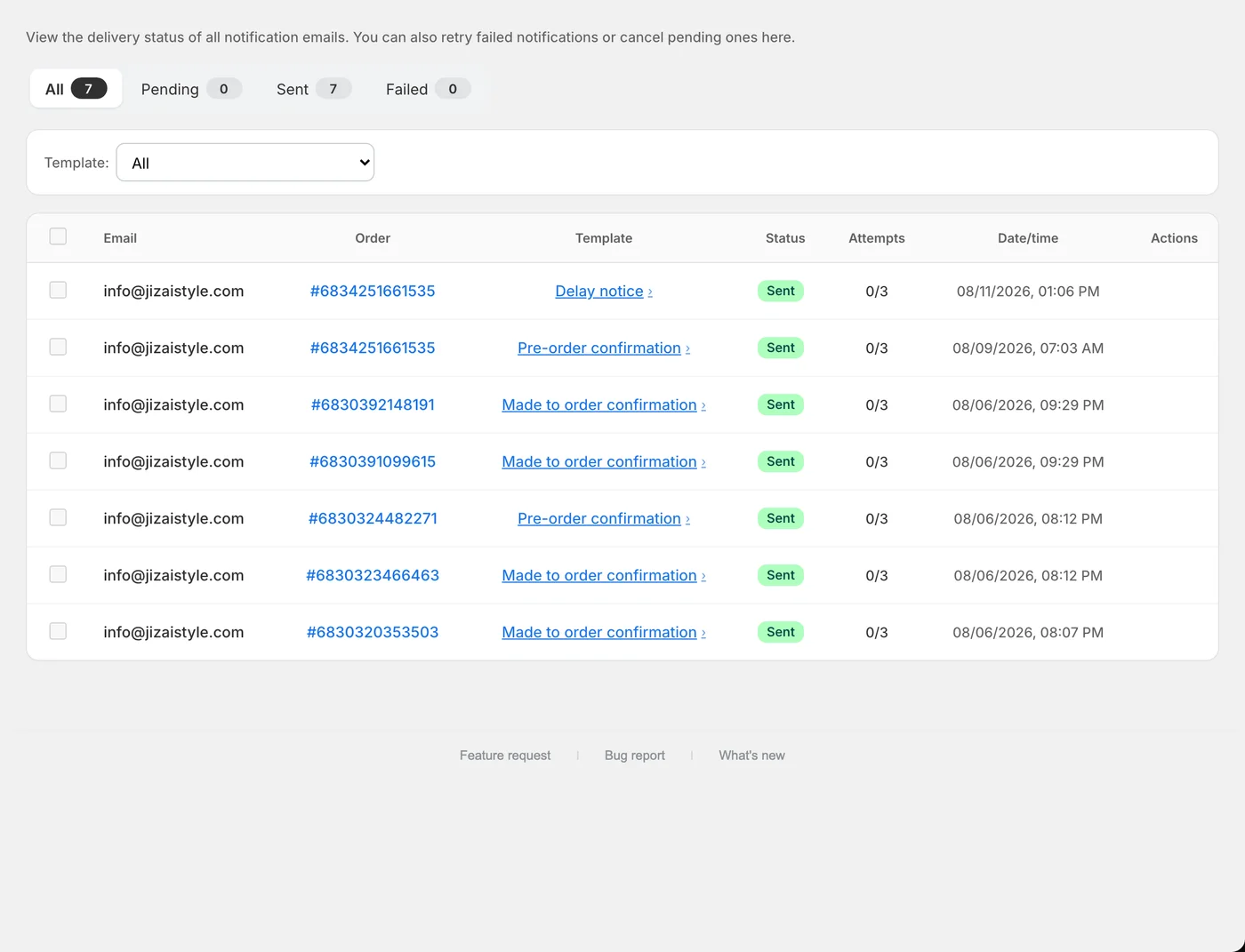
The Delivery log lists recipient, order, template, status, attempts, and timestamp, with per-status counts at the top. The statuses are Pending, Processing, Sent, Failed, and Cancelled.
- "Failed": open the row to read the error. Unless the recipient address is simply mistyped, select the row and choose Retry to put it back in the queue
- "Pending" and "Processing": sending is still in progress. Wait a little and check again. To stop it before it sends, you can cancel it
- "Sent": sending has completed. Open the row to see exactly the body that was sent
- No matching row in the log: under "Settings → Email templates", check that the template has not been disabled ("Stopped")
How to read the Delivery log is also covered in detail in the notification emails section of the user guide.
If it says Sent but nothing arrived, check the receiving side
If the Delivery log shows Sent, the app's sending work is done. The remaining causes sit on the receiving side: a wrong address, spam filtering, or the sender's reputation.
- Confirm there is no typo in the recipient address in the Delivery log
- Ask the customer to check their spam folder and other inbox tabs (such as Promotions)
- Review the sender (reply-to) address in Settings
Using an address on your own domain as the sender is the safe choice. Free mail such as gmail.com is easily flagged as spoofing and can cause non-delivery. Avoid a noreply@ address that cannot receive replies, too.
Whether a message reaches the inbox also depends on the customer's mail service and provider filters. Sent means the sending process finished; it does not guarantee the message reaches the customer's eyes. Sending a template's "test send" (an email whose subject starts with "[Test]") to another address of your own can show you at which receiving environment it gets stuck.
This is also a good stage to review the wording and language. Notification emails can be edited per language and are sent to match the customer's language; the article on preparing notifications in multiple languages explains how.
Decide whether to resend or to contact support
Once the checks above show where it stopped, the next step is acting on it. Here is the decision table.
| Where it stopped | Screen state | Likely cause | Next step |
|---|---|---|---|
| Signup | No row in the list | Never signed up, different variant, deleted, or still filtered | Clear the filter and search; re-register if missing |
| Signup | Excluded, Unsubscribed by customer, or Excluded by merchant | Set not to send | Do not send to opted-out recipients |
| Conditions | Still Pending | Stock not back, rule disabled, or a manual schedule takes priority | Match inventory, rule, and schedule |
| Sending | Failed | Recipient or sending error | Open the row, read the error, and Retry |
| Sending | Stuck on Pending or Processing | Sending still in progress | Wait and re-check; cancel to stop it |
| Sending | No row in the log, template Stopped | That notification type is disabled | Re-enable the email template |
| Receipt | Sent but not delivered | Spam filtering, wrong address, or sender reputation | Check the receiving side; move the sender to your own domain |
Two things to watch when resending: avoid sending twice to the same person, and avoid sending to someone who opted out.
- Only rows marked Failed can be resent. There is no operation to send a Sent notification again, and no bulk-resend feature — that is by design, so you do not send twice to people who already received it
- Unsubscribed by customer means the customer themselves stopped receiving via the stop link. Do not send to them from the store side
- To contact people individually, use the Waitlist's CSV export, then contact the addresses excluding those who opted out. The CSV is UTF-8, so when opening it in Excel, import it via "Data → From Text/CSV" and specify UTF-8
If it still does not resolve, contact support with information that reproduces the situation
If none of the checks reveals the cause, gather the details that let support reproduce the situation and contact support. When the support side can reproduce what happened, it leads to a faster answer.
- Your store URL (something.myshopify.com)
- Product name and product ID (include the variant name if the problem involves a variant)
- When it happened (with the time zone if possible)
- What you expected and what actually happened
- The relevant row in the Delivery log (essential for investigating email notifications)
- A screenshot of the screen
You can also reach out via "Feature request" and "Bug report" inside the app. A symptom-by-symptom checklist is also in the guide's troubleshooting section.
Frequently Asked Questions
I restocked but the restock notification never arrived. What do I check first?
Check the status of that address in the Waitlist. If it is still Pending, the notification conditions are not met yet or the entry is excluded; if it shows Sent, the problem is on the receiving side. If you cannot find the signup at all, clear the filters and check whether the customer registered on a different variant or the entry was deleted.
The log says Sent, but the customer says nothing arrived.
Sending has completed, so check the receiving side. Confirm there is no typo in the recipient address in the Delivery log, and ask the customer to look in their spam folder. If it keeps happening, consider switching the sender (reply-to) address to one on your own domain.
Can I resend all the notifications that did not arrive at once?
The only resend option is selecting a row marked Failed in the Delivery log and choosing Retry. There is no way to resend a notification marked Sent, and no bulk-resend feature. To contact people individually, export the Waitlist as CSV and reach out — excluding anyone marked Unsubscribed by customer.
What is the most reliable way to test delivery myself?
Sign up on a test product with your own email address, set inventory to 0 once, then back to 1 or more. Check both the Waitlist status and the Delivery log, and compare the received email's subject and body with the row you open in the log — that shows where it stopped.
A missing notification can be traced through four checkpoints
When a restock notification does not arrive, looking at the screens in the order signup → conditions → sending → receipt will show you roughly where it stopped. Checking the state before sending to the same person again is the shortcut to preventing duplicate sends and mistaken sends to opted-out customers.
For how to decide the overall sales rules, see the advance and limited sales overview. The SellRules Launch plan is US$7.99 per month and includes a 10-day free trial. Charges apply if you keep using it after the trial.
Features and pricing checked on September 18, 2026, based on the Shopify App Store listing and the official guide.
Related articles: How to decide advance and limited sales overall