
"You want to start taking pre-orders — but there are so many apps that you cannot tell which one to pick." Search the App Store for "pre-order" and every listing reads much the same, which makes them hard to compare.
The basic approach: decide what kind of pre-order your store needs first, then compare on the same criteria. There are 3 things to pin down: when customers pay, what intake and selling rules you need, and who gets notified how. List your conditions in that order and the shortlist narrows itself.
This article compares 3 apps currently offered in the App Store's pre-order category whose listing pages document payment methods and pricing — Timesact, STOQ, and Essent Preorder Back in Stock — against JizaiDev's SellRules on the same axes. This is not a ranking: it is material for checking each app against the requirements you cannot drop.
This blog is run by JizaiDev, the developer of the pre-order app SellRules. Everything stated here — including about the compared apps — is based only on what each app's listing page says. Features and pricing checked: September 18, 2026.
First decide what kind of pre-order your store needs
Before you start looking at apps, write down the shape of the pre-order your store needs. There are 3 things to decide: when customers pay, what kind of intake it is, and what rules and notifications you need.

Payment timing falls into 3 patterns.
- Full payment at order: same as a regular purchase — you collect payment when the order is placed. Revenue arrives early, but a long gap to shipping raises customer anxiety
- Part now (deposit): collect part of the price at reservation and the rest around shipping. Lowers the customer's burden for expensive items or long pre-order windows
- At shipping / pay later: no charge at order time; billing happens when you ship. Kindest to the customer, but it requires a way to store and collect payment later
The shape of intake depends on whether you are taking pre-orders for a product with a fixed launch date, want to keep taking orders on a sold-out item, or make to order. Rules and notifications are things like "2 per person" or "members first" purchase conditions, whether you want to collect emails before launch, and whether you need a way to tell customers when shipping slips.
An example of a finished list: "a new bag launching in December (month 12), pre-orders open in November (month 11). Payment at order time is fine. When it sells out, switch to notification signups. Cap it at 2 per person against resellers." Get this far and you have every condition you need for the comparison.
There is also the option of going without an app — Shopify's built-in settings, manual work, or custom development. The "continue selling when out of stock" inventory policy and scheduled product publishing need no app, but Shopify has no built-in way to switch product-page buttons on a schedule or to take deposits and deferred pre-orders. Our article on making launch prep easier sorts out the choice between manual work, apps and development, and the pillar article on advance and limited sales covers the broader decisions.
Compare when customers pay and what each app supports
Anything other than "full payment at order" — deposits or paying later — runs on Shopify's "preorder" purchase option mechanism. As Shopify's help explains, displaying pre-orders and arranging payment requires a pre-order app, and which payment styles are supported differs by app.
| App | Full at order | Partial / deposit | At shipping / deferred | Split payments |
|---|---|---|---|---|
| SellRules | ○ | — | — | — |
| Timesact | ○ | ○ | ○ (supports 0-yen reservations and charge at shipping) | ○ |
| STOQ | ○ | ○ | ○ (deferred payments) | ○ |
| Essent | ○ | ○ | ○ (deferred payments) | ○ |
The table is easy to read: if you want to push payment later, SellRules is out of scope. SellRules processes pre-orders as regular Shopify orders and only supports full payment at order time. Conversely, if "full payment at order" works for you, all 4 stay in the running.
If you go the pay-later route, check Shopify's own constraints at the same time. The preorder purchase option cannot be used with accelerated checkouts such as Shop Pay, Apple Pay or Google Pay, nor with local payment methods such as Klarna or iDEAL, and it does not work on customized checkouts. Supported channels are limited to the online store and custom storefronts, and you cannot combine a different purchase option such as a subscription on the same product. Shopify also requires a reasonable basis for shipping within 30 days of purchase when no shipping date is stated, and asks merchants to communicate a revised shipping estimate plus cancellation and refund rights if timing slips. Stating a shipping estimate on the product page is a baseline whichever app you choose.
Handling of mixed carts — pre-order and regular items bought together — also differs by app. STOQ and Timesact document mixed-cart support on their listings, and Essent has a setting to prevent mixing. SellRules treats pre-orders as regular orders, so they can share a cart, but when a pre-order or made-to-order item is in the cart some payment methods such as cash on delivery are hidden automatically (official guide).
Compare selling rules and notifications
Once payment is settled, the next questions are "how do you take orders" and "how do you keep in touch". Line the apps up on the same criteria and their different strengths become visible.
| App | How intake is set up | Out-of-stock behavior | Purchase conditions | Signup & notifications | Main integrations |
|---|---|---|---|---|---|
| SellRules | Date-and-time schedule (announcement → pre-order → regular sale → end) | Auto-switch to pre-order, made-to-order or notify-only at 0 stock | Pre-order caps; per-order, per-customer and per-count limits; login and customer-tag eligibility | Announcement form + notification list, 7 email types — pre-order confirmation, made-to-order confirmation, pre-order start, restock, delay, shipped and cancelled — per-language templates | Shopify Flow |
| Timesact | Assign products via tags, CSV or Flow; coming-soon support | Turns pre-orders on and off by inventory level | Pre-order quantity limits | Waitlist, pre-order and restock emails, SMS (metered) | Klaviyo, Flow, page builders |
| STOQ | Pre-order / Notify-me buttons on sold-out or pre-launch products; Markets and multiple locations | Button switches on sold-out items | Order quantity limits | Waitlist, restock email and SMS, reminders | Klaviyo, Mailchimp, Omnisend, POS, Flow |
| Essent | Campaign-based, per-variant, Markets and B2B support | Switches for sold-out, coming soon and made-to-order | Order quantity limits, mixed-cart prevention | Notify-me form, restock emails | Omnisend, Flow, page builders |
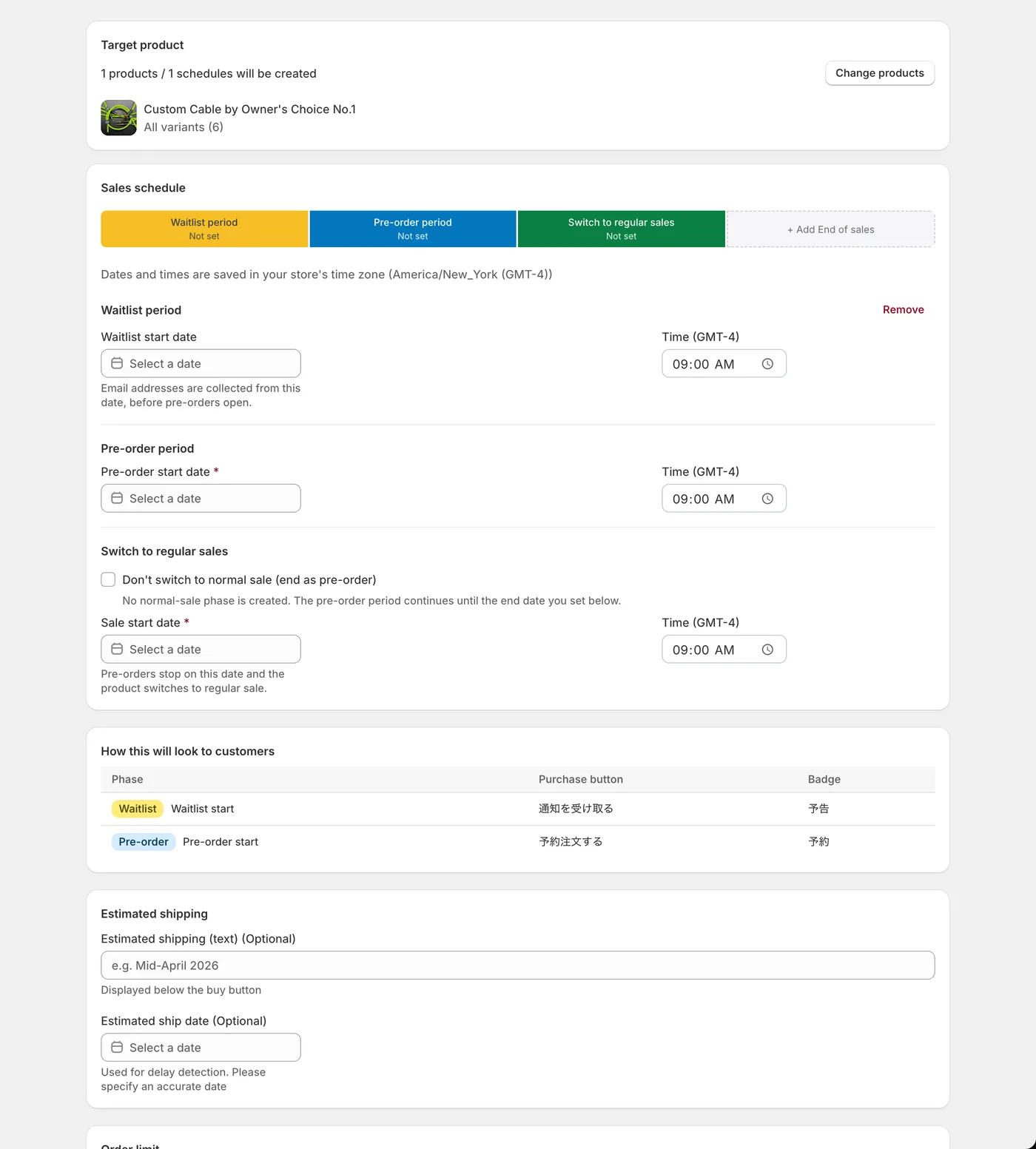
Summing up the differences: every app has quantity caps, but only SellRules documents purchase eligibility such as "cumulative per customer" or "members with a tag only". Phase-based management that switches launch date, intake end and sale end at set times is also a SellRules trait as far as the guide shows. Conversely, badges, banners and countdown effects, SMS notifications, POS intake and email integrations such as Klaviyo are absent from SellRules' listing — if your operation needs them, look at the other candidates.
Check pricing and trial options
Finally, pricing. All four bill in US dollars through Shopify's billing, but flat-rate versus capped plans with metered overage is the dividing line.
| App | Free entry | Paid plans (monthly, USD) | Metered / caps | Trial |
|---|---|---|---|---|
| SellRules | None | Launch 7.99 (all features, no volume cap) | None | 10-day free trial |
| Timesact | Up to 20 orders a month (branding shown) | CORE Flex 5+ (charge at shipping is PRO Flex 7+), unlimited Fixed tiers 23–117 by Shopify plan | 0.2–0.3 per order over the cap, metered SMS | Test on the free plan |
| STOQ | Up to 10 pre-orders and 30 emails a month | Lite 10 (100/month) – Pro 29 (400/month) – Unlimited 69 | 0.25–0.1 per order over the cap, metered SMS | 14-day trial on paid plans |
| Essent | Up to 25 pre-orders and 300 notifications a month | Lite 4.95 (100/month) – Starter 8.95 (300/month) – Essentials 24.95 (500/month), unlimited Professional 59 | 0.25–0.1 per order over the cap, metered notifications | 14-day trial on paid plans |
Plug in your monthly volume and the flat-versus-metered difference shows up in dollars. Take a store taking 80 pre-orders a month (a hypothetical estimate): SellRules is a flat 7.99, Essent Starter is 8.95 (no overage to 300), STOQ Lite is 10 (up to 100), and Timesact CORE Flex is 5 + 50 overage × 0.2 = 15 — all monthly figures in USD. Conversely, a store testing a few pre-orders a month spends less starting on the free tiers of the other 3.
Beyond pricing, let me be honest about the track-record gap. Review counts on the listings: Timesact 4.9 with 2,066 reviews, STOQ 5.0 with 3,704, Essent 5.0 with 1,267. SellRules launched on September 4, 2026 and had 0 reviews at the time of checking. Review volume is a useful signal of operational history, but treat it as a separate axis from fit with your requirements.
Test with the same product
Once you are down to about 2 candidates, stop comparing documents — the reliable way is to actually run the same product under the same conditions. All of them have a free entry point, so you can test under non-overlapping conditions.
- Pick 1 product to test: a product whose real intake has not started yet, or a test product customers cannot see
- Set identical conditions: same pre-order start time, same shipping-estimate wording, same intake cap. If the conditions differ you cannot tell a display difference from a feature difference
- Check the customer side: open the product page and check the button, wording and shipping display; if you will use notifications, sign up with your own email address and confirm the message arrives
- Check the surroundings: compatibility with your theme's app embeds and page builders, whether your payment methods still work on a pre-order cart, and how cancellation and uninstall are handled
For SellRules, the 10-day free-trial checklist covers setup and a 1-product check, and the pre-order setup guide covers initial intake configuration. If you are on a different pre-order app and weighing a switch, see the app-switching checklist for how to change over without breaking open orders.
Assumptions and caveats
This comparison relies solely on what each listing page stated on September 18, 2026. I will not declare a feature "unsupported" just because the listing does not mention it, but if it is a hard requirement, asking the developer before installing is the surest path. Pricing and plan contents can change, so re-check each listing before you subscribe.
The 3 apps were chosen because they are currently offered in the App Store's pre-order category and their listings document payment methods, features and pricing. Their pricing structures (flat, metered, tiered) and payment coverage differ from one another, which makes them a useful set for seeing how the axes differ.
Let me also be direct about where SellRules does not fit: deposits, deferred or split payments are mandatory; you want SMS notifications; you want to take pre-orders at POS; you weight an established review history — if any of these is a hard requirement, the other 3 apps compared here are your candidates. Conversely, if you want to collect full payment at order time and test launch-date switching, purchase eligibility and notifications on 1 product, SellRules runs flat-rate with no volume counting.
Whichever app you choose, keeping the promised shipping estimate is the store's responsibility. An app handles intake and display switching; it does not guarantee restocking or shipping. Set a realistic shipping estimate and plan to notify customers promptly if it changes — that is the baseline of operation.
Frequently Asked Questions
Which app should I choose if I want customers to pay at shipping time?
To charge at shipping or later, you need an app that supports Shopify's preorder purchase option. Of the apps compared here, Timesact, STOQ and Essent Preorder Back in Stock list deferred payments or charge-at-shipping on their listings. SellRules only supports full payment at order time, so it is out if deferred payment is a hard requirement. Note that pay-later pre-orders cannot use accelerated checkouts such as Shop Pay or some local payment methods.
Can customers buy pre-order and regular items in the same cart?
It depends on the app and its settings. SellRules records pre-orders as regular Shopify orders, so they can be bought in the same cart (some payment methods such as cash on delivery are hidden automatically when a pre-order item is in the cart). Other apps either document mixed-cart support or offer settings to prevent mixing, so check how the app treats mixed orders during your trial.
How far can I test for free?
Timesact, STOQ and Essent all have free plans with volume caps, and SellRules has a 10-day free trial. Free plans limit monthly pre-orders or notifications (for example, STOQ's free plan covers up to 10 pre-orders a month). Decide how many products and how long you want to test before comparing.
What should I watch out for when switching from my current pre-order app?
Notification signups and schedule settings that live only inside the app are often lost on uninstall, so record your open orders and the promises you made to customers first. The orders themselves usually stay in Shopify, but the safest path is to finish handling open orders in the old app and start only new intake in the new one.
Summary
Choosing a pre-order app means writing your conditions on 3 axes — "payment timing", "intake and selling rules", "notifications and pricing" — and comparing on equal terms. To push payment later, you need an app that supports Shopify's preorder purchase option; to collect full payment at order and manage selling rules, SellRules is also a candidate. Once your conditions are written down, decide by testing on the same product.
Related articles: How to start pre-orders · What to check in the free trial · Choosing between an app, manual work and custom development · How to decide on advance and limited sales
Features and pricing checked: September 18, 2026. Based on the Shopify App Store listing, the official guide, and each app's listing page (Timesact · STOQ · Essent Preorder Back in Stock).