
"I want to sell this product to members only." "For the first few days after launch, only my regulars should be able to buy." Even once you've decided that, Shopify's standard settings offer no obvious way to keep a product page public while limiting purchases to specific customers.
Members-only selling comes down to three jobs. Decide who can buy, align the conditions with sign-in and customer tags, and test purchases as both a member and an outsider. Alongside that, prepare the message for shoppers who can't buy before you go live.
This article separates what Shopify itself can do from how to restrict per product with purchase eligibility. The topic is "who can buy" — not quantities or order counts. If you want to cap how many each person can order, see the article on deciding purchase limits.
First, decide who you're selling to
"Members-only" can mean "anyone who's signed in can buy" or "only customers carrying a specific tag", and the setup differs between the two. Start by deciding which of the following your buyers should be.
| Who you want to sell to | Condition needed | Good fit for |
|---|---|---|
| Every signed-in customer | Sign-in required | Members-only shops, members-only pricing |
| Customers with a specific tag | Sign-in + customer tag | VIP early access, wholesale, insider products |
| Anyone (normal selling) | No restriction | After switching to general release, open selling |
Decide what "member" means here, too. In Shopify, customers are registered in the admin's customer list and sign in with a customer account to view things like their order history. Buying without signing in is a guest checkout. If your store calls newsletter subscribers or LINE friends "members", those people need to be linked to customer records so a customer tag can identify them.
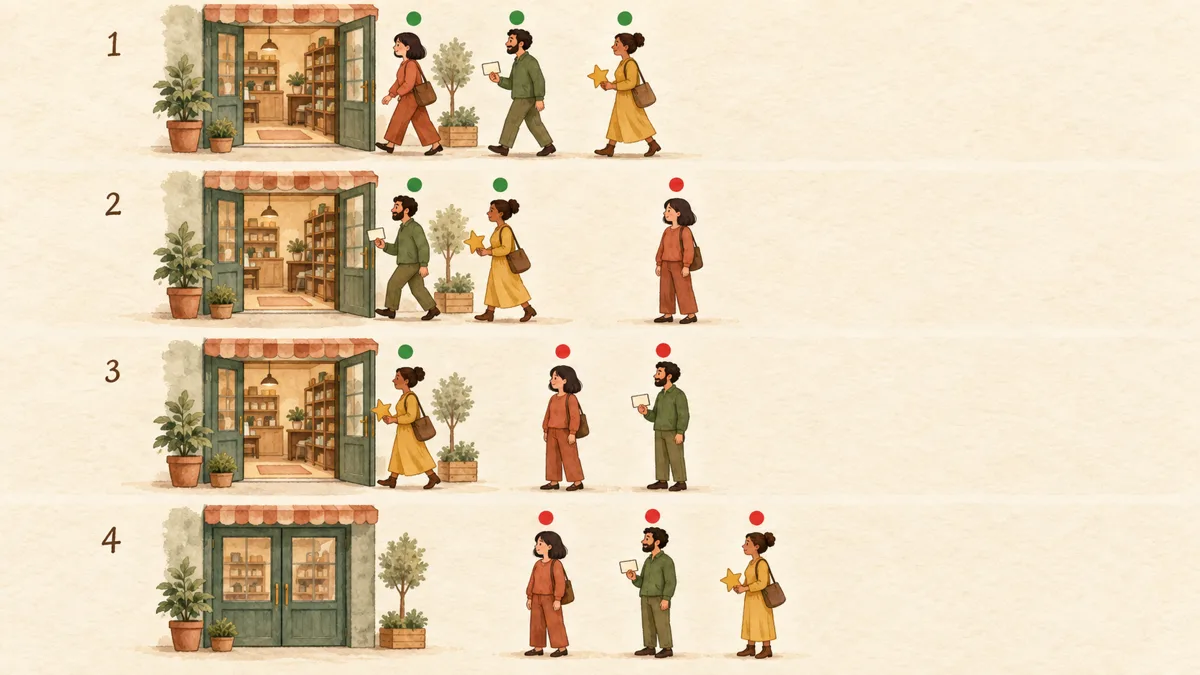
Shopify's built-in sign-in requirement applies to the whole store
In the Shopify admin, "Settings → Checkout" has an option to require customers to sign in to their account before checkout. Enable it and guest checkout stops working — but it applies to every product in the store. There's no "members-only for just this product".
To change who can buy on a per-product basis, you need an app that can set purchase eligibility. Deciding on early-access and limited sales overall also treats "who can buy" as the part that purchase eligibility handles.
Align sign-in and the eligibility conditions
The setup has two parts. On Shopify's side you register "who is a member"; in the app you set "who can buy this product".
1. Shopify side: tag your members
If you're restricting by tag, tag the relevant customers in Shopify first. You can add and remove tags in the "Tags" field on a customer profile, or select several customers and tag them at once. As Shopify's help explains, tags aren't case sensitive, so "VIP" and "vip" are treated as the same tag.
For the membership sign-up path, the setting to show a sign-in link on the store is under "Settings → Customer accounts". The current customer accounts are passwordless: customers sign in with a 6-digit code sent to their email. See Shopify's customer accounts help as well. To get people to become members, point them to account creation from the product page or a members-only notice.
2. SellRules side: set eligibility to "Tag required"
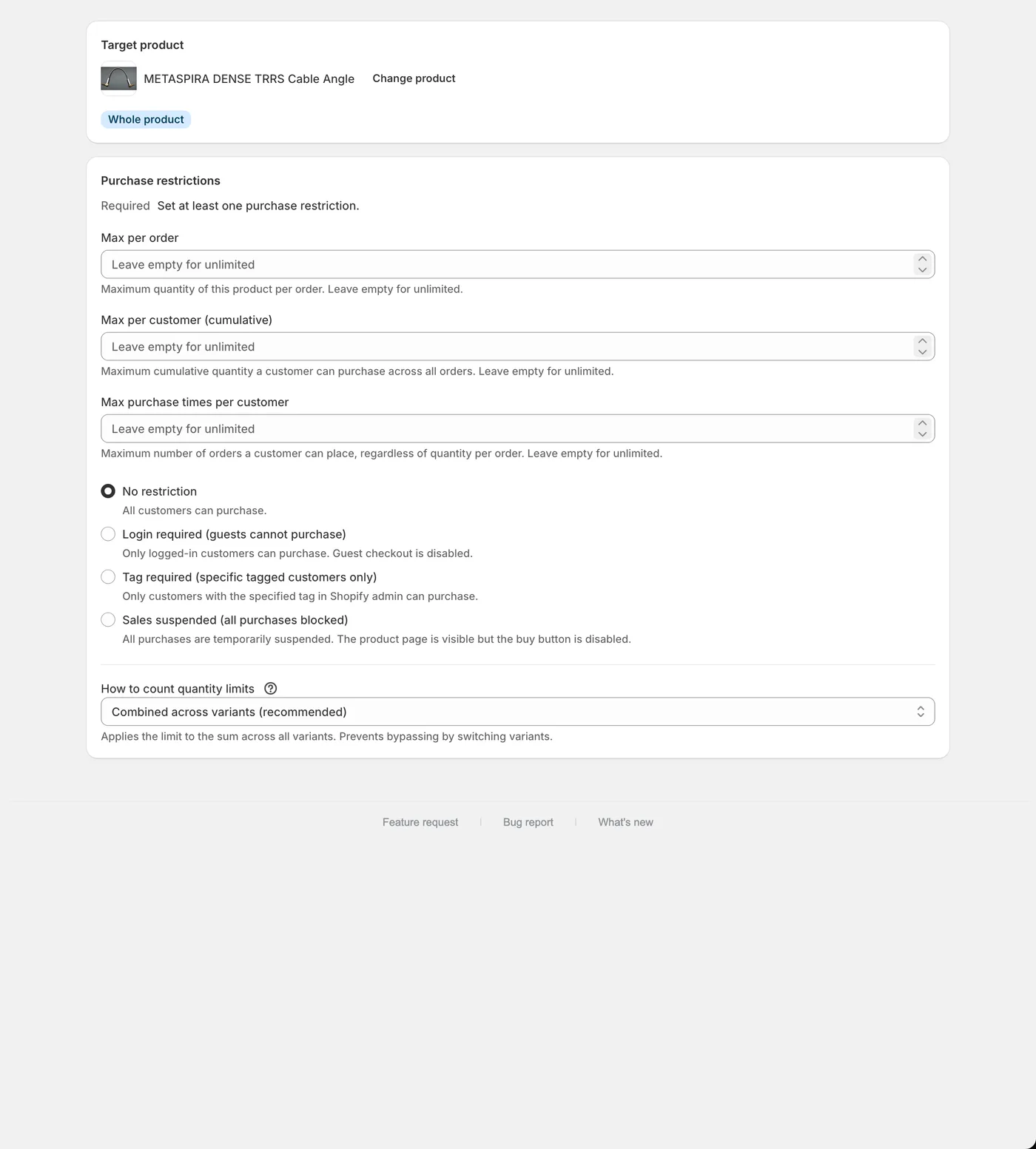
In SellRules you create a purchase restriction rule per product (or per variant) from "Rules → Purchase restrictions → Create rule". Purchase eligibility comes in four options.
- No restriction: applies the quantity caps only
- Sign-in required: customers who aren't signed in can't buy
- Tag required: only customers carrying the specified tag can buy
- Sales suspended: the product page stays visible but the buy button is disabled
Choose "Tag required", then enter the tag name used for the check and the "Message shown to customers". Tag names aren't case sensitive, and the tag name itself is never shown to customers. Signed-out visitors can't be matched against tags, so choosing "Tag required" effectively requires sign-in too.
3. Run "Settings → Re-sync customer tags" once
The "Tag required" check matches orders against the app's own copy of your customer tags at checkout. Newly registered or updated customers sync automatically, but for customers who were registered before you set this up, run "Settings → Re-sync customer tags" once. It's safe to run as often as you like.
Forget this step and members you did tag tend to be judged "not eligible" and blocked. It's the kind of thing you notice quickly if you test with a member account right after setting up.
4. Be careful combining it with Shopify's own sign-in requirement
The app's "Sign-in required" applies only to that product, but Shopify's own setting applies to every order in the store. Enable both and no product can be bought as a guest. If only some of your products are members-only, the manageable setup is leaving guest checkout allowed on Shopify's side and setting conditions per product in the app.
Test buying as both a member and an outsider
Saving the settings doesn't tell you what customers will see. Before going live, test both sides — the ones who can buy and the ones who can't.
- With a tagged member account: sign in, go from the product page through checkout, and confirm the purchase goes through
- With an untagged account: confirm the buy button on the product page can't be pressed and the reason message appears
- Signed out: confirm a guest can't buy and is stopped at checkout too
The easy way is preparing a test customer account, or adding and removing the tag on your own customer profile. If you also set quantity caps, check in the same run whether an over-cap order is blocked. The 'one per customer' article explains the quantity settings and counting methods with screenshots.
If the button or the message doesn't appear on the product page at all, the theme's app embed and the targeting conditions need reviewing. The article on troubleshooting a button that won't show covers the order of checks in detail.
Prepare the message for customers who can't buy
What breeds the most frustration in limited sales isn't the restriction itself — it's not understanding why you can't buy. Decide what to tell non-eligible customers at the same time you set the rule.
"Message shown to customers" can be set per rule; left empty, the default text is used. Without any setup it's shown automatically in 9 languages matched to the customer's language — but if you want to explain the reason and the conditions for becoming able to buy, it's worth rewriting in your store's own words. You can edit the product-page button and messages under "Settings → Storefront wording".
Three things worth putting in the message:
- Who can buy this product: "members only", "VIP members during the early-access period", etc.
- How to become able to buy: "please sign in", "general sale starts later this month", etc.
- How to become a member or where to ask: account creation guidance and a contact for customers who believe they qualify
Putting the same conditions in the product description too lets shoppers cross-check it against the message near the buy button, which reduces misunderstandings.
What to check when you lift or change the rule
Limited sales always change eventually — the early-access window ends or you switch to general release. Decide how you'll revert, and what to confirm after changing.
- Pausing it only: set the rule to "Disabled". The settings stay, so enabling it again restores the same conditions
- Switching to general sale: change eligibility to "No restriction". Everyone can buy while any quantity caps stay in place
- Removing it for good: press "Delete this rule" on the edit screen
After any change, always confirm that an account that wasn't eligible before can now buy. If the restriction silently stays on because you only meant to disable it, the general release can start with customers still unable to purchase.
When something isn't working, check these three things first.
- The restriction doesn't apply at checkout: under "Rules → Purchase restrictions", confirm the rule is enabled; for "Tag required" confirm you've run the customer tag re-sync, and that the counting method is what you intended
- The theme app embed is off: turn the embed off and the buy button returns to normal, and checkout validation stops working too. Your settings data remains
- Confusion with the schedule screens' purchase restriction fields: the pre-order, made-to-order and stock-out schedule screens also have purchase restriction fields, but they're separate from the rules you create under Rules
One more thing: eligibility restrictions work on orders Shopify can identify as coming from the same customer. They don't completely block workarounds like signing in with a different account. The right way to see it is as a big reduction in manually cancelling orders one by one.
Frequently asked questions
Can Shopify's built-in features handle members-only sales?
Not per product. All the built-in setting does is require sign-in under 'Settings → Checkout', which turns every order in the store members-only. To limit specific products to members you need an app that can set purchase eligibility.
I added the customer tag but existing members still can't buy
The 'Tag required' check runs against the app's own copy of your customer tags. New and updated customers sync automatically, but for customers who were registered before you set this up, run 'Settings → Re-sync customer tags' once. It's safe to run as often as you like.
What does the product page look like to non-members?
The product page itself still displays; only the buy button is disabled and a reason is shown. You can change the message per rule — leave it empty and the default text is used.
Can customers see the tag name I set?
No. The tag name is only used for the eligibility check; what customers see is whatever you put in 'Message shown to customers'. Tag names aren't case sensitive.
Once you've decided who can buy, test small, then go live
Members-only selling can be tried on 1 product once you've sorted out who the target is. SellRules has a single Launch plan at $7.99 USD per month, and it includes every feature including purchase restrictions. There's a 10-day free trial, billed through the Shopify App Store's billing system. Uninstall during the trial and you're never charged.
How to use the free period is in the checklist for trying it on 1 product. For screen-by-screen steps, see the SellRules user guide.
Features and pricing checked on September 18, 2026, based on the Shopify App Store listing and the official guide.
Related articles: Deciding on early-access and limited sales / How to set 'one per customer' on Shopify / Trying SellRules for free? Start with 1 product