
Once you start taking pre-orders or made-to-order work, every order carries a stretch of waiting between checkout and shipping. Events that happen in that gap — a pre-order arriving, a ship date slipping — can go unnoticed until someone opens the right screen.
The reliable way in is to pick one event worth reporting, decide who should hear about it and where, and prove that path with a small test. SellRules exposes four triggers to Shopify Flow — waitlist sign-up, pre-order/made-to-order order received, pre-order status changed, and shipping delay detected — and a Flow workflow can turn any of them into an internal email or a Slack message for your team.
This article walks through choosing what to report, wiring and testing one workflow, recovering when it fails, and the manual check to keep even after automation.
Pick the event your staff should hear about
Decide "what's worth reporting" first. If you notify everything, the notifications themselves start getting ignored. Choose the one event that hurts most when it's missed.
| Event (SellRules trigger) | When it's worth reporting |
|---|---|
| Pre-order/made-to-order order received | The person who makes the items needs a "start work" signal |
| Shipping delay detected | An order past its ship date must not sit unseen until someone opens the list |
| Pre-order status changed | Announcement, pre-order and regular-sale transitions should be visible to more than one person |
| Waitlist sign-up | The buyer responsible for restock or launch wants to see demand accumulating |
A made-to-order shop notices "order received" in its daily order review anyway, but "past its ship date" only shows up on the schedule screen. The longer your waiting period, the more a delay-type event earns its notification.
Decide "who gets it" at the same time. If you run the shop alone, that's your own address; if production is delegated, it's the channel that person actually watches. The message only needs enough detail to say who should check what — the recipient opens the order for the real judgement call.
Note that everything here concerns messages to people inside the shop. Telling a customer about a delay has a different recipient and purpose. Customer-facing notices are handled by SellRules' notification emails and are outside this article's scope.
Check which integrations are available
Staff notification combines SellRules' Shopify Flow integration with Shopify's own free app, Shopify Flow.
On the SellRules side: four triggers and one action
As documented in "How it fits with Shopify" in the official guide, SellRules provides:
- Triggers (tell Flow an event happened): waitlist sign-up, pre-order/made-to-order order received, pre-order status changed, shipping delay detected
- Action (let Flow drive SellRules): switch sales phase
Reporting to staff uses the trigger side. The action is for having Flow move a product between sales phases — for example, returning to regular sales when stock arrives — and is not covered here.
On the Shopify side: Flow availability and delivery endpoints
Per the Shopify Help Center, Shopify Flow is a free app available to stores on the Basic, Grow, Advanced and Plus plans (the Starter plan is not eligible). Install the Flow app from the Shopify App Store to use it. The app's interface is in English.
A workflow is assembled as "trigger → condition → action". Two actions deliver to staff:
| Destination | Best when | What it needs first |
|---|---|---|
| Send internal email | Reaching yourself or a small group reliably | Just the destination address; variables can insert the order number and more into the body |
| Send Slack message | Sharing with a team in a channel | Connecting Flow to your Slack account and adding FlowBot to each destination channel |
Stores on Grow and above can also use "Send HTTP request" to reach external services directly, but the two standard endpoints cover most needs.
The prerequisite is that both SellRules and Shopify Flow are installed on the store. App-provided triggers only exist when the app and Flow are both present.
Test with a small scope
Here's the construction sequence for a workflow that reports "shipping delay detected" by internal email. The mechanics are the same for every trigger.

1. Create the workflow
Open Shopify Flow and create a new workflow. For the trigger, choose SellRules' "Shipping delay detected". If the SellRules triggers don't appear in the list, confirm SellRules is installed — the integration only exists when both apps are present.
2. Narrow the condition (only if needed)
A condition after the trigger limits what gets reported — for instance, made-to-order orders only. It's simplest to run without conditions first and tighten them if the volume proves noisy.
3. Set the destination and message
Add the "Send internal email" action and enter the responsible person's address. Variables can insert the order number or product name into the body, so write a message that shows what slipped at a glance. For Slack, choose "Send Slack message" instead, finish the connection and FlowBot setup, then name the channel.
4. Trigger it for real and watch it arrive
Turn the workflow on, then fire the trigger under test conditions and confirm the notification arrives. For "shipping delay detected", you can create the delayed state by changing the ship date on a test order (the order progress guide explains that orders past their ship date or pushed back land in "Delayed").
Check that the received message carries the right order details to the right destination. Saving the workflow and actually receiving the notification are two different things — if nothing arrives, work through the next section.
Check for duplicates and failures
After automating, decide where you'll verify it's still working.
- Shopify Flow's run log: each workflow keeps a record of runs, including failures. The Shopify Help page on monitoring runs explains the views. A failed run can be retried manually after you fix the cause
- The notifications themselves: once a week, glance at the subjects or channel to confirm they look the way you intended
The classic duplicate is reporting the same event from two workflows. A workflow holds exactly one trigger, so building "delays to internal email" and "delays to Slack" as separate workflows delivers every delay twice. If you want a second destination, add a second action inside the same workflow — it's easier to manage.
Also, don't confuse the customer-facing delay notice with the staff notification. Checking the notification box in SellRules' "Change ship date" sends a delay email to the customer. The Flow workflow is internal mail — no customer sees it. Because a retry reuses the original run's trigger data, retrying a failed run repeatedly can deliver the same notification more than once.
Common delivery failures are worth knowing in advance. For Slack, the typical causes are FlowBot being removed from the channel or the connection needing re-authorization. For internal email, suspect a typo'd address or the spam folder first.
Switching off is simple: turn the workflow off in Flow and the notifications stop, without touching your SellRules settings or the customer-facing emails.
Keep a manual check in the routine
A notification is an entry point for attention, not the response itself. Even after automating, keep a step where a person looks at real orders. On a plan where Flow isn't available, this manual loop is the primary mechanism anyway.
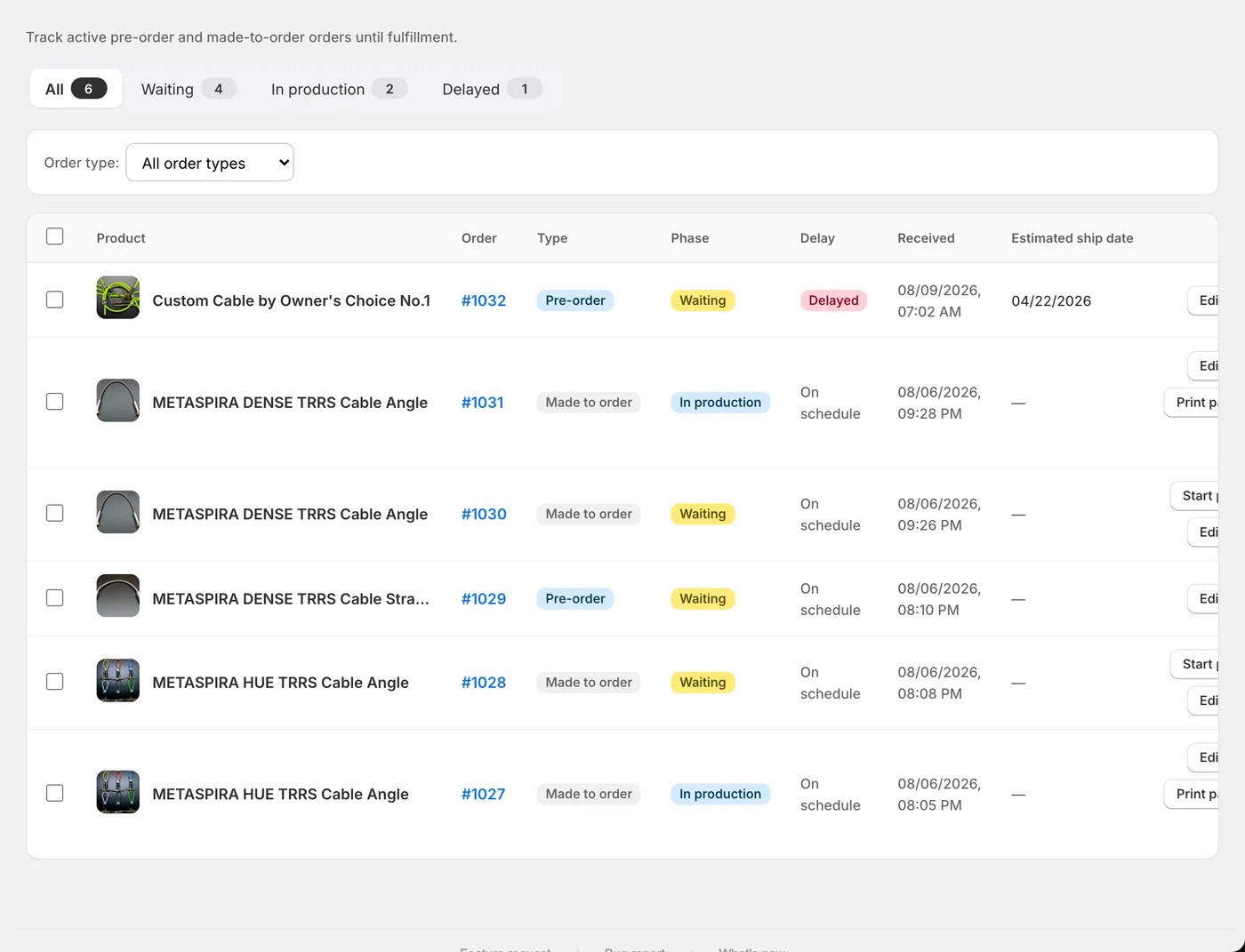
SellRules' Order progress lists only unshipped pre-order and made-to-order orders under "Awaiting", "In production" and "Delayed", with counts at the top. Making "open this screen first thing in the morning or before shipping work" a fixed habit keeps you honest even when a notification never fires. The Home screen also gathers products nearing their pre-order cap and upcoming sale dates, and the delivery log shows whether each customer email came out as Sent, Failed or still Pending.
Weekly, set aside time to decide next steps from the numbers, as in the weekly pre-order review — that catches shifts a notification can't surface. For the surrounding work of making items, changing dates and notifying customers, see the article on managing made-to-order orders through shipping.
Frequently asked questions
Does using Shopify Flow cost extra?
Shopify Flow itself is a free app, but it only works on Basic, Grow, Advanced and Plus stores — not on the Starter plan. On the SellRules side, the Launch plan ($7.99/month) already includes Flow integration along with every other feature; there is no integration surcharge.
How is a staff notification different from the customer notification emails?
The seven notification emails SellRules sends (delay notice, shipping confirmation and so on) all go to your customers. Reaching staff is a separate concern handled by a Shopify Flow workflow using the Send internal email action or a Slack message. The recipients differ, so you manage the two channels independently.
Can one workflow watch for two different events?
No. A workflow accepts exactly one trigger. If you want to hear about both "shipping delay detected" and "waitlist sign-up", build two workflows. You can attach as many conditions and actions as you like inside a single workflow.
What do I check when a notification never arrives?
Start in the Shopify Flow run log (workflow runs) to see whether the workflow fired and whether it failed. For Slack, confirm FlowBot is still a member of the channel; for internal email, check the destination address and the spam folder. If the run never happened, re-check the trigger conditions and that the workflow is turned on.
Decide the delivery path once, then let the mechanism and the habit carry it
The full anti-oversight pattern is four steps: pick one event worth reporting, test it small in Flow, confirm behaviour in the run log, and keep the order-progress habit. You don't have to automate everything at once — getting a single delay to reach someone already shrinks the risk considerably.
SellRules has one plan: Launch at $7.99/month (USD), with every feature included — Flow integration among them. There's a 10-day free trial, billed through the Shopify App Store. The Shopify App Store listing confirms the integration under "Works with Shopify Flow".
If you haven't yet set up scheduled sales switching itself, start with the article on automating launch-time changes — it makes the sequence clearer.
Feature and pricing checked on September 18, 2026, based on the Shopify App Store listing, the official guide and the Shopify Help Center page on Shopify Flow.
Related articles: Deciding on early-access and limited sales / Managing made-to-order orders through shipping / Reviewing pre-order sales weekly / No need to wait at a new product's launch time