
Once pre-orders are running, the numbers pile up — orders, sales, inventory. But "I'm looking at the numbers, yet I still can't decide what to change next" is a common place to end up.
The weekly review itself is simple. Align the period and the products you look at, check sales and orders still waiting for action, inspect inventory and intake limits, and decide on just one setting to change. Check the effect under the same conditions the following week, and the review stops being a number-watching exercise.
Align the period and the products you review
The most important part of a weekly review is using the same ruler every week. If the period or the scope keeps shifting, you can't tell whether a difference in the numbers is a real change in sales or just a different set of conditions.
- Fix the period to the last 7 days. On the SellRules home, revenue and order counts for pre-orders and made-to-order can be switched across 7 days, 30 days, 90 days, 1 year, or all time. For a weekly review, stick to 7 days.
- Pick a day and time. Right after a launch or the morning after a weekend event skews the numbers, so keep the checking time consistent.
- Write down the scope. Decide in advance whether this week covers products currently taking pre-orders or orders waiting to ship.
- State the conditions when comparing. Numbers change depending on whether cancellations and refunds are included. In Shopify's sales reports, gross sales include pending, canceled and unpaid orders, while net sales are gross sales minus discounts and sales reversals (returns, cancellations, order edits and similar adjustments), as defined in the Shopify sales reports documentation.
Keeping "period, scope, what's included" in the same note or sheet every week means next week's review happens under identical conditions.
Check sales and orders still waiting for action
With the period fixed, look at revenue and volume first, then at the orders still waiting for you. Not ending the review at "sales went up" or "sales went down" is the whole point.
On the SellRules home, alongside revenue and counts for the selected period, upcoming announcement, pre-order and sale start dates are listed with the days remaining. You can also see every product's phases laid out by month in "Schedules → Calendar view" (yellow for announcements, blue for pre-orders, purple for made-to-order, green for regular sales). For store-wide sales or per-product breakdowns, open the sales and order reports under Analytics → Reports in the Shopify admin (Shopify report types).
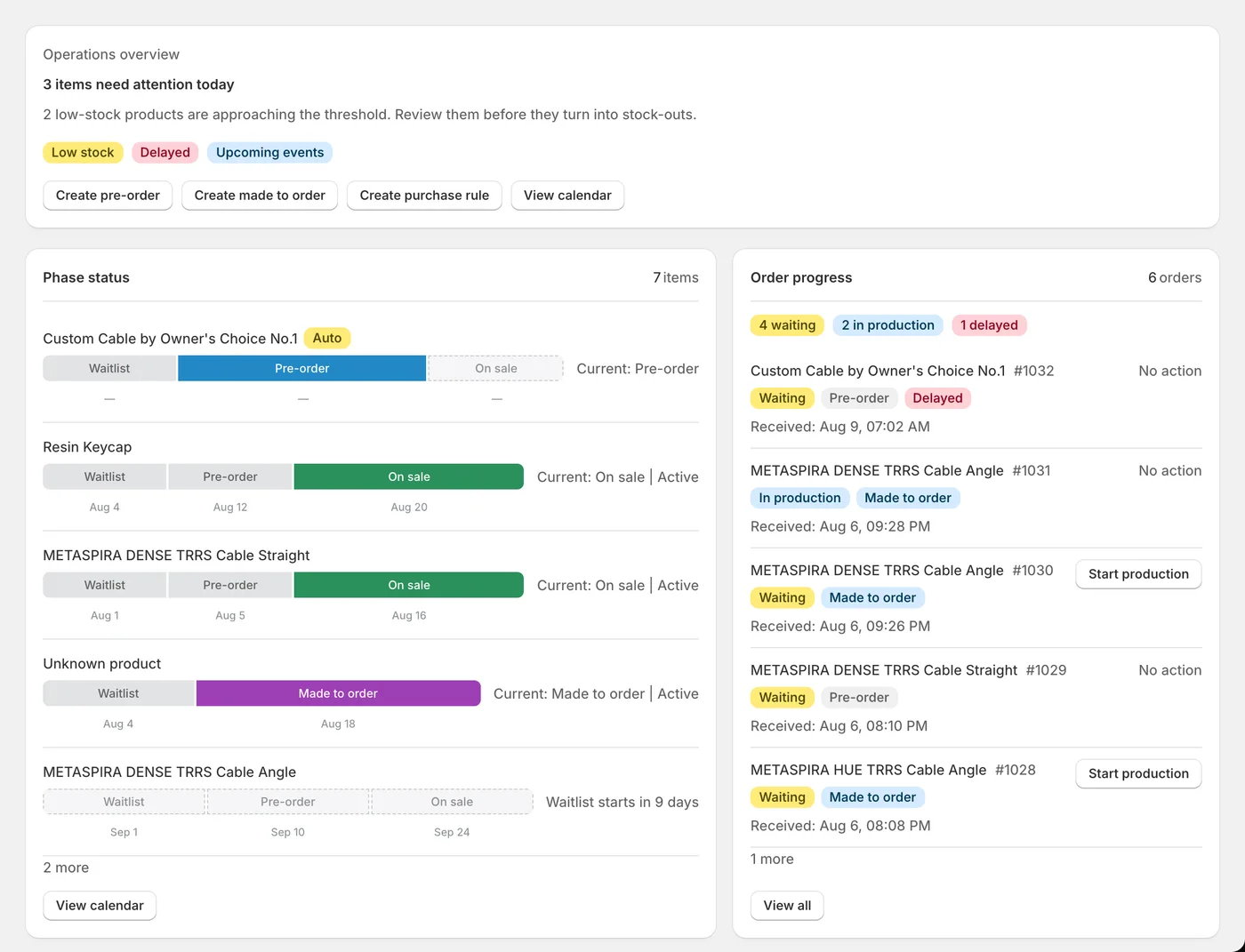
Then open Order progress. Only pre-order and made-to-order orders that haven't shipped yet are listed here, with counts for Awaiting, In production and Delayed across the top.
| Status | Meaning | What to do in the weekly review |
|---|---|---|
| Awaiting | Order received but production hasn't started | Select the ones to begin and press Start production |
| In production | Being made now | Ship the ready ones in Shopify |
| Delayed | Past the ship date, or pushed back | Change the ship date and send a delay notification if needed |
Delayed orders come first in the weekly review. Change the ship date with the new date and a reason (up to 500 characters); ticking "Notify the customer of the delay" sends the delay email. You can update several orders at once, and the confirmation message shows how many customers were notified. To confirm delivery, check that the delivery log shows the notification as sent.
Canceled orders drop off the list, but when reading the week's numbers, note "new orders received" and "cancellations or refunds" separately so next week's comparison stays clean. For how to work through the remaining orders and manage them through shipping, see the made-to-order and pre-order management article.
Check inventory and intake limits
After sales and orders, look at the settings that accept the next orders. The home's Inventory alerts show products at eighty percent or more of their pre-order limit and products low on stock. The low-stock threshold can be set from 1 to 999 under "Settings → Inventory alerts" (default 10).
Check three things:
- Is any product nearing its pre-order limit? The pre-order limit is the maximum you'll accept; once reached, intake stops automatically and the product switches to sold out. Each week, decide whether to raise the limit or let it close.
- Is anything sold out with nothing configured? The home also lists products out of stock with no settings. For the choice between pre-orders when the restock date is known and restock alerts when it isn't, see the article on turning sold-out products into future orders.
- Do the ship dates still match production? A product with a growing In production queue and a near ship date is a candidate for revising its schedule before delays appear.
Decide on just one setting to change
Don't change everything that caught your eye at once. Change several settings in the same week and next week you can't tell which one made the difference. Pick exactly one setting for the coming week.
| What last week showed | Example of the one setting to change |
|---|---|
| Intake stopped at the limit | Raise the pre-order limit (as far as production and shipping can keep up) |
| Awaiting orders piled up | Fix when production starts, or shorten the intake window |
| Delays kept happening | Adjust the ship-date setting to real production time |
| Taking pre-orders with no restock in sight | Stop intake and switch to restock alerts |
| Bulk buying or skewed orders | Add per-order or per-customer purchase limits |
Changing a setting isn't the only outcome. Deciding "this product's intake stays as it is" is also a weekly decision. If you're torn, work through the things that already affect customers — delays or stopped intake — first.
Say one week's review shows "a product with a pre-order limit of 50 has reached 42 and appears in inventory alerts", "one delayed order", "sales about the same as the week before" (the figures are examples). You'd change the delayed order's ship date and send the notification right away, then note "raise the pre-order limit to 60" as the single setting for next week. Raising the limit and shortening the intake window in the same week would make next week's numbers impossible to attribute.
Next week, check the effect under the same conditions
Look at a changed setting again the following week — same weekday, same period, same scope. The trap here is reading one week's movement as "the effect of the setting."
- Align the conditions when comparing. Note anything that happened only this week — a sale, a social post.
- Keep cancellations and refunds separate. More orders plus more cancellations is a different picture.
- Causation isn't guaranteed. If sales rose the week you raised the limit, seasonality, ads or stock may be the real reason. Record "the setting changed" and "that week's numbers" as a pair and watch a few weeks before deciding the next step.
Premises and limits when reading the numbers
- The numbers you're seeing are for pre-orders and made-to-order. The SellRules home's revenue totals the pre-order and made-to-order orders the app manages. Store-wide sales and regular-sale orders live in Shopify's reports — don't compare them as if they were in the same box.
- Each metric has its own definition. Even within Shopify's sales reports, gross sales and net sales treat cancellations and refunds differently. Note which definition the number came from.
- A weekly review is a decision habit, not a sales machine. Looking at numbers has no causal link to sales going up. What it does is reduce unhandled work and let you change the next setting with a reason.
Weekly checklist (ready to use)
Following the same order every week takes about 15 minutes. It's laid out for printing or copying into notes.
| # | What to check | Where to look | Decision |
|---|---|---|---|
| 1 | Same period and scope as last week | Your notes | Same conditions as last week? |
| 2 | 7-day revenue and order count | SellRules home / Shopify reports | Record the change and its conditions |
| 3 | Counts of Awaiting, In production, Delayed | Order progress | Handle delays on the spot |
| 4 | Products at eighty percent of pre-order limit, low stock | Inventory alerts on home | Decide whether to change the limit |
| 5 | Out-of-stock products without settings | Home | Choose pre-order or restock alert |
| 6 | Next week's upcoming events | Home | Prepare for launches and intake starts |
| 7 | The one setting to change | Your notes | Write next week's check date too |
Frequently asked questions
How long does a weekly review take?
Just looking at the numbers takes a few minutes; including action on waiting or delayed orders, the same fixed order of checks takes about 15 minutes. Time is usually lost re-deciding what to look at, so fixing the sequence comes first.
If sales were down last week, should I change a setting right away?
Check the differences in conditions before changing anything. A sale, a restock, cancellations or refunds can all produce the same-looking drop. Changing a setting on one week's movement hides the cause — if you change, pick one thing and check it next week.
Why do the sales figures differ between the SellRules home and Shopify reports?
They cover different scopes and definitions. The app's home totals the pre-order and made-to-order orders it manages, while Shopify's sales reports cover the whole store and gross sales include pending, canceled and unpaid orders. Neither is wrong — they measure different ranges.
After looking at the numbers, where do I start changing?
Clear the orders still waiting for action first: move Awaiting into production, and change the ship date with a notification for delays. Then choose one setting to change. If you're unsure where to begin, start by checking whether any order is delayed.
Can I run the same review without the app?
Yes. Shopify's Analytics → Reports sales and order reports plus the orders list give you the same weekly sequence in the standard admin. The app just reduces the number of places to look, since pre-order and made-to-order sales and inventory alerts sit on one home screen.
What to read next
Once the weekly review surfaces delays or unhandled orders, the made-to-order and pre-order management article covers how to work each order through shipping. To get delay detection or new pre-orders pushed to your team automatically, see running SellRules with Shopify Flow.
Features and pricing checked September 18, 2026, based on the Shopify App Store listing and the official guide.
Related articles: How to decide on pre-order and limited sales overall / What to do when a Shopify product sells out / Made-to-order and pre-order management / SellRules with Shopify Flow