
With made-to-order work, the sale is the short part — the making and shipping that follow take much longer. "When did I promise to ship that order?" "The materials are late, will this order still make it?" The more orders you take, the less a mental list can keep up.
Two things matter most in managing made-to-order orders: keep the promised ship dates and the orders you took lined up in one place, and when an order is going to be late, tell the customer before the promised date passes. If your store runs SellRules, the Order progress screen — which lists only unshipped pre-order and made-to-order orders — is where you can build both into your daily routine.
Line up promised ship dates with the orders you took
The first step in managing made-to-order orders is reconciling "what, by when, to whom" against the order list.
When you create a made-to-order intake in SellRules, the shipping estimate is set as a number of days: "ship within N days of the order". The product page shows "Ships within N days of your order", and that becomes your promise to the customer (see Start made-to-order in the guide for how to set it up). That number of days is the baseline date everything else is managed against.
When an order arrives, it appears in SellRules' Order progress with the phase Awaiting, and the customer receives a made-to-order confirmation email. Only pre-order and made-to-order orders that haven't shipped yet are listed here. Once you fulfil an order in Shopify it drops off the list — so whatever remains is exactly the set of promises you haven't kept yet.
Made-to-order orders carry the marker "_Made-To-Order: True" on their line items in the Shopify order details (pre-orders show "_Pre-order" plus a ship date). Orders without the marker don't appear in Order progress.
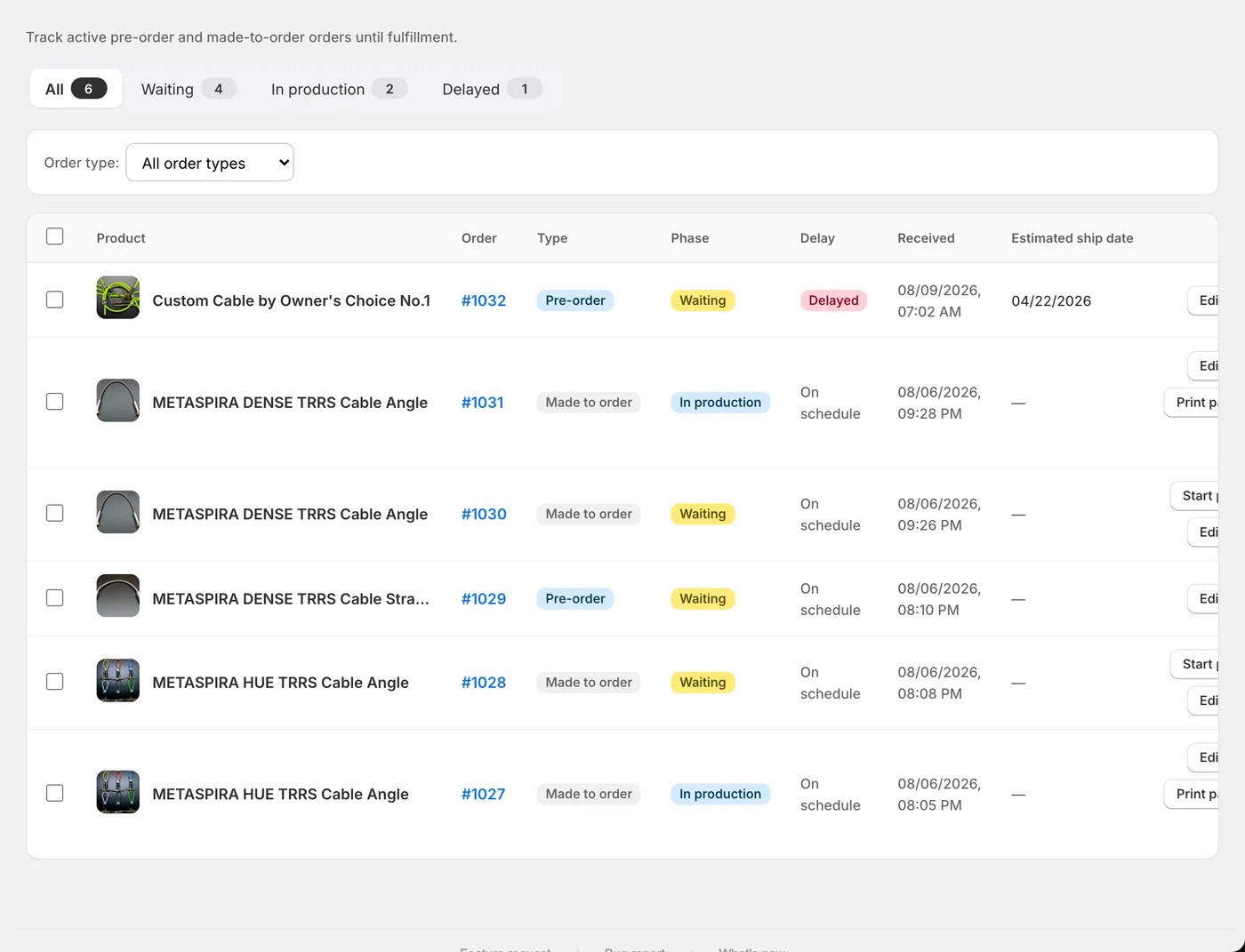
Within Order progress, each order moves through three states:
| Phase | State | What to do next |
|---|---|---|
| Awaiting | The order is in but you haven't started making it | Decide the order of work and press Start production |
| In production | You're making it now | Once ready, fulfil it in Shopify |
| Delayed | The ship date has passed, or you pushed it back | Set a new date and send a delay notice if needed |
One thing to keep in mind: these states exist for your own tracking — setting an order to In production doesn't move the actual shipping along. Shipping is recorded by the fulfilment you do on the Shopify side. Treat the states the app manages and the hands-on work of making and sending as two separate things.
Decide what to make first in a quick daily check
Once the Awaiting list grows, re-deciding "what do I make today" every time becomes a burden. In Order progress you can filter by phase, by order type (pre-order or made to order) and by delay status, and counts for Awaiting, In production and Delayed sit at the top.
For a morning check, this order works well:
- Filter to Delayed. Anything past its promised date is top priority.
- Compare the ship dates in Awaiting. Each made-to-order order has its own promised date, so pick today's work by earliest date, not by when the order arrived.
- Select today's work and press Start production. You can move several orders to In production at once.
- Take packing slips to the workbench. You can print packing slips for the selected orders in one go. Swap the header logo under "Settings → Packing slip logo" (PNG, JPEG, WebP or SVG, up to 300 KB).
"Closest promised date first" is the basic rule. If you shuffle the order because of waiting on materials or supplier timing, the order stays visible as long as it's still Awaiting and you can pick it back up later. The opposite problem — started making something but left it as Awaiting — blurs the line between remaining work and work in progress.
If you can only make a limited number of items, set a made-to-order limit on the intake itself. Once the limit is reached, intake stops automatically — a safeguard against promising more than you can produce.
Separate orders that need a new date with "Change ship date"
Late materials or production delays sometimes mean an order won't make its promised date. The tool for that is Change ship date in Order progress.
Enter the new date and a reason (up to 500 characters), tick "Notify the customer of the delay" and run it — the customer receives a delay notice email. You can change several orders at once, and the message shown after the update tells you how many notices went out.
Three constraints to know:
- Dates in the past are rejected. You can't move the promise back to "yesterday" — a change sets a new promise.
- Dates more than two years out are also rejected.
- Orders already shipped or cancelled can't have their ship date changed.
You can also change the date without notifying anyone — untick the box if you don't want a notice. But if you keep adjusting dates silently, from the customer's side it looks like the promise quietly changed on its own. It's safer to make "if the date moves, we tell them" your default.
When you're going to be late, reach out before the promised date
Timing is what makes a delay message work. A message sent after the promised ship date is an apology; sent as soon as you know you won't make it, it arrives as an update with a new date. Ideally you contact the customer before they have to ask.
You can prepare the delay notice wording in advance under "Settings → Email templates". A test send to your own address lets you check the wording before any real customer sees it. There are 7 notification types in total, and the delay notice is one of them.
After sending, check the delivery log to see whether it arrived. The statuses are Pending, Processing, Sent, Failed and Cancelled; failed ones can be selected and put back in the queue with Retry. Notices still Pending can be cancelled — sent emails can't be recalled.
For anything other than a delay — an address change, a question about what was ordered — you write from the Shopify side. From the order page, open the customer's email in the Contact section, write your message and send it (Shopify Help: viewing and managing order details).
If a customer says a message never arrived, check its status in the delivery log first. Sent means it left your store — ask them to look in the spam folder. Using a free mail address as the sender (reply-to) makes delivery less reliable, so an address on your own domain is recommended.
Fulfil in Shopify, then reconcile against what's left
Fulfilment itself happens in Shopify. "Fulfil in Shopify" in Order progress takes you to Shopify's fulfilment flow; once the fulfilment is recorded, a shipping confirmation goes out to the customer and the order leaves the list.
On the Shopify side you can add a tracking number, or ship only some of the items in an order as a partial fulfilment. Orders are tracked as Unfulfilled, Partially fulfilled and Fulfilled, and an order isn't complete until every item has shipped (Shopify Help: fulfilling orders, order statuses). For the shipping and messaging policy when a made-to-order item and a regular item end up in the same order, see our article on combined orders.
The distinction worth keeping: an order leaves Order progress because its fulfilment was recorded. Marking it In production in the app and actually shipping it are different actions, so the final word on "has it shipped" is the order's status in Shopify. How a partially shipped order remains in Order progress is also worth verifying against your own real order.
As a closing check, comparing these two once a week keeps things honest:
- Orders marked Unfulfilled in your Shopify order list
- Orders still listed in SellRules' Order progress
Check that no made-to-order order is sitting Unfulfilled in Shopify, and conversely that nothing left in Order progress has already had its fulfilment recorded. For a checklist covering older pre-orders that don't show up in a shipping app, see our article on finding older orders.
Cancelling an order in Shopify sends the cancellation email and removes it from the list. Refunds are handled on the Shopify side too.
What the app manages and what stays manual
Splitting the roles clearly makes it easier to find your way back when something is unclear.
| Task | Owner |
|---|---|
| Tracking Awaiting / In production / Delayed states and counts | SellRules (Order progress) |
| Made-to-order confirmation, delay notice, shipping confirmation and cancellation emails | SellRules (sent automatically, wording editable) |
| Changing ship dates and triggering delay notices | You, from Order progress |
| Making, packing, shipping arrangements, partial fulfilment, refunds | You (Shopify admin and your shipping method) |
| How long production takes and how much you can accept | You (the "within N days" estimate and the made-to-order limit at intake) |
What the app manages ends at "which order is in which state" and "notifying the customer". The work of making, wrapping and sending stays yours. The flip side: if you keep the states moving properly, leftover orders and missed customer messages become visible on the screen.
When something doesn't work: check in this order
An order doesn't appear in Order progress
Order progress lists only unshipped pre-order and made-to-order orders. In the Shopify order details, check whether the line items carry "_Made-To-Order: True" or "_Pre-order"; if not, the product was on regular sale when it was bought. Filters can also stay applied — clear them and look again.
A delay notice or shipping confirmation never arrived
Check that notification's status in the delivery log. If it's Failed, open the row to read the error, select it and press Retry. If it's Sent, the message left your store — ask the customer to check the spam folder. It's also worth confirming in "Settings → Email templates" that the notification isn't marked as stopped.
You can't change a ship date
Ship dates can't be changed on orders that are already shipped or cancelled — check the order's status in Shopify. If you only want to correct the date without sending a notice, untick the box and change it.
You sent a notice by mistake
Sent emails can't be recalled. Only ones still Pending can be cancelled from the delivery log. For a notice that already went out, follow up with a correction from the Shopify order page.
Frequently asked questions
Does pressing Start production notify the customer?
No. Customers only receive set notification types such as the made-to-order confirmation, the delay notice and the shipping confirmation. Start production is internal tracking on your side. If you want to tell them you've started, contact them from the Shopify order page.
What happens to an order once its ship date has passed?
Its phase in Order progress changes to Delayed, and you can filter by delay status too. Set a new date with Change ship date and, if needed, send the customer a delay notice.
Can I ship only part of an order first?
Yes — partial fulfilment in Shopify lets you choose which items and quantities to ship. For orders mixing made-to-order and regular items, our article on combined orders explains how to set your shipping and messaging policy.
What if I send a delay notice by mistake?
Sent emails can't be recalled. Notices that are still Pending can be cancelled from the delivery log. For anything already delivered, send a correction from the Shopify order page.
Pricing and what we verified for this article
SellRules has a single Launch plan at $7.99 USD per month, which includes Order progress and the notification emails. There's a 10-day free trial, billed in USD. To try the workflow, create a test order before real ones come in and run it through Awaiting, In production and shipping once — that's the fastest way to see it.
For screen-by-screen steps such as setting up intake and editing notification wording, see the SellRules user guide.
Features and pricing checked on September 18, 2026, based on the Shopify App Store listing and the official guide.
Related articles: Deciding on early-access and limited sales / When a pre-order item and a regular item are bought together / When an older pre-order doesn't show up in your shipping app