
"A product still taking pre-orders and a regular product that could ship today, in the same order." Once you start pre-order sales, this situation is bound to happen.
The short answer: a mixed order is recorded as a single Shopify order, and whether you "ship everything together on the pre-order date" or "ship the regular items first" is your store's call. Both are handled with ordinary Shopify operations — but what matters most is keeping the product-page message consistent with what you actually ship. If the page says "ships together" and parcels arrive separately, or regular items are held back with no explanation, you lose on both support volume and trust.
This article walks through the decision, the pre-purchase message, shipping checks, test orders, and what to do when an order needs to change after the fact. For how to start taking pre-orders in the first place, see our article on setting up pre-order sales.
Decide before orders arrive: ship together or split
There are two policies. "Ship everything together on the pre-order date" (combined shipping), or "ship the regular items now and the pre-order on its date" (split shipping). Which one fits depends on how far out the pre-order ship date is, and who pays for the second parcel.
As a baseline, a mixed order is recorded as one order, one payment, and one shipping charge. SellRules has no feature that automatically splits a mixed order. On the Shopify side, an order can be split into separate fulfillments when items ship from different locations or when part of the order is for in-store pickup — but "is it a pre-order" is not a reason Shopify splits an order (Shopify Help: fulfilling orders). Splitting is a decision your store makes and carries out by hand.
|| Ship together (combined) | Ship separately (split) | || --- | --- | --- | || Delivery timing | Everything on the pre-order date | Regular items now, pre-order on its date | || Postage | One parcel is enough | Two parcels (a second shipping cost arises) | || Customer experience | They wait for regular items too | Part of the order arrives early | || Best when | The wait is a few days to about a week | The wait is several weeks or more, or items should arrive quickly |
Choosing by your situation looks like this:
|| Your situation | Policy that fits | || --- | --- | || Pre-order ships in a few days to a week | Combined. "Everything ships together on [date]" is easy to accept | || Pre-order ships in several weeks or months | Split. The longer the wait, the more combined shipping frustrates | || You don't want to pay for a second parcel | Combined, or fold the cost into prices/shipping fees | || Seasonal or perishable regular items should go out first | Split |
"Decide case by case when orders come in" breaks down as volume grows. Set one default — "combined as the rule, exceptions handled by message" — and the wording becomes much easier to write.
Tell customers on the product page when things arrive
Once the policy is set, communicate it where shoppers can see it before buying. Whether your messaging works is measurable: can a customer who reads the product page correctly predict when each item will arrive?
- SellRules' shipping estimate: setting "Ship on a fixed date" or "Ship within N days of the order" displays that text under the pre-order button. But this only covers the pre-order product itself — it says nothing about what happens to regular items bought alongside.
- The product description: if you combine, add a line like "If ordered together with other items, everything ships on [date]." If you split, "In-stock items in the same order ship first." Put that sentence in the pre-order product's description.
- The pre-order confirmation email: a confirmation email goes out automatically when a pre-order comes in. The wording is editable under "Settings → Email templates", so including the same message there makes it certain.
Sample wording for combined shipping: "This item is a pre-order shipping on [date]. Orders placed together with regular items will all ship together on [date]. If you need an item sooner, please order it separately." For split shipping: "This item is a pre-order shipping on [date]. In-stock items in the same order will ship first." Either way, adding "if you're in a hurry, please order separately" reduces mixed orders themselves.
Check the shipping fee and the order's conditions
The sticking point with split shipping is postage. Shopify's checkout presents a single shipping charge for the whole order. Even when an order contains products from different shipping profiles, the individual rates are combined and shown as one amount (Shopify Help: combined shipping rates across profiles). In other words, shipping the same order in two parcels doesn't increase what the customer pays.
That means the postage for the second shipment is a decision you have to make: absorb it, or build it into your shipping fees or prices ahead of time. "Charging extra postage after the fact" invites disputes — best avoided as a rule.
Beyond shipping, a few conditions are worth checking before you start taking orders.
- When payment happens: orders containing pre-orders are paid in full at checkout, all at once. There's no built-in "charge the pre-order part when stock arrives."
- How fulfilment runs: for stores selling pre-orders or made-to-order items, manual fulfilment is the natural setting in Shopify's order processing. Manual means no risk of every line item being marked fulfilled automatically (Shopify Help: order processing settings).
- How to change an order: when a customer asks to "cancel just the pre-order part," Shopify's order editing lets you remove items, adjust quantities and modify shipping fees. If the total decreases, a separate refund step is needed (Shopify Help: editing orders).
You could also put pre-order products in their own shipping profile, but that only changes how the shipping fee is calculated — it doesn't separate the ship dates. Delivery-date messaging has to be provided apart from the shipping settings.
Verify the real behaviour with a test order
Once your policy and messaging are set, create a mixed order yourself before real ones arrive. Four things to check:
- The shipping charge at checkout. Put a pre-order item and a regular item in the same cart and see how the shipping fee displays.
- How the order is recorded. In the Shopify order details, check whether the pre-order line carries
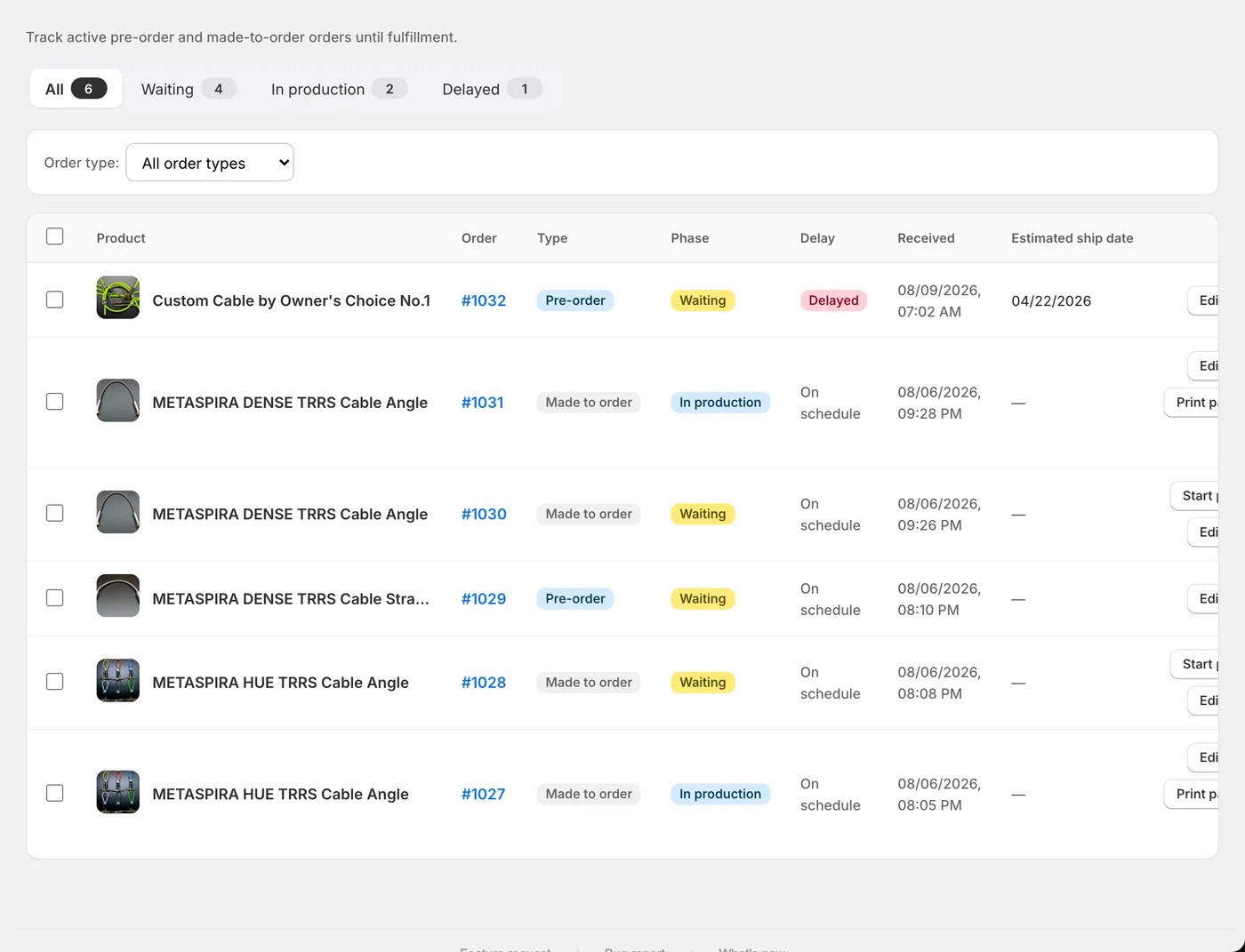
_Pre-orderand a ship date. - The Order progress display. Check that the order appears in SellRules' "Order progress". Only unshipped pre-order and made-to-order orders are listed there.
- The emails that go out. Check that notifications like the pre-order confirmation arrive as intended for a mixed order.
Stores that chose split shipping have one more thing to verify. In Shopify's fulfilment flow, choose which items and quantities to ship and send only the regular items as a partial fulfilment. Each shipment can carry its own tracking number and shipping notification, and the order stays "Partially fulfilled" until everything has shipped (Shopify Help: fulfilling orders, order statuses). Managing tracking numbers across multiple parcels is covered in our article on shipping in multiple packages.
Note that the guide doesn't spell out how a partially shipped mixed order remains in Order progress. Whether such an order drops off the list or stays on it is something to verify with your own test order before settling the workflow.
Contacting and handling orders that need to change
Even with a policy in place, messages like "actually, please ship it now" or "I don't need the pre-order part anymore" will come in. Handling them combines individual contact from the Shopify order page with partial fulfilment and order editing.
- "Ship it sooner": send just the regular items with a partial fulfilment. A second shipping cost arises, so decide beforehand whether the store absorbs it or charges for it.
- "Cancel just the pre-order part": removing the pre-order item in order editing means a refund for that amount. Editing alone doesn't complete the refund — the refund step has to follow.
- The ship date moved: in SellRules' Order progress, use "Change the ship date" and tick "Notify the customer of the delay" — the customer receives a delay notice email. It's the mechanism for communicating a new promise.
Contact goes out from the Shopify order page (Shopify Help: managing order details). When a message changes what you promised a customer, the rule is to send it early and proactively — framed as "here's the new schedule," not "sorry, please keep waiting."
Assumptions and limits: what the app does vs what you decide
Three things worth stating honestly.
- SellRules' role ends at switching the pre-order intake and managing Order progress plus notification emails. It has no feature that splits orders or charges a second shipping fee.
- Fulfilment, partial fulfilment, order editing and refunds are all operations on the Shopify side. Don't confuse them with app features.
- We could not confirm a standard way to present "this order arrives in two shipments" at checkout. Pre-purchase messaging has to live on the product page and in emails.
Frequently asked questions
If a customer buys a pre-order item and a regular item together, are they charged shipping twice?
No — customers see one shipping charge at checkout. Even if you ship in two parcels, a second shipping fee is not charged automatically, so decide in advance whether your store absorbs that cost or builds it into your prices.
What if a customer later asks to ship just the regular items first?
Partial fulfilment in Shopify lets you ship only the regular items first, with a separate tracking number and notification for each shipment. Since a second parcel means extra postage, deciding your policy on charging for it beforehand makes it easier to explain.
Do mixed orders show up in SellRules' Order progress?
Unshipped orders that contain a pre-order item are listed. In the Shopify order details, check whether the pre-order line carries _Pre-order and a ship date. If the marker is missing, the product was on regular sale when it was purchased.
Can I charge for the pre-order part later?
No. Orders containing pre-orders are paid in full at checkout, like any other order. If you need to collect payment when stock arrives, look into a separate payment method.
Pricing and what we verified for this article
SellRules has a single Launch plan at $7.99 USD per month, which includes pre-order intake, Order progress and the notification emails. There's a 10-day free trial, and billing is in USD.
If you want to try it, the fastest check is a test order with one pre-order product and one regular product in the cart — then look at the checkout shipping, the order-detail markers and the Order progress display. Step-by-step setup is in the SellRules user guide.
Features and pricing checked on September 18, 2026, based on the Shopify App Store listing, the official guide and Shopify Help (fulfilling orders, order statuses, editing orders, combined shipping rates, order processing settings, managing order details).
Related articles: Deciding on early-access and limited sales / How to start pre-order sales / Managing tracking numbers across multiple packages