Click Post Label Won't Print: Check Display, Scale, and Reprint Rules
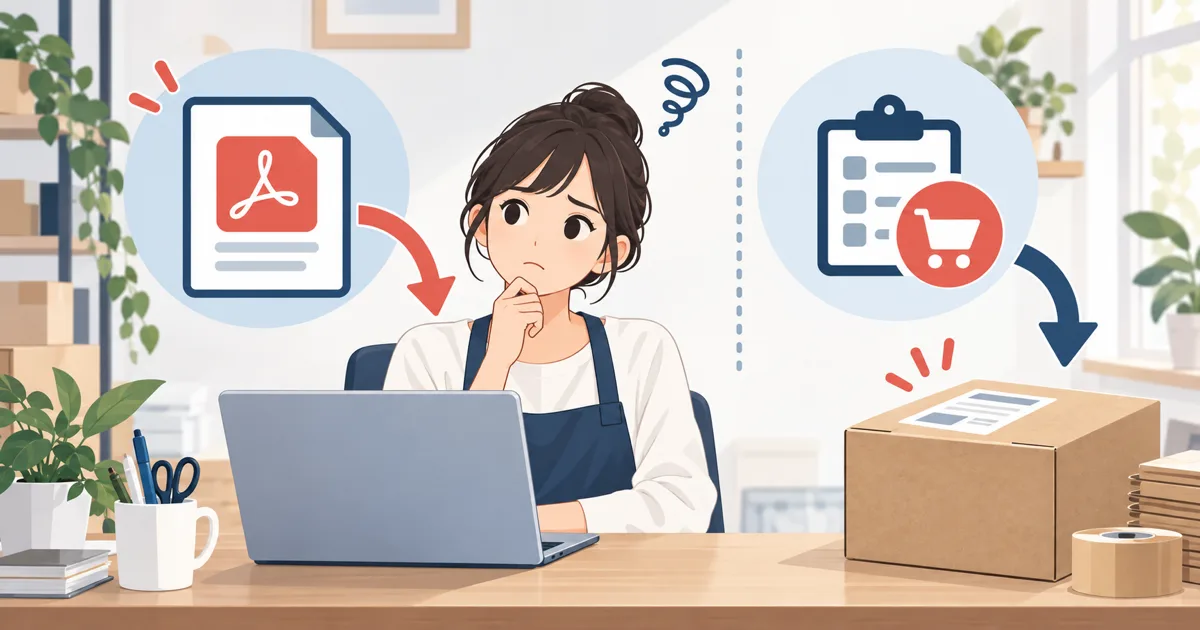
Payment completed, but the label never comes out. "The print button leads to an error page," "the PDF opens but nothing reaches the paper," "the printed label is too small to read" — getting stuck mid-shipment is a real problem when the ship date is close.
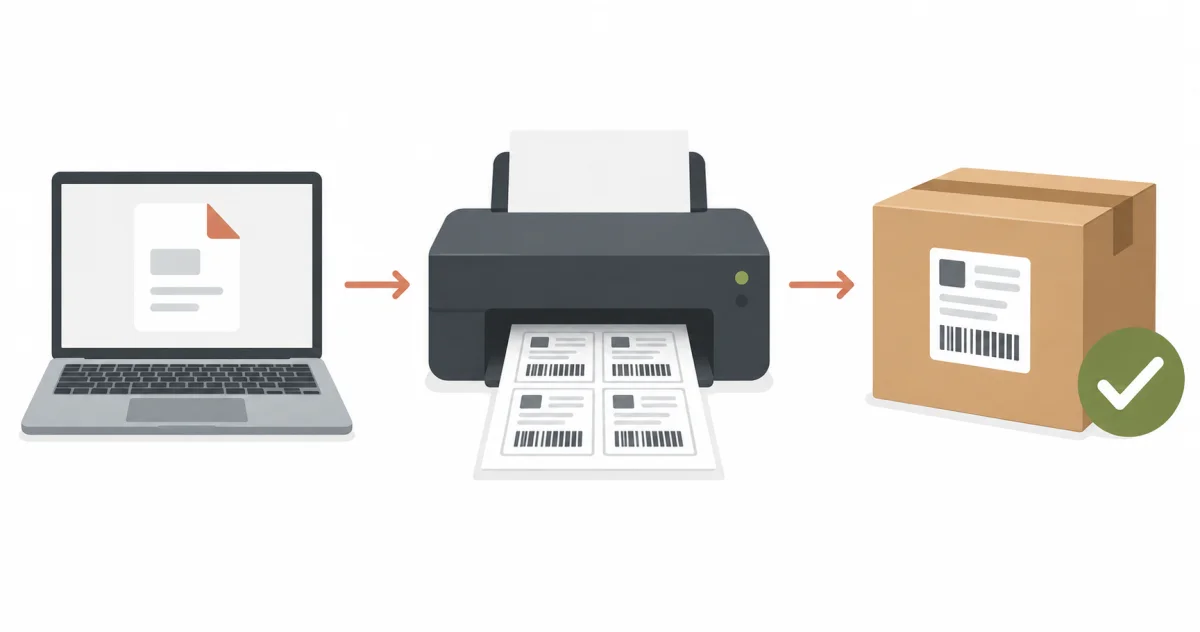
Here is the answer up front: label printing trouble narrows down to one cause once you separate it into three stages — whether the PDF opens, whether it prints correctly on paper, and whether the label is still usable. If it won't open, look at the browser; if it opens but prints small, look at the print settings; if it prints but you can't use it, look at the validity period or reprint rules. We will go through them in that order.
First, isolate which stage is stuck
| Symptom | Likely layer | Section to read |
|---|---|---|
| Pressing Print shows an error page or nothing opens | Browser / PDF display | Next section |
| The PDF opens but nothing reaches the paper | Printer / OS print settings | Printing section |
| It prints, but too small, misaligned, or clipped | Print dialog scale / paper size | Printing section |
| It printed, but you are unsure the label can be used | Validity period / reprint rules | Reprint section |
Even under the same phrase "won't print," the cause sits in a different layer. Adjusting printer settings while the PDF itself never opens solves nothing, so use the table to confirm which stage your symptom belongs to first.
When the PDF won't open or shows an error page
When the PDF never opens, the cause is mostly on the browser display side. The official Click Post site has also published notices about printing errors caused by browser environments.
One known case from the official notices: when printing an address label in Google Chrome, some environments show a "page not found" error message (displayed in Japanese). Depending on the environment, disabling the Adobe Acrobat extension can resolve it.
At this stage, try the following in order.
- Temporarily disable PDF-related extensions. In Chrome, open Settings > Extensions, turn off Adobe Acrobat-related extensions, and press the Print button again. This is the fix published in the official notice itself.
- Check the popup blocker. The label printing screen opens in a separate window (popup), so a blocked popup makes it look like nothing happened. The official notice also asks users to check browser settings such as popup blocking and cookie acceptance when printing.
- Check that cookies and JavaScript are enabled. Official outage notices also describe cases where pages fail to work correctly when these are disabled.
- Try a different browser. If it still will not open, follow the official guidance to try another browser. A clean browser with few extensions also helps isolate the cause.
- Open the downloaded PDF in a dedicated app. Instead of the browser's built-in viewer, save the PDF once and open it in a dedicated app such as Adobe Acrobat Reader to separate display-side problems.
One caution: the official notices state that commercially available "input assistance systems" can prevent the service from working correctly. If you keep autofill tools resident in your browser, they may be interfering with display or navigation, so try disabling them while you isolate the cause.
When it prints too small or misaligned on paper
When the PDF opens fine but the paper comes out small, shifted, or clipped, the cause usually sits in the print dialog settings.
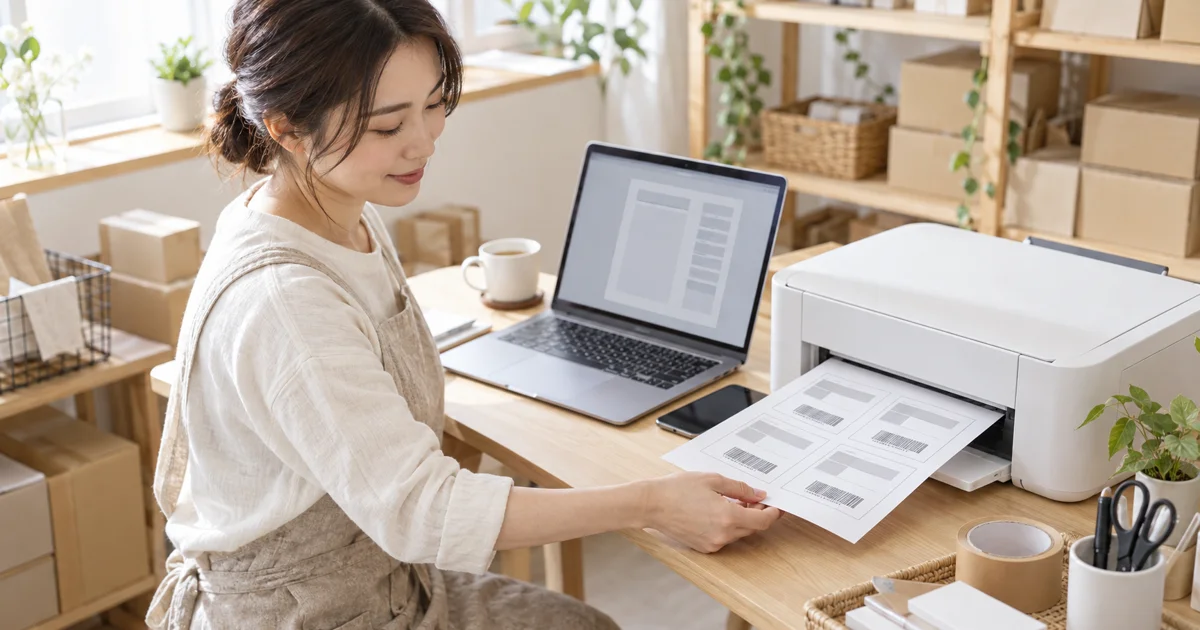
As a premise, labels from batch printing are small by design. Click Post's batch printing lays out four labels per A4 sheet and can output up to 20 shipments per round. Each label is therefore a quarter of an A4 page — roughly A6 — which is the intended size, made to be cut apart and attached to parcels. "Smaller than expected" alone is not a malfunction.
If it prints even smaller, or only part of the page prints, check the following in the print dialog.
- Set the scale to Actual size or 100%. If an option like Fit to page or Shrink to fit paper is selected, the PDF page is scaled to the sheet and the label's proportions shift.
- Match the paper size to A4. If the dialog's paper setting is Letter or another size, edges get clipped or the scale changes.
- Check the preview for clipped barcodes and addresses. Confirming in the print preview that nothing is cut off at the edges saves wasted paper.
- Print one sheet first. Before printing a batch, run a single test print and confirm the label is readable.
Detailed screen names and setting locations differ by printer model and environment, but covering the three points — scale, paper, preview — resolves most cases. Hardware-level trouble, such as the printer not feeding paper or running out of ink, is outside this article's scope.
Inspect the printed label before shipping
Once the label is on paper, check that it is readable before dropping it in the post box. Japan Post's acceptance process works by scanning the barcode, so an unreadable barcode means the parcel cannot be accepted.
- Is the barcode intact? Check for clipping at the paper edge or broken lines from faded ink.
- Is the tracking number readable? Even if the barcode fails to scan, a legible printed number helps staff verify it at the counter.
- Do the address and name fit inside the frame? Reprint anything that overflows the frame because of a scaling error.
- Will the barcode stay uncovered when attached? Attach the label so it does not wrap over a parcel edge or sit under glossy tape.
One reassuring point: Click Post charges are finalized at the moment Japan Post processes acceptance (the barcode scan). Labels that failed to print or were never used generate no charge as long as they are not accepted. A misprint only costs you a sheet of paper, so feel free to reprint.
Reprinting and re-applying are different operations
When reprinting a label, two things get confused: reprinting the same label with the same tracking number, and re-applying to get a new number. The distinction matters.
- Labels are valid for seven days starting the day after payment. Within that period you can reprint the same tracking number as many times as needed. If your printer was misbehaving on the day, reprinting the next day still works.
- Expired labels are void. An expired label cannot be accepted, and dropping it in a post box gets it returned to you. The same number never revives, so re-apply from the shipment details to issue a new tracking number.
- Unused labels are not charged. As covered above, no charge is finalized unless acceptance is processed. Labels that expired or whose shipment was cancelled do not require a refund procedure in principle.
- Duplication for a different parcel is prohibited. You cannot copy a label and attach it to another parcel. One tracking number corresponds to one parcel; duplicates break tracking and confuse acceptance. Always run a separate application for each parcel.
One time-sensitive caution: the official notices announce that the service will be down for system maintenance from 23:30 on September 30, 2026 (Wednesday) until 6:00 on October 1 (Thursday). The Click Post website itself will be unreachable during that window. In addition, the fare changes from 185 yen (tax included) to 240 yen (tax included) on October 1, and transactions whose payment completes by 23:30 on September 30 keep the old fare. If you hold a label close to its expiry, factor this downtime into your schedule.
Once printed, send the tracking number back to Shopify
With the label printed correctly, you can attach it to the parcel and drop it in the post box. What remains on the shop side is registering the issued tracking number on the Shopify order and sending the customer a shipping notification.
The Shopify app "Instant Shipping! for Click Post" reads the original label PDF you saved when printing, registers the tracking number on the matching order, and sends the shipping notification email automatically. Note that this app is developed and provided by JizaiDev, the operator of this site.
One scope note: this article covered trouble in the "printing the label on paper" stage. If the PDF printed fine but importing it into the app stalls on "cannot read" or "order not found," that is a different cause — see the checklist for PDF import problems in the app. The batch application flow is covered in how to run a bulk application, and the registration mechanism itself in how to register tracking numbers automatically.
Frequently asked questions
My label prints out extremely small
The PDF from batch printing is designed with four labels per A4 sheet, so each label being a quarter of the page is the correct specification — they are meant to be cut apart. If it comes out even smaller, check that the print dialog scale is not set to an option like Fit to page, and choose Actual size or 100%.
Until when can I reprint a label?
A label is valid for seven days starting the day after payment completes, and you can reprint the same tracking number within that period. Once it expires, the label is void and the number cannot be revived, so you apply again from the shipment details to issue a new number.
Am I charged for labels that fail to print?
Click Post charges are finalized when Japan Post processes acceptance by scanning the barcode. Labels that failed to print or were never used incur no charge as long as they are not accepted, so a failed print just costs you a sheet of paper.
Can I copy a label and use it for a different parcel?
No. Each tracking number corresponds to one parcel, and duplicating a label for another parcel is not supported. Always issue a label with a new number through a separate application for each parcel.
Can I issue labels without a printer at home?
The label is a PDF file, so you can save it to a USB drive or similar and print it from a convenience store multi-copier. Shipping itself happens via post box drop-off or at a post office counter, so only the printing location needs to be substituted.
Can I print using only a smartphone?
You can operate the Click Post screens in a smartphone browser. The common printing route is sending the PDF from your phone to a convenience store multi-copier via an app. When you need fine print-dialog settings such as scale, working on a computer is more reliable.
Summary
Isolate printing trouble into the three stages — display, printing, label handling — and the place to investigate narrows to one. The small size from batch printing is the intended specification, scale drift comes from the print dialog's ratio setting, and an expired label means re-applying for a new number rather than reprinting. Keep these three points in mind and shipping-day surprises become rarer.
Pricing and terms confirmed on September 18, 2026, based on the official Click Post site and the Click Post app listing. The app costs 8 US dollars per month with a 10-day free trial; continued use is paid.
Check the flow from label issue to tracking registration in the usage guide
Related articles: Click Post shipping guide (map of the whole process), when PDF import into the app fails, how to run a bulk application, how to register tracking numbers automatically