Shipping Included vs. Separate: Which Sells Better? The 3,000-Yen Rule for Displaying Shipping Fees
The short answer: products priced at 3,000 yen or more protect profit margins better with shipping included (displayed as free shipping), while items under 1,000 yen yield healthier profits when shipping is charged separately. The decision hinges entirely on a single metric: the shipping-to-price ratio. In practice, a ratio of 10% or less calls for inclusive shipping, while 20% or more calls for charging shipping separately.
Decision Thresholds by Product Price Tier
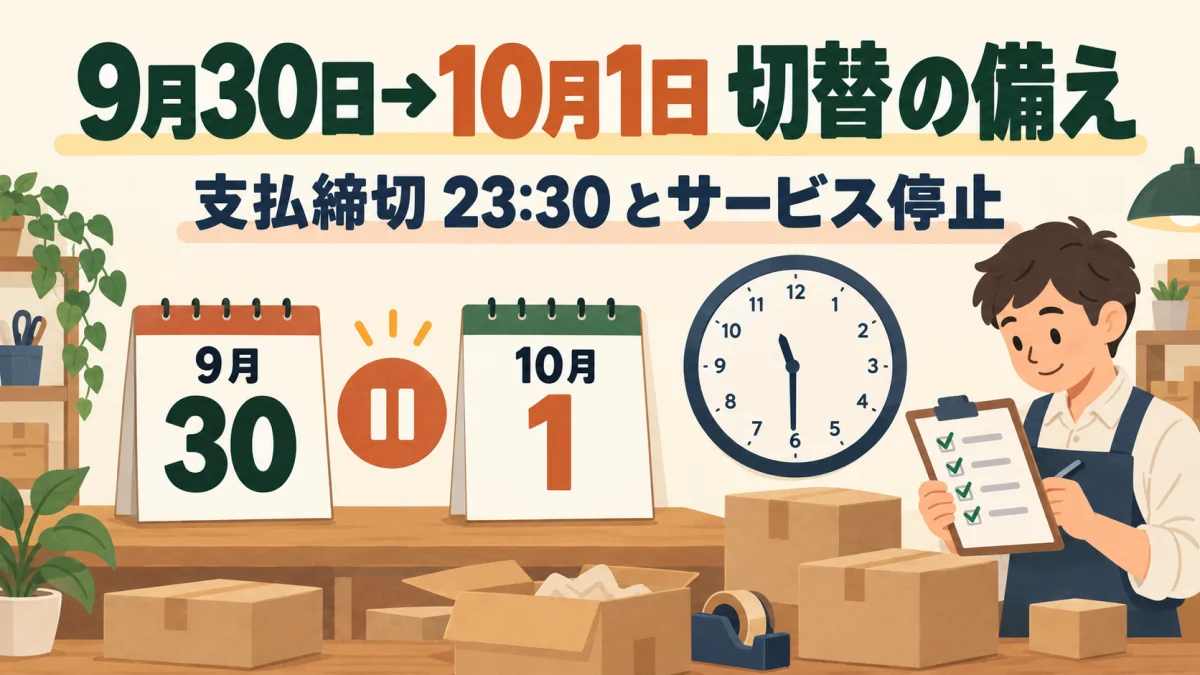
- Shipping cost calculations are based on Click Post's 185 yen rate effective through September 30, 2026. As the rate will be revised to 240 yen on October 1, you can apply the same ratio logic by substituting 185 yen with 240 yen.
| Product Price | Ratio (185 yen Shipping) | Recommendation | Rationale |
|---|---|---|---|
| 500 yen or less | 37% or more | Separate shipping | Nearly doubling the product price creates strong psychological price resistance |
| Around 1,000 yen | Approx. 19% | Either option viable | Decide based on customer demographics and brand positioning |
| 2,000 yen | Approx. 9% | Leaning toward shipping included | Even with a 9% price increase, the appeal of "free shipping" usually wins |
| 3,000 yen or more | Approx. 6% or less | Shipping included (displayed as free shipping) | Dependably reduces cart abandonment |
| 5,000 yen or more | Approx. 4% or less | Shipping included without question | In higher price brackets, customers simply expect free shipping |
How Shipping Models Impact Store Performance
| Evaluation Criteria | Shipping Included (Free Shipping Display) | Separate Shipping |
|---|---|---|
| Cart abandonment rate | ⬇ Decreases | ⬆ Increases |
| Perceived product page price | ⬆ Looks higher | ⬇ Looks lower |
| Profit margin management | Fluctuates depending on sales mix | Stable, as customers cover shipping directly |
| Multi-item purchases | Built-in shipping fees boost margins | Feels fairer and more rational to buyers |
| Comparison sites & search listings | Disadvantage (prices look higher) | Advantage (ranked by lower base price) |
The fundamental difference between inclusive and separate shipping is whether the final price changes at checkout. The number-one driver of cart abandonment in ecommerce is unexpected added costs—and with inclusive pricing, the total amount never shifts at checkout.
In my own store, I tested both approaches simultaneously across TRRS cables (priced in the 4,000-yen range) and artisan resin keycaps (1,000 to 2,000 yen). The result: conversion rates stabilized with shipping included for higher-ticket items, and with separate shipping for lower-priced products. Below, I break down the reasoning and provide a practical, price-tier decision framework from an operator's perspective.
The Psychological Impact of "Free Shipping" on Shoppers
When the Total Changes at Checkout, Shoppers Drop Out
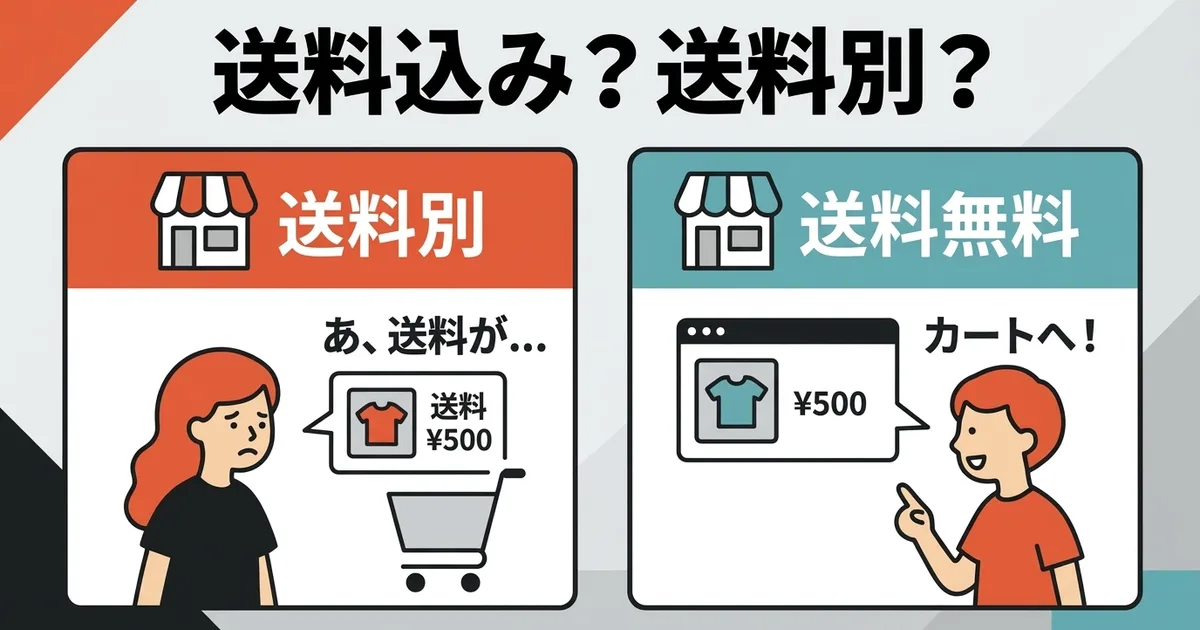
One of the leading causes of cart abandonment (adding items to the cart but leaving without buying) in ecommerce is unexpected extra fees. A customer spots an item listed for 1,500 yen on the product page, but when 500 yen in shipping is tacked on at checkout, the total jumps to 2,000 yen. The moment they see that difference, many buyers decide to walk away.
When you roll shipping into the product price and display "Free Shipping," the total never budges at checkout, effectively eliminating that drop-off point.
The Word "Free" Exerts Powerful Leverage
Paying "185 yen for shipping" versus "Free Shipping (with 185 yen added to the product price)" amounts to the exact same total out of pocket. Yet "Free Shipping" creates significantly less psychological resistance. Shoppers aren't making a purely rational calculation; they are reacting emotionally. That is precisely why so many major ecommerce marketplaces put "Free Shipping" front and center.
Comparing Inclusive vs. Separate Shipping
| Factor | Shipping Included (Free Shipping Display) | Separate Shipping |
|---|---|---|
| Shopper impression | Peace of mind with "no hidden fees" | Total increases at checkout |
| Cart abandonment rate | Tends to decrease | Tends to increase |
| Product page appearance | Prices look higher | Prices look lower |
| Margin transparency | Shipping costs are blended into the price | Shipping and product prices remain distinct |
| Price competitiveness | Can appear more expensive in search listings | Appears cheaper when compared on base price |
| Multi-item orders | Extra built-in shipping charges can boost margin | Feels fair and cost-efficient for the buyer |
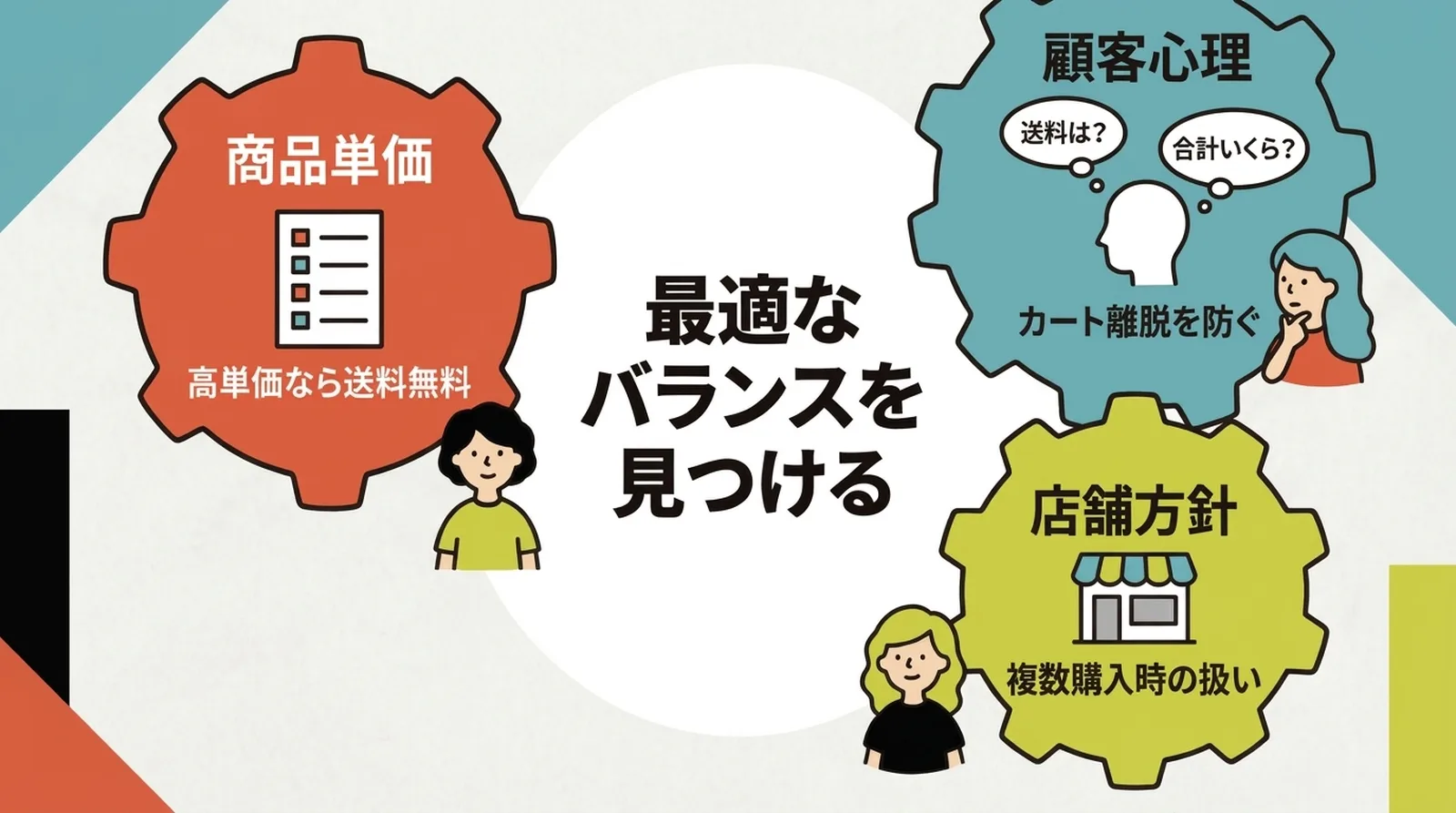
There is no universal right answer. The ideal setup varies depending on product characteristics, price points, and target customer demographics.
Evaluating the Shipping-to-Price Ratio
One reliable benchmark is calculating shipping cost as a percentage of your item's retail price.
Low Shipping Ratio (Products Priced at 3,000 Yen or More)
If a product costs 3,000 yen and shipping is 185 yen, shipping accounts for roughly 6% of the price. At this level, pricing the item at 3,185 yen and promoting "Free Shipping" barely alters buyer perception of the price. Instead, the "Free Shipping" badge is far more likely to lift conversion rates.
High Shipping Ratio (Products Priced at 1,000 Yen or Less)
If a product costs 800 yen and shipping is 185 yen, shipping represents about 23% of the item price. Bumping the price to 985 yen to include shipping makes the product page price look more than 20% higher. Because that markup stands out prominently, charging shipping separately is often more effective for emphasizing affordability.
Benchmark Thresholds
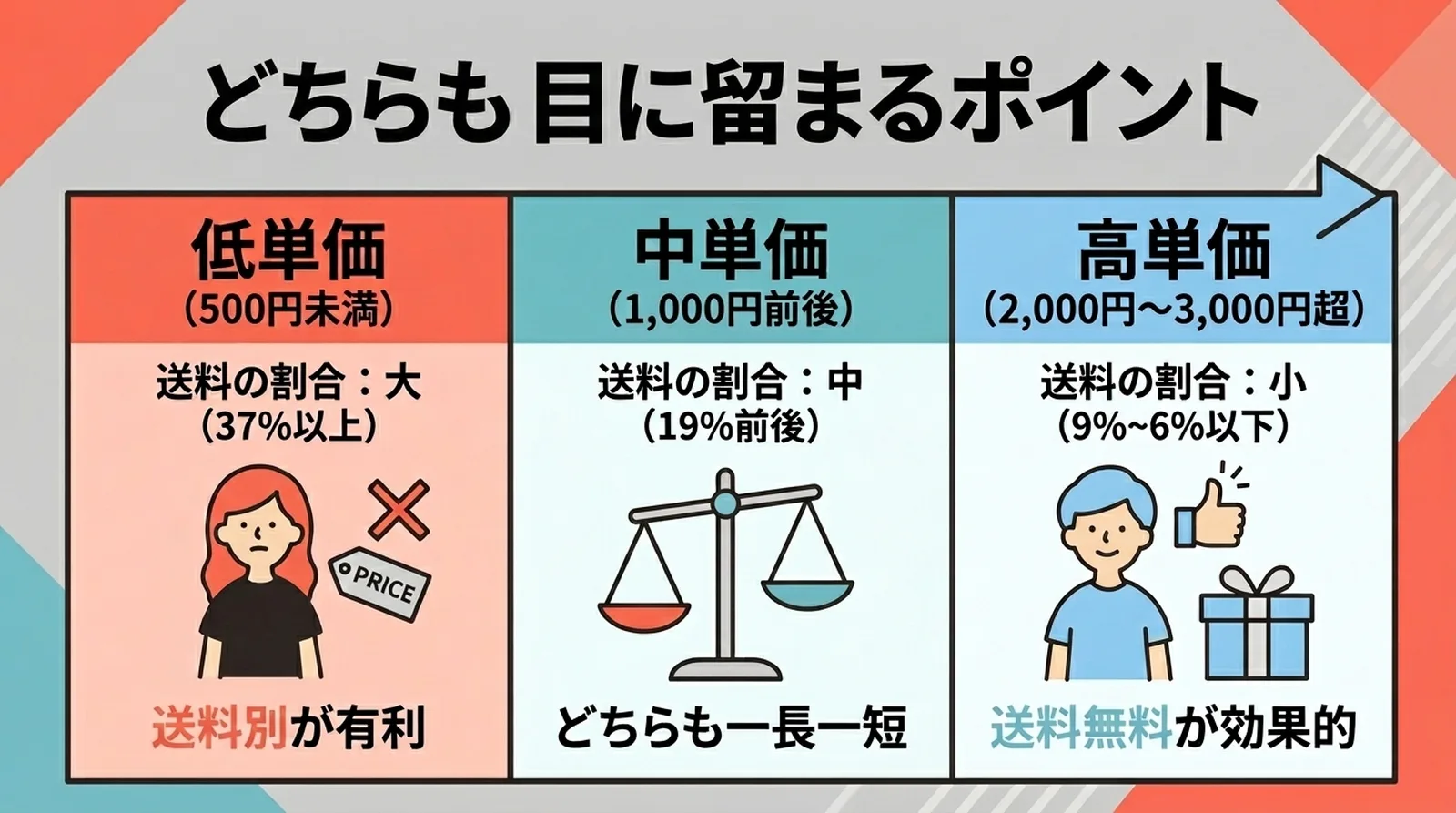
| Product Price | Ratio (185 yen Shipping) | General Trend |
|---|---|---|
| 500 yen or less | 37% or more | Separate shipping highlights low product prices more effectively |
| Around 1,000 yen | Approx. 19% | Both approaches have pros and cons |
| 2,000 yen or more | Approx. 9% or less | Rolling shipping into the price has little negative impact on perception |
| 3,000 yen or more | Approx. 6% or less | Shipping included (displayed as free shipping) tends to be highly effective |
Keep in mind these figures are general guidelines. Fine-tune them to reflect your store's specific circumstances.
How I Handle Shipping in My Own Store
In my own business selling handmade items across varying price points, I opted for charging shipping separately. There are three main reasons:
1. Price points vary widely across products
My TRRS cables run around 1,500 yen, whereas resin keycaps range between 2,000 and 3,000 yen. Because unit prices vary so much, managing flat inclusive shipping across the entire catalog gets tricky.
2. Combining shipping on multi-item orders
When a customer buys two or more items at once, I consolidate them into a single parcel. If shipping is baked into every product price, the customer effectively pays shipping multiple times. While I could configure Shopify shipping settings to grant "free shipping on 2 or more items" or issue manual partial refunds, either method adds operational overhead.
3. Upfront shipping charges build greater trust
Shoppers buying handmade goods often feel a close personal connection to the maker. Rather than disguising shipping costs behind a "free" label, I felt that being upfront—clearly stating "shipping is X yen"—fosters more trust.
That said, this setup works well specifically for my product mix and customer base; it won't necessarily be the right fit for every store.
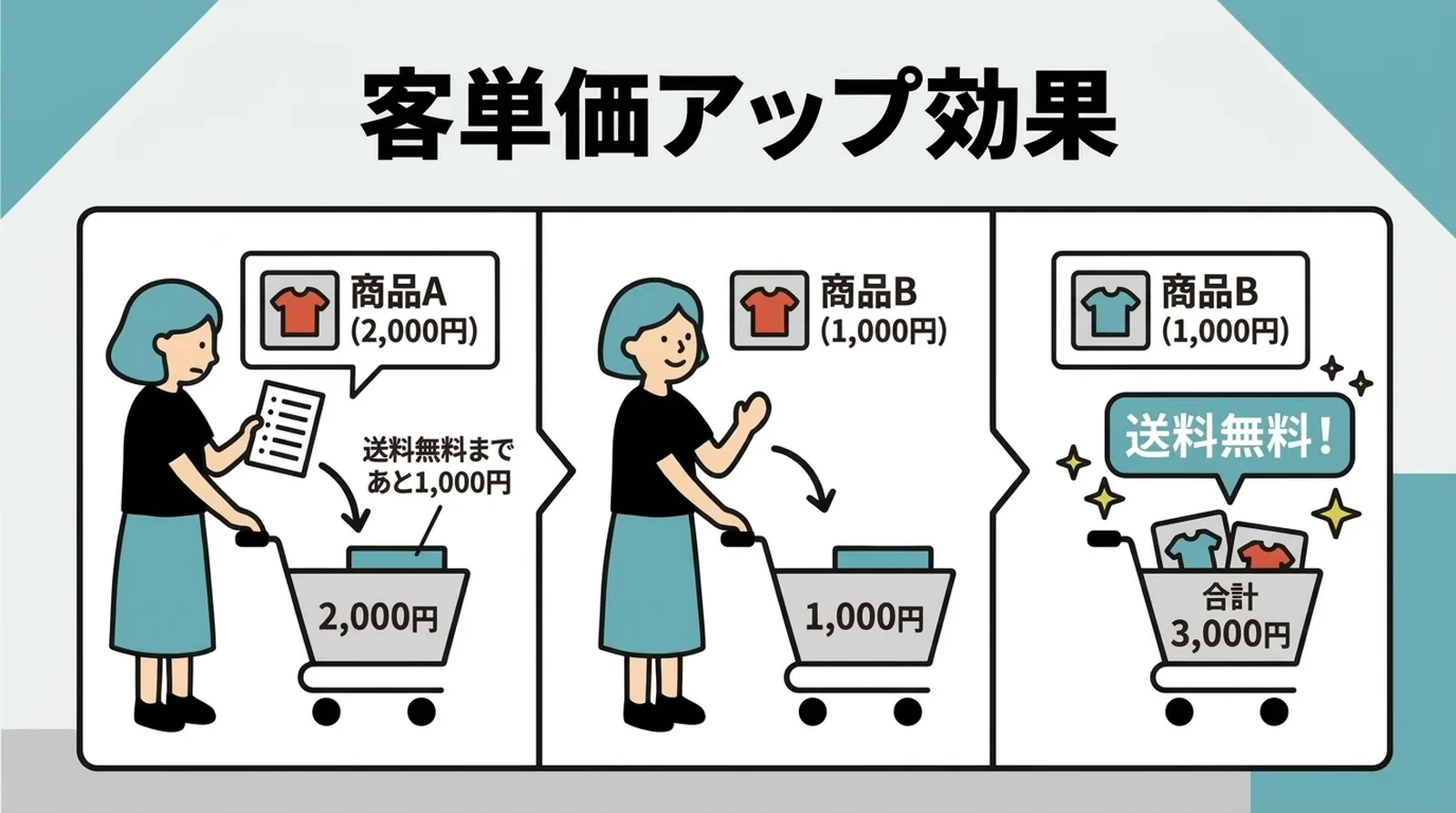
A Balanced Middle Ground: "Free Shipping Over X Yen"
Rather than treating this as a strict either/or choice, you can also offer free shipping once an order reaches a specific spending threshold.
Driving Higher Average Order Value (AOV)
When shoppers realize they are "just 500 yen away from free shipping," they are far more likely to add an extra accessory or add-on to their cart. This provides a well-rounded strategy: it preserves the motivational pull of free shipping while ensuring you recover fulfillment costs on smaller orders. Best of all, you can easily set this up in Shopify's shipping settings.
How to Choose Your Free Shipping Threshold
A proven rule of thumb is setting the threshold slightly above your store's average order value (AOV). For instance, if your current AOV is 2,500 yen, establishing free shipping at 3,000 yen gives customers a compelling and reachable target to add one more item.
Conversely, if the threshold is set too high above your average order size, shoppers think, "I'm never spending that much anyway," and the incentive loses its power. Review your store's existing order data to find the sweet spot.
The Strategic Advantage of Keeping Base Shipping Low
Whichever pricing model you choose, keeping your baseline shipping costs as low as possible softens the impact on both you and your customers.
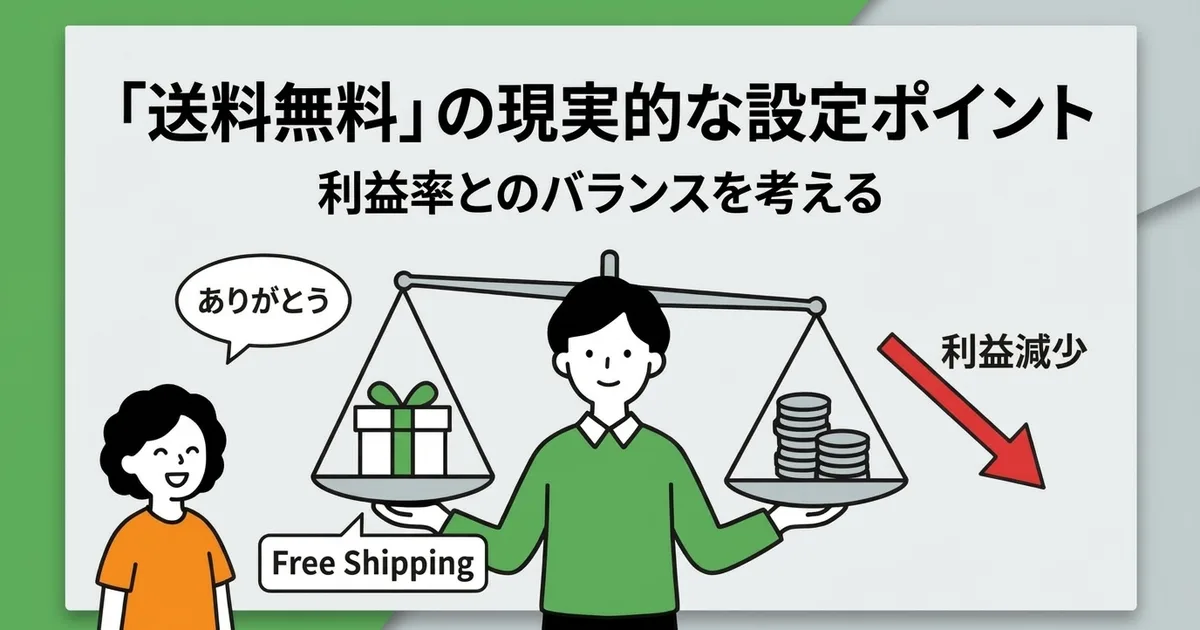
Click Post's nationwide flat rate of 185 yen (through September 30, 2026; 240 yen starting October 1) ranks among the most affordable options for small parcels. Compared to Yu-Packet (250 to 360 yen; flat 360 yen starting October 1), Click Post saves 65 to 175 yen per shipment. At 50 shipments per month, that amounts to 3,250 to 8,750 yen in monthly savings, or tens of thousands of yen annually.
Keeping shipping rates low minimizes price inflation when you include shipping, and reduces friction for buyers when you charge shipping separately. It benefits your store regardless of which policy you adopt.
Frequently Asked Questions
Q. Which is better for sales: shipping included or separate shipping?
For higher-ticket items (3,000 yen and above), including shipping tends to produce a more noticeable lift in conversion rates. For lower-priced items, rolling shipping into the product price can make items look expensive on the product page, meaning separate shipping is often more advantageous. Start by reviewing your current cart abandonment rate; if shoppers frequently drop off during the shipping step, testing inclusive shipping is a smart move.
Q. How do I set up "Free Shipping" in Shopify?
In your Shopify admin, navigate to Settings > Shipping and delivery and edit your shipping profile. Setting the shipping rate to 0 yen will display "Free Shipping" to customers at checkout. You can also configure conditional rules, such as "Free shipping on orders over X yen," from this same settings screen.
Q. Won't offering free shipping wipe out my profit margins?
Because the premise is incorporating the shipping cost into the retail price, your underlying profit margin remains unchanged. For example, selling an item for 1,500 yen plus 185 yen shipping (or 240 yen after October 1) generates the exact same gross revenue as pricing it at 1,685 yen with free shipping. However, since a higher list price may put you at a disadvantage during competitive price comparisons, weigh the ratio of shipping to your product price before deciding.
Conclusion
Whether to include shipping in your product price or charge it separately depends on your shipping-to-price ratio, customer base, and store strategy.
For high-ticket products where shipping represents a small fraction of the total price, inclusive shipping (displayed as free shipping) reliably lifts conversion rates. For lower-priced items, separate shipping allows you to emphasize competitive base prices. When seeking middle ground, conditional threshold rules like "Free shipping on orders over X yen" offer an effective compromise.
Under either strategy, keeping your baseline shipping costs low gives you far more pricing flexibility. If you fulfill orders with Click Post and want to streamline your workflow—from CSV export all the way to tracking number updates—give Instant Shipping! for Click Post a try.
Related Articles
- Streamlining Shopify & Click Post Fulfillment — A practical step-by-step workflow from CSV export to tracking number sync
- When Is "Free Shipping" Actually Feasible? — Free shipping only works when your profit margins can absorb the fulfillment cost, and product...
![[2026 Latest] Click Post 185 Yen (240 Yen from Oct 1) vs. Yu-Packet from 250 Yen (Flat 360 Yen from Oct 1) | Rates & Size Comparison Chart](/blog/images/clickpost/02_01_shipping_comparison/thumb.webp)