![[2026 Latest] Click Post 185 Yen (240 Yen from Oct 1) vs. Yu-Packet from 250 Yen (Flat 360 Yen from Oct 1) | Rates & Size Comparison Chart](/blog/images/clickpost/02_01_shipping_comparison/thumb.webp)
[2026 Latest] Click Post 185 Yen (240 Yen from Oct 1) vs. Yu-Packet from 250 Yen (Flat 360 Yen from Oct 1) | Rates & Size Comparison Chart
Through September 30, 2026, Click Post (flat 185 yen nationwide) is the cheapest option for items within 3 cm thickness and 1 kg. Yu-Packet starts from 250 yen (tiered across three thicknesses), Nekopos is capped at 360 yen under individual contracts, and nonstandard mail uses a weight-based rate from 140 to 750 yen. The ideal shipping method varies depending on your product dimensions and order volume. Please note that starting October 1, 2026, Click Post will be revised to 240 yen, within 60 cm total dimensions, within 34 cm length, up to 2 kg, and drop-off primarily via post boxes, while Yu-Packet's standard rate will be revised to a flat 360 yen.
2026 Small Parcel Shipping Services Quick Reference: Rates & Sizes
| Service | Rate (2026) | Size Limits | Thickness | Tracking | Drop-off Locations |
|---|---|---|---|---|---|
| Click Post | 185 yen (240 yen from Oct 1) | Length 34 cm × Width 25 cm (From Oct 1: Total dimensions 60 cm, Length 34 cm) | 3 cm | Yes | Post box, post office (From Oct 1: post box primarily) |
| Yu-Packet (1 cm) | 250 yen | Length 34 cm, total dimensions 60 cm | 1 cm | Yes | Post box, post office |
| Yu-Packet (2 cm) | 310 yen | " | 2 cm | Yes | " |
| Yu-Packet (3 cm) | 360 yen | " | 3 cm | Yes | " |
| Nekopos | Up to 360 yen (Contract-based) | Length 31.2 cm × Width 22.8 cm | 3 cm | Yes | Yamato service centers, select convenience stores |
| Nonstandard Mail (Standard Size, 50g) | 140 yen | Length 34 cm × Width 25 cm | 3 cm | No | Post box, post office |
| Nonstandard Mail (Standard Size, 500g) | 510 yen | " | 3 cm | No | " |
Rates and sizes in this table reflect the October 2024 revisions and apply through September 30, 2026. Starting October 1, 2026, Click Post will be revised to a flat 240 yen nationwide, with dimensions within 60 cm total / 34 cm length / must fit into a post box, weight up to 2 kg, and drop-off primarily via post boxes; Yu-Packet's standard rate will be revised to a flat 360 yen. Sources: Japan Post Click Post Rates, Japan Post Yu-Packet Rates, Yamato Transport Nekopos, Japan Post Nonstandard Mail.
Estimated Annual Shipping Costs for 100 Shipments per Month
| Service | Per Shipment | 100 Shipments/Month | 1,200 Shipments/Year |
|---|---|---|---|
| Click Post | 185 yen (through Sep 30) | 18,500 yen | 222,000 yen |
| Yu-Packet (2 cm thickness) | 310 yen | 31,000 yen | 372,000 yen (+150,000 yen) |
| Nekopos | 360 yen | 36,000 yen | 432,000 yen (+210,000 yen) |
*Calculated using rates through September 30, 2026. From October 1, Click Post will be revised to 240 yen and Yu-Packet to a flat 360 yen (for 100 shipments per month, Click Post will be 24,000 yen/month).
Shipping 100 packages a month means a 210,000-yen difference per year compared to Nekopos, and a 150,000-yen difference compared to 2 cm-thick Yu-Packet. Choosing the right shipping service directly impacts your e-commerce cash flow. For more details on preparing for rate revisions, see Preparing for Shipping Rate Hikes.
Please note that items exceeding 3 cm in thickness are outside the scope of this article. For borderline 3 cm packaging decisions and alternative services for 2.5 cm, 2.9 cm, and 3.1 cm items, see Handling Packages Exceeding Click Post's 3 cm Thickness Limit | Decision Flow for 2.5 cm, 2.9 cm, and 3.1 cm.
Drawing from my experience shipping 2,200 packages over three years, I will now explain criteria for choosing the right shipping method based on product characteristics and shipment volume.
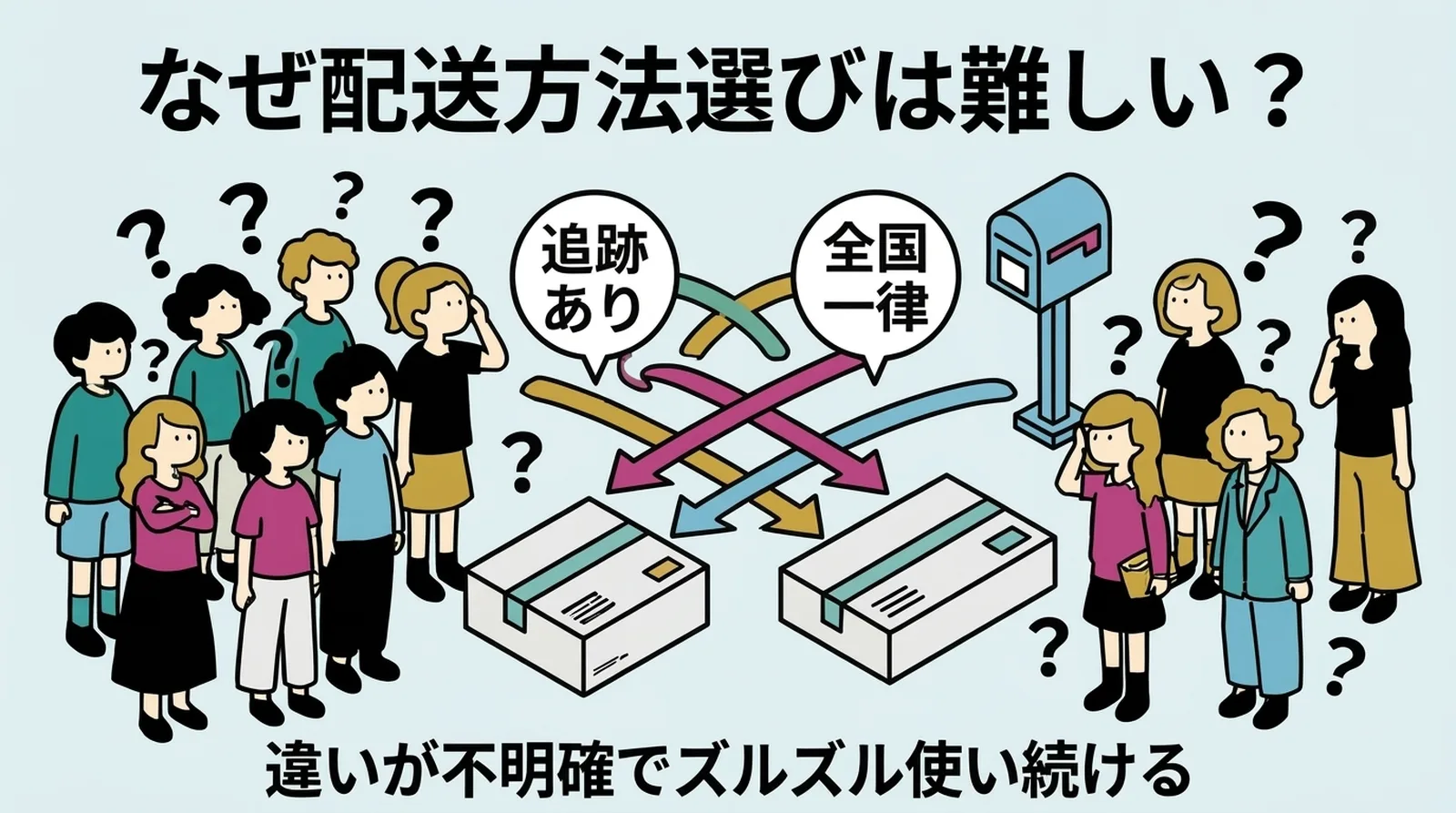
Why Choosing a Shipping Method Is So Challenging
Many Services Look Similar, Making the Differences Hard to Spot
Small parcel shipping services all share similar selling points: post box drop-off, tracking included, and flat nationwide pricing. Because they appear virtually identical at first glance, it is completely natural to feel unsure about which one to choose.
In practice, however, subtle distinctions emerge in pricing structures, size constraints, drop-off options, and tracking availability. These differences ultimately add up, impacting both your total monthly shipping bill and your day-to-day operational workload.
Sticking with Whatever You Picked on Day One
It is surprisingly common for merchants to stick with the shipping method they chose somewhat arbitrarily when launching their store, even as order volumes grow. Yet when your product mix changes or monthly shipments expand, the ideal shipping method shifts as well.
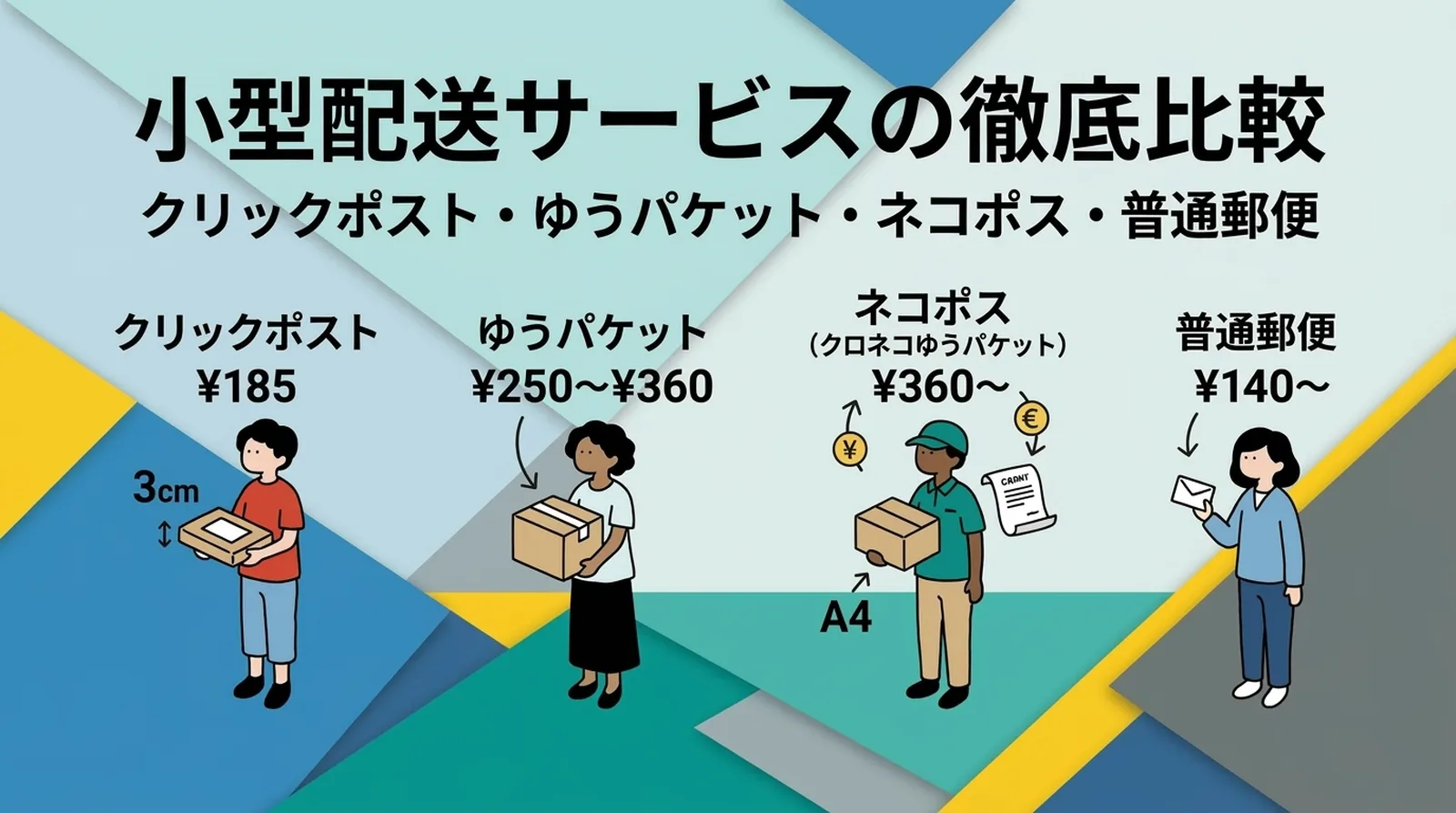
Comparing 4 Small Parcel Shipping Services
Comparison Table
| Feature | Click Post | Yu-Packet | Nekopos (Kuroneko Yu-Packet) | Nonstandard Mail (Standard Size) |
|---|---|---|---|---|
| Rate | Flat 185 yen nationwide (240 yen from Oct 1) | 250 to 360 yen (3 tiers by thickness; flat 360 yen from Oct 1) | Capped at 360 yen (Individual contract) | 140 to 750 yen (Weight-based) |
| Size Limit | Length 34 cm × Width 25 cm × Thickness 3 cm (From Oct 1: 60 cm total dimensions, 34 cm length) | Within 60 cm total dimensions, Length 34 cm × Thickness 3 cm | Length 31.2 cm × Width 22.8 cm × Thickness 3 cm | Length 34 cm × Width 25 cm × Thickness 3 cm |
| Weight Limit | 1 kg (2 kg from Oct 1) | 1 kg | 1 kg | 1 kg (Standard size) |
| Tracking | Yes | Yes | Yes | No (Available with Recorded Delivery for +210 yen) |
| Delivery Method | Mailbox delivery | Mailbox delivery | Mailbox delivery | Mailbox delivery |
| Drop-off Locations | Post box, post office counter (From Oct 1: post box primarily) | Post box, post office counter | Yamato service centers, convenience stores, etc. | Post box, post office counter |
| Sunday & Holiday Delivery | Yes (Delivered daily) | Yes (Delivered daily) | Delivered by Japan Post (Subject to confirmation) | No |
| Payment Method | Yahoo! Wallet / Amazon Pay | Postage stamps, counter payment | Corporate contract | Postage stamps, counter payment |
While this chart may be enough to make a decision in some cases, the ideal service changes depending on your products' weight and size, as well as your monthly shipment volume. Below, we examine the characteristics of each service in detail.
Click Post
The biggest appeal of Click Post is its low cost of a flat 185 yen nationwide (through September 30, 2026; 240 yen from October 1). Because tracking is included, it is the ideal choice when you want to minimize shipping expenses while keeping customers informed about where their package is.
Drop-off is done either by depositing packages in a post box or bringing them to a post office counter; convenience store drop-offs are not supported. Pickup service is also unavailable, meaning you must drop off packages yourself. Furthermore, starting October 1, 2026, drop-off will be restricted primarily to post boxes; counter drop-offs will only be permitted under exceptional conditions (such as the post box being full or broken, volume exceeding what can be deposited at once, or the post box slot being too narrow despite the package meeting dimensional limits) and will be restricted to packages 3 cm or less in thickness. Deliveries run every day, including Saturdays, Sundays, and public holidays.
Payment is accepted exclusively via Yahoo! Wallet or Amazon Pay. While Click Post supports bulk registration by uploading a CSV file through its "Bulk Application" feature, payment authorization must still be confirmed one package at a time—bulk payment is not supported. Each CSV upload is limited to 40 shipments.
Yu-Packet
Yu-Packet uses a three-tier pricing structure based on package thickness (rates following the October 2024 revision, applicable through September 30, 2026; standard rates will be revised to a flat 360 yen starting October 1).
| Thickness | Rate |
|---|---|
| Within 1 cm | 250 yen |
| Within 2 cm | 310 yen |
| Within 3 cm | 360 yen |
Items that fit within 1 cm thickness cost 250 yen, but once thickness reaches 2 to 3 cm, the price climbs to 310–360 yen, widening the gap with Click Post. Packages can be sent via post box drop-off or at post office counters. Like Click Post, dropping off at convenience store counters is not supported.
Nekopos (Kuroneko Yu-Packet)
Since October 2023, Nekopos has been transitioning phased into "Kuroneko Yu-Packet." Under this model, Yamato Transport accepts the parcel and Japan Post handles final delivery.
Pricing is based on individual contracts scaled to shipping volume, with a nationwide ceiling of 360 yen. Because it requires a contract intended for corporations and established e-commerce merchants, it presents a barrier to entry for small, solo-operated shops. The size limit is also slightly smaller at 31.2 cm length × 22.8 cm width, so keep in mind that standard A4 envelopes may barely fail to fit.
Nonstandard Mail (Standard Size)
While it lacks tracking, items weighing 50 g or less can be sent for just 140 yen, making it the cheapest available rate. It is a compelling option for lightweight, non-fragile items such as stickers, decals, or thin accessory components.
However, the lack of tracking carries risks that should not be overlooked. If a customer reaches out saying their order hasn't arrived, you have no way to verify delivery status. Adding the Recorded Delivery (Tokutei Kiroku) option enables tracking for an additional 210 yen, but that brings the total cost to 350 yen or more—well above Click Post's 185 yen (240 yen from October 1).
Nonstandard mail is cost-effective if strictly limited to lightweight, inexpensive goods, but relying on it without tracking leads to hidden customer support costs whenever shipping issues arise. In my case, after receiving a few "package never arrived" inquiries on shipments without tracking numbers, I made it a policy to rely primarily on tracked services.
How to Choose a Shipping Method Based on Product Characteristics
If the comparison chart alone does not make the choice obvious, you can narrow down your options using these three criteria:
1. Evaluate by Product Weight
Nonstandard mail uses a weight-based pricing model. While it is economical at 140 yen for items up to 50 g, rates rise quickly as weight increases: 270 yen up to 150 g, and 320 yen up to 250 g. Click Post, by contrast, charges a flat 185 yen regardless of weight up to 1 kg (up to 2 kg and 240 yen from October 1).
As a general guideline, Click Post is cheaper in almost every scenario once an item exceeds 50 g.
2. Decide Whether Tracking Is Necessary
Whether a package includes tracking directly impacts your customer service workload. With tracking, you can monitor where the parcel is in transit, and you receive confirmed delivery records. Without tracking, you have no way to investigate shipping mishaps or non-delivery claims.
While untracked shipping might be acceptable for low-cost consumables or promotional freebies, choosing tracked shipping as your default provides essential peace of mind when selling commercial products where customers have paid for the goods.
3. Consider Available Drop-off Locations
If you have post boxes or post offices near your home or workshop, Click Post, Yu-Packet, and nonstandard mail are exceptionally convenient. If your nearest postal facility is far away and convenience stores are much easier to access, Kuroneko Yu-Packet (available via Yamato service centers and convenience stores) becomes a viable candidate.
When to Reevaluate Your Shipping Methods
When Monthly Order Volume Increases
At around 10 orders per month, the difference in shipping rates across services is negligible. But once your volume grows to 50 or 100 shipments a month, a difference of just tens of yen per package quickly adds up to thousands of yen each month.
| Monthly Shipments | Click Post (185 yen through Sep 30) | Yu-Packet 3 cm (360 yen) | Difference |
|---|---|---|---|
| 30 shipments | 5,550 yen | 10,800 yen | 5,250 yen |
| 50 shipments | 9,250 yen | 18,000 yen | 8,750 yen |
| 100 shipments | 18,500 yen | 36,000 yen | 17,500 yen |
At 100 shipments per month, the annual difference reaches 210,000 yen (calculated using rates through September 30; from October 1, comparing 240 yen to 360 yen yields a difference of 12,000 yen per month, or about 140,000 yen annually). When shipment volume scales, it is an ideal time to rethink your logistics.
When Your Product Lineup Changes
Introducing new products often shifts the dimensions and weights of your shipments. If you previously carried only thin, flat items but are now adding bulkier goods, you must reevaluate your shipping strategy.
In my own experience, I initially shipped primarily TRRS cables and relied on nonstandard mail. Later, as I began adding thicker and heavier items like artisan resin keycaps and realized the necessity of tracking, I switched to Click Post. Since making the switch, I have been able to handle shipments reliably, keeping both costs and tracking under control.
What to Do When Thickness Exceeds 3 cm
Most small parcel services cap thickness at 3 cm. When items exceed this limit, your options change. Note that starting October 1, 2026, Click Post's size specifications change to "within 60 cm total dimensions, within 34 cm length, and must be able to fit into a post box" (up to 2 kg), meaning it may still be usable for items thicker than 3 cm as long as total dimensions remain within 60 cm and the package fits through the post box slot.
Letter Pack Plus (600 yen)
Letter Pack Plus uses a dedicated envelope, has no thickness limit, accommodates up to 4 kg, and costs a flat 600 yen nationwide. A tracking number is also included. For items that slightly exceed 3 cm in thickness, Letter Pack Plus is the next best alternative. However, it requires purchasing dedicated envelopes in advance, and dimensions are restricted to roughly A4 size (34 cm × 24.8 cm).
Yu-Pack & Yamato TA-Q-BIN (Size 60+)
For items where total dimensions exceed 60 cm or weight exceeds several kilograms, standard parcel services like Yu-Pack or Yamato TA-Q-BIN starting from Size 60 become the appropriate choice. Pricing varies depending on the origin and destination regions, typically ranging around 800 to 1,000 yen for Size 60 (Yu-Pack has announced an approximate 10% rate increase effective October 1, 2026, starting at 840 yen for intra-prefecture Size 60).
Decision Flow for Oversized Packages
- Check if the package fits within 3 cm thickness → If yes, use small parcel services like Click Post
- Exceeds 3 cm thickness, but fits within A4 dimensions and 4 kg? → Letter Pack Plus (600 yen)
- Doesn't fit in Letter Pack either? → Yu-Pack or Yamato TA-Q-BIN (Size 60+)
The 3 cm thickness limit must be evaluated after packaging, not before. Even if an item itself measures 2.5 cm, adding protective cushioning can push it past 3 cm. Measuring the package in its fully packed state beforehand prevents costly shipping method mismatches.
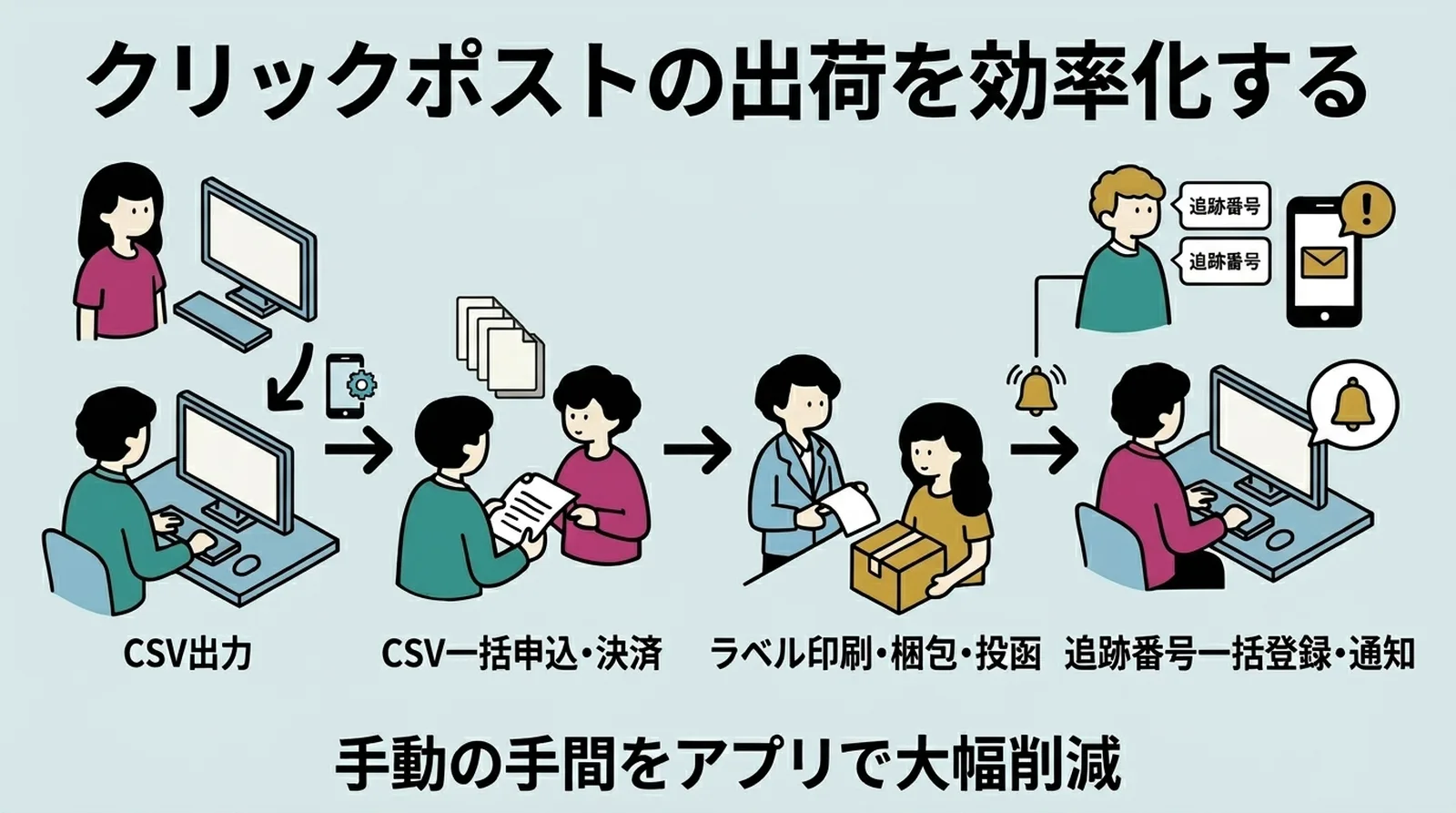
Streamlining Your Click Post Shipping Workflow
Once you choose Click Post, streamlining your day-to-day fulfillment becomes the next challenge. When running a store on Shopify in particular, you have to navigate several operational steps from exporting order details to syncing tracking numbers:
- Export Shopify order data formatted for Click Post CSV import
- Upload the CSV to Click Post's "Bulk Application" and complete payments
- Print shipping labels, pack items, and drop them off
- Sync tracking numbers back to each Shopify order and send shipment notifications
Among these, Step 1 (CSV export) and Step 4 (tracking number syncing) consume significant time when performed manually as order volume grows. By using an app that automates CSV export and bulk tracking updates, you can complete both Steps 1 and 4 in just a few minutes.
What Is the Difference Between Click Post and Nekopos?
"Which is really better, Click Post or Nekopos?" is one of the most common questions merchants ask. Here is a breakdown of their primary differences:
| Comparison Point | Click Post | Nekopos (Kuroneko Yu-Packet) |
|---|---|---|
| Operator | Japan Post | Yamato Transport (Delivered by Japan Post) |
| Rate | Flat 185 yen nationwide (240 yen from Oct 1; individuals eligible) | Capped at 360 yen (Requires corporate contract) |
| Eligibility | Anyone with a Yahoo! JAPAN ID or Amazon account | Corporate contract / E-commerce businesses |
| Size Limit | Length 34 cm × Width 25 cm × Thickness 3 cm (From Oct 1: 60 cm total dimensions, 34 cm length) | Length 31.2 cm × Width 22.8 cm × Thickness 3 cm |
| Drop-off Locations | Post box, post office counter (From Oct 1: post box primarily) | Yamato service centers, convenience stores, etc. |
| CSV Bulk Processing | Bulk Application (40 shipments/batch) | Yamato Business Members |
The single biggest difference lies in the barrier to entry. Anyone with a Yahoo! JAPAN ID or Amazon account can start using Click Post immediately as an individual, whereas Nekopos requires a corporate contract. Price-wise, Click Post also holds a clear advantage at 185 yen (240 yen from October 1) versus up to 360 yen. On the other hand, Nekopos's key strength is supporting drop-offs at convenience stores.
For solo entrepreneurs and small shops, Click Post is the top recommendation thanks to its low pricing and simplicity. If you already hold a corporate contract and convenience store drop-off is non-negotiable, Nekopos becomes a viable contender.
Frequently Asked Questions
Q. Which Service Is Ultimately the Most Recommended?
While there is no one-size-fits-all answer, if your packages meet the criteria of "within 3 cm thickness, within 1 kg, and tracking required," Click Post offers the lowest cost at a flat 185 yen nationwide (240 yen, within 60 cm total dimensions, and within 2 kg from October 1). If tracking is not needed and the item is 50 g or less, nonstandard mail is the cheapest. If you want to drop off at convenience stores, Yu-Packet becomes a candidate.
Q. How Should I Choose Between Nonstandard Mail and Click Post?
Base your decision on item weight and whether you require tracking. If an item is 50 g or under and does not need tracking, nonstandard mail (140 yen) is cheaper. However, once weight exceeds 100 g, nonstandard mail rates approach Click Post's rate, and factoring in tracking makes Click Post the more sensible choice. Be sure to factor in the hidden cost of handling customer inquiries when shipments lack tracking.
Q. Can I Still Use Nekopos?
Consumer-facing Nekopos has been transitioning phased into "Kuroneko Yu-Packet" since October 2023. If you currently hold an active corporate contract for Nekopos, you may be able to continue using it, but new users must use Kuroneko Yu-Packet. Because dimensions and rate structures may have changed, please verify the latest details on Yamato Transport's official website.
Q. At What Monthly Volume Should I Reevaluate My Shipping Methods?
There is no strict threshold, but reaching 30 shipments per month is a good benchmark. At 30 shipments per month, the difference between Click Post and 3 cm Yu-Packet is 5,250 yen—over 60,000 yen annually (calculated using rates through September 30; from October 1, comparing 240 yen to 360 yen yields a difference of 3,600 yen for 30 shipments). Furthermore, as volume expands, fulfillment efficiency becomes crucial, making CSV bulk processing support an important factor in your decision.
Q. When Is the Right Time to Switch to Yu-Pack or Standard Parcel Delivery?
The time to switch is when package size and weight exceed the upper limits of small parcel services—specifically, when items exceed 3 cm in thickness or when items over 1 kg increase (from October 1, this threshold relaxes as Click Post expands to 60 cm total dimensions and up to 2 kg). I recommend a phased approach: first considering Letter Pack Plus (600 yen), and transitioning to Yu-Pack or standard parcel delivery (TA-Q-BIN) only if the item cannot fit in Letter Pack either.
Conclusion
Choosing the best small parcel shipping service requires looking beyond base rates alone—evaluating tracking availability, dimensional limits, and convenient drop-off locations as a cohesive whole.
For items within 3 cm thickness and 1 kg weight, Click Post's flat 185 yen nationwide rate (240 yen, within 60 cm total dimensions, up to 2 kg from October 1) holds the clear pricing advantage. However, as product catalogs and order volumes evolve, building the habit of periodically reevaluating whether your current shipping strategy is still optimal remains essential.
If you choose Click Post for your fulfillment and want to streamline exporting CSVs from Shopify and syncing tracking numbers back to your orders, try Instant Shipping! for Click Post. We introduce the app's features and onboarding process in detail on this page.
Related Articles
- Streamlining Shopify & Click Post Fulfillment — Practical workflow from CSV export to tracking number syncing
- How to Export CSVs from Shopify to Click Post — Order data export procedures and key considerations
- How to Eliminate Manual Tracking Number Entry — Automatically sync tracking numbers from shipping labels
- Handling Packages Exceeding Click Post's 3 cm Thickness Limit | Decision Flow for 2.5 cm, 2.9 cm, and 3.1 cm — Choosing alternative services based on actual packed dimensions