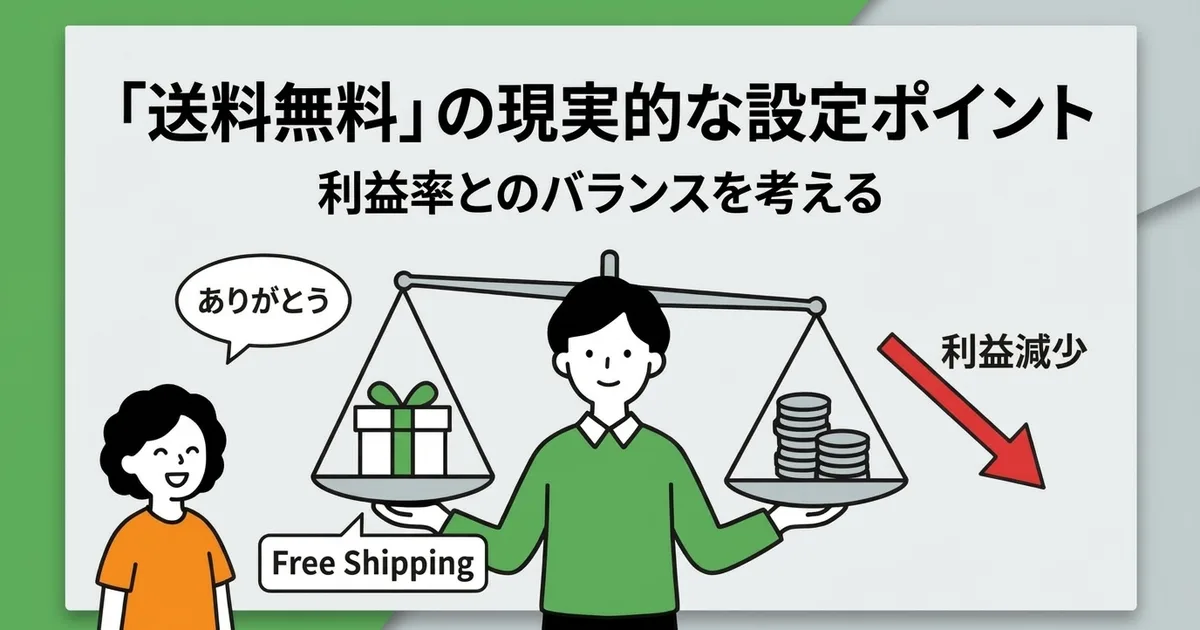
When Does Free Shipping Actually Make Sense? Balancing Delivery Costs and Profit Margins
Seeing "Free Shipping" is a powerful purchase trigger for shoppers. But shipping is never truly free—the incurred cost always has to be absorbed somewhere on the merchant's side.
As a merchant who has wrestled with shipping rate strategies—and as a developer building apps to streamline fulfillment—I've learned that how you set your conditions matters far more than simply deciding whether or not to offer free shipping. While 185 yen might sound negligible at first glance, it can wipe out a huge chunk of your profit depending on your product's price point.
Note: The calculations in this article are based on the Click Post rate effective through September 30, 2026 (a nationwide flat rate of 185 yen). Because the rate will increase to 240 yen on October 1, you can apply the exact same reasoning and framework by substituting 240 yen in place of 185 yen.
In this article, I'll walk through realistic ways for small Shopify stores to design a sustainable free shipping strategy, balancing it against profit margins using concrete numbers.
How Much of Your Revenue Does 185 Yen in Shipping Actually Take?
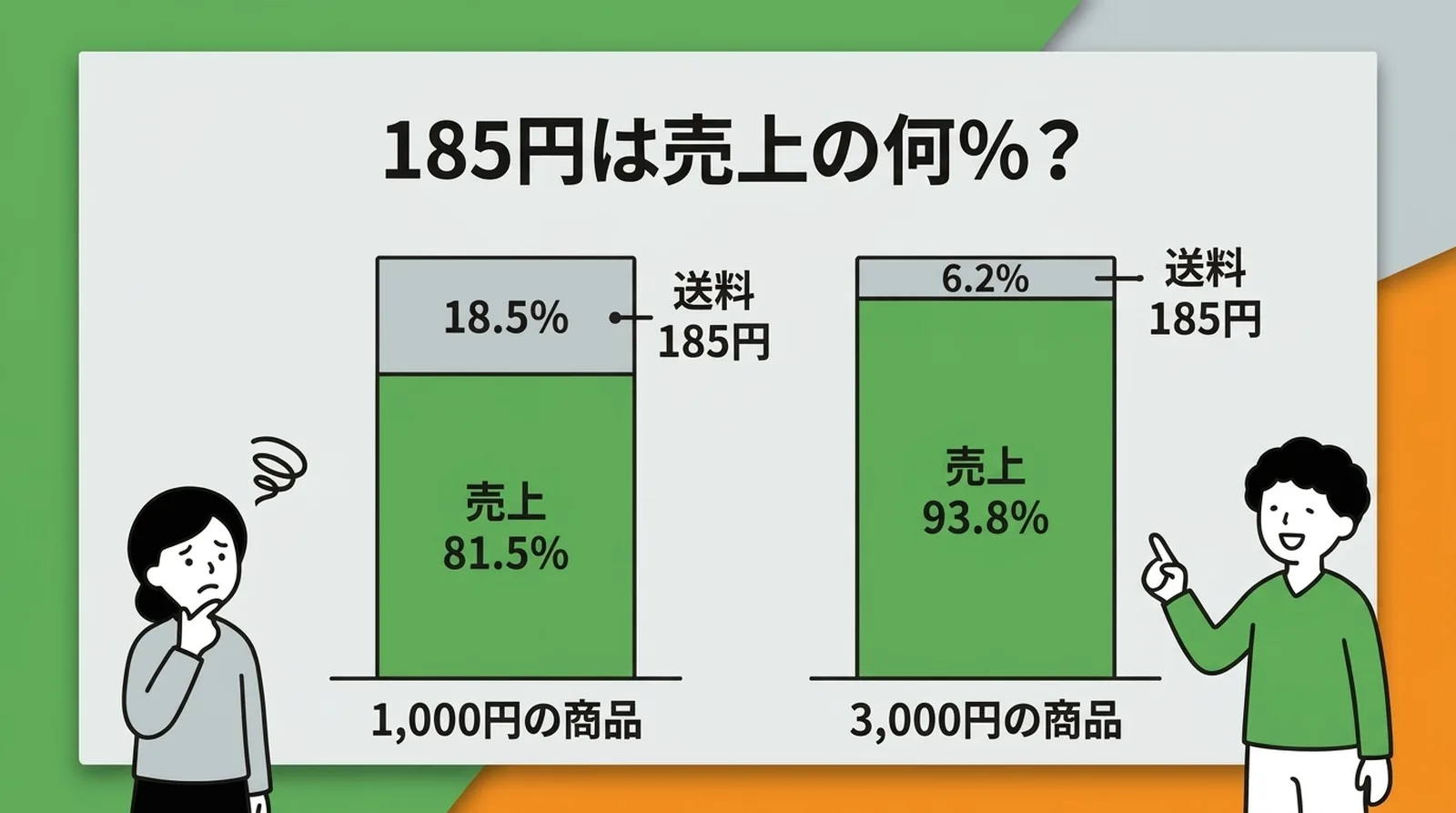
Click Post offers a nationwide flat rate of 185 yen (through September 30, 2026; increasing to 240 yen on October 1). Let's take a look at what percentage of total sales that 185 yen represents across different price points.
| Product Price | Shipping Ratio (185 yen) |
|---|---|
| 500 yen | 37.0% |
| 1,000 yen | 18.5% |
| 1,500 yen | 12.3% |
| 2,000 yen | 9.3% |
| 3,000 yen | 6.2% |
| 5,000 yen | 3.7% |
For a 1,000 yen product, shipping eats up 18.5% of the sale. If you offer "free shipping" and absorb that cost as the merchant, 185 yen comes directly out of your profit. On a product with a 40% cost of goods sold (COGS), your profit drops significantly from 600 yen down to 415 yen.
At a 500 yen price point, shipping hits a staggering 37% of the sale. Since shipping wipes out virtually all of your margin, offering free shipping here simply isn't realistic.
On the other hand, once product prices climb past 3,000 yen, the 185 yen shipping cost drops to around 6% of sales. If your profit margins have a healthy cushion, absorbing that cost becomes well within reason.
3 Approaches to Offering Free Shipping
Pattern 1: Bake Shipping into the Product Price
This approach involves rolling the shipping cost into the retail price in advance. For example, you price a 1,000 yen item at 1,185 yen and advertise it as "free shipping."
- Pros: The total checkout amount is immediately clear to customers, and the "Free Shipping" badge provides a strong incentive to buy.
- Cons: Your products may look more expensive when shoppers compare prices against competitors who charge for shipping separately.
This strategy works best when your products are distinctive. It is particularly effective for handmade items or original goods where shoppers cannot easily make direct price comparisons with other stores. In my own store, I sell custom-made, one-of-a-kind TRRS cables that aren't easily compared to items elsewhere. That makes it a category where all-inclusive shipping pricing is easy to adopt.
Be careful, however, if identical or similar products are listed on major online marketplaces. Marketplace listings often display lower base prices with shipping added separately, which might lead customers to dismiss your listing as overpriced at first glance.
Pattern 2: Free Shipping Above a Minimum Order Threshold
This method sets a qualifying rule, such as "Free shipping on orders over ¥X." You can easily configure this in Shopify's shipping settings.
The crucial decision here is determining the right threshold amount.
Assuming Click Post's 185 yen rate (through September 30; 240 yen starting October 1), here is a breakdown of baseline thresholds that protect your profitability even after waiving shipping fees.
| Free Shipping Threshold | Est. Average Order Value | Shipping Ratio of Sales | Impact on Profit |
|---|---|---|---|
| 2,000 yen or more | 2,500 yen | 7.4% | Low |
| 3,000 yen or more | 3,500 yen | 5.3% | Minor |
| 5,000 yen or more | 5,500 yen | 3.4% | Negligible |
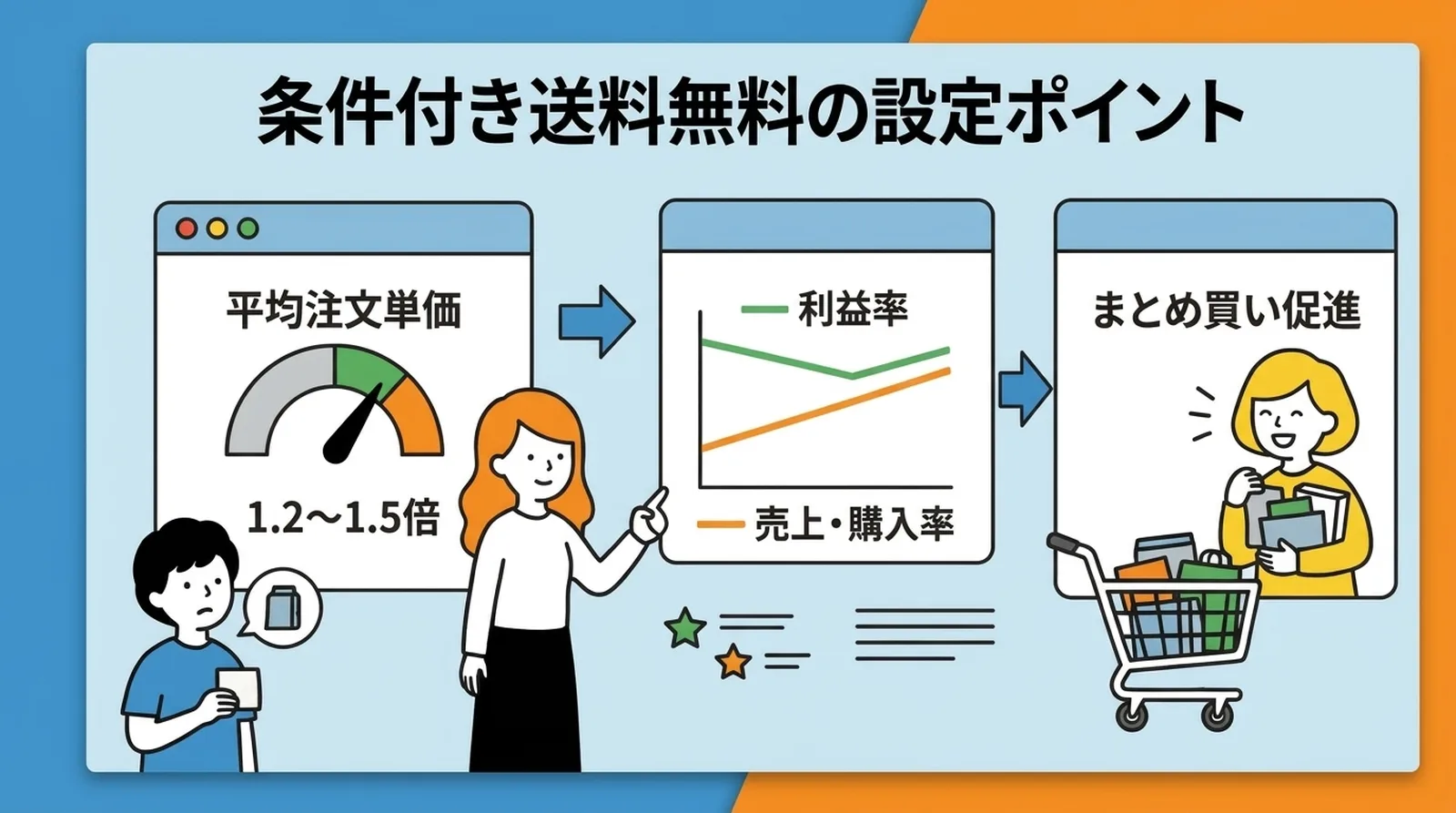
As a general rule of thumb, setting the threshold at roughly 1.2 to 1.5 times your average order value (AOV) encourages customers to add more items to their cart while protecting your margins.
For example, if your shop's average order value is 1,500 yen, a threshold between 2,000 and 2,500 yen makes a strong candidate.
Pattern 3: Do Not Offer Free Shipping
This approach simply charges for shipping separately on top of the product price.
Click Post's 185 yen fee (240 yen starting October 1) is already one of the most affordable parcel options available. As long as you clearly communicate "Nationwide Flat Rate: 185 yen" on your product pages and site, many buyers will happily accept it. Rather than forcing a free shipping offer that eats into your margins, presenting shipping transparently at cost can often be the healthier operational choice.
This is especially true when your products are priced under 1,000 yen or carry profit margins below 30%, where offering free shipping can quickly plunge you into the red. You need to weigh carefully which has the bigger impact: lost sales from shoppers who abandon checkout over a 185 yen shipping fee (240 yen from October onward), or eroded margins from subsidizing shipping yourself.
Calculating Backward from Your Profit Margins
Deciding whether to offer free shipping ultimately comes down to calculating your margins.
Case Study: A 2,000 Yen Product
Let's compare numbers using an example of a 2,000 yen product with a 35% cost of goods sold (COGS).
When shipping is charged separately (customer pays 185 yen):
- Revenue: 2,000 yen
- Cost: 700 yen (35%)
- Profit: 1,300 yen
When offering free shipping (store absorbs 185 yen):
- Revenue: 2,000 yen
- Cost: 700 yen
- Shipping cost: 185 yen
- Profit: 1,115 yen
Profit drops from 1,300 yen to 1,115 yen, pushing your profit margin down from 65% to 55.8%. Whether this margin hit is acceptable depends on how much free shipping improves your conversion rate and overall order volume.
How to Calculate the Breakeven Point
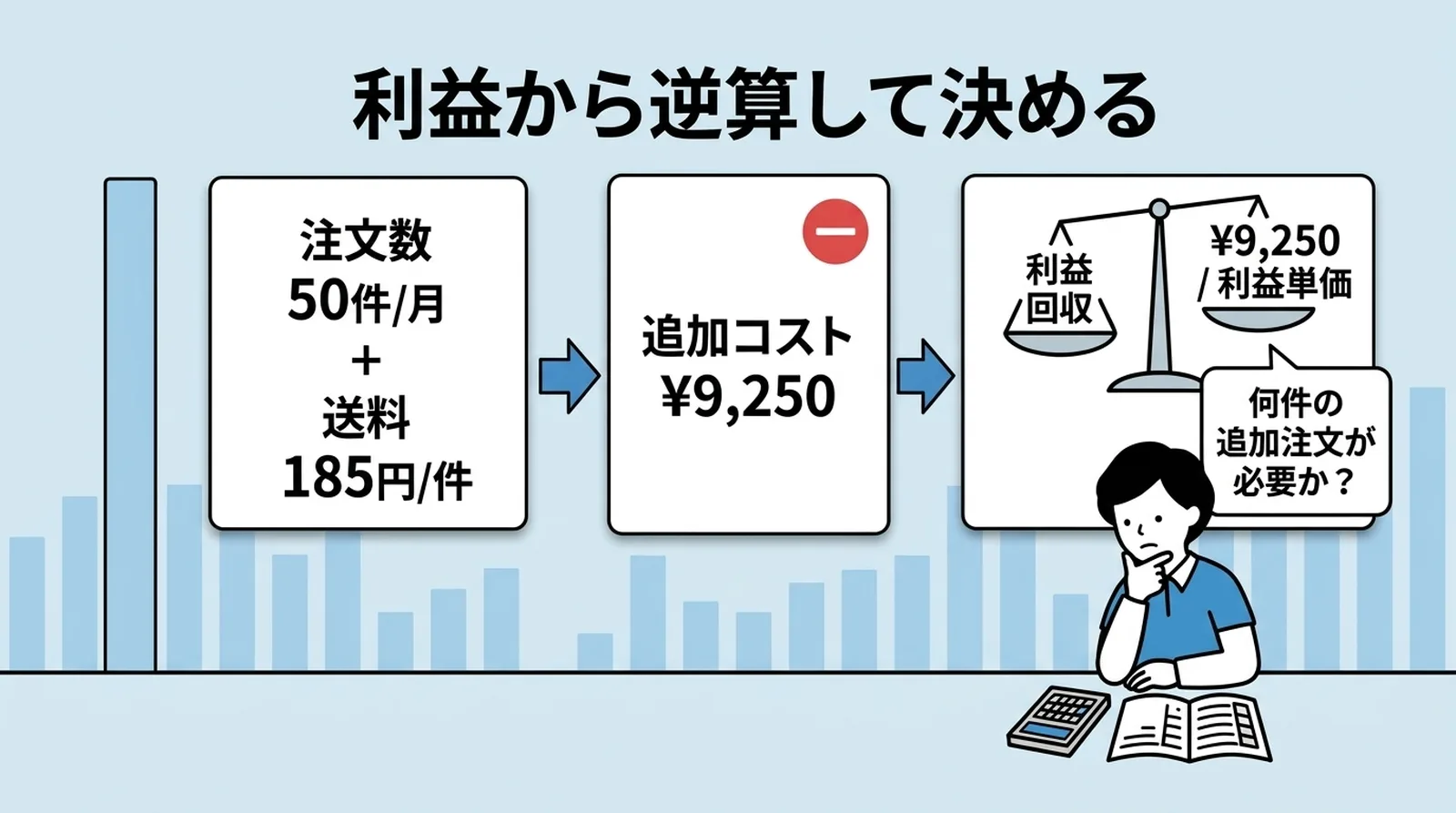
If a store averaging 50 orders per month introduces free shipping, the new shipping expense is 50 orders × 185 yen = 9,250 yen/month (calculated at the pre-October rate; from October 1 onward, 50 orders × 240 yen = 12,000 yen/month). To justify this extra expenditure, the benchmark is whether free shipping drives enough incremental orders to make up the difference.
With a profit of 1,115 yen per order, you would need just under 9 additional orders per month to break even.
However, the actual lift in order volume driven by free shipping varies widely depending on your product type and customer demographics. If you are hesitant, running a limited-time free shipping promotion to gather real order data before committing long-term is the safest route.
What I Do in My Own Store
In my own store, I also used to charge for shipping separately. Because most of my catalog consisted of unique, one-of-a-kind items like custom TRRS cables and resin artisan keycaps, very few shoppers hesitated to buy over a 185 yen shipping fee.
However, once I added lower-priced items like stickers to the lineup, the 185 yen shipping fee represented a disproportionately large percentage of the item price, and some shoppers began to feel it was poor value. That led me to rethink the strategy and introduce a "Free shipping on orders of 2,000 yen or more" rule, encouraging customers to add an extra item or bundle products together.
As a result, more customers began purchasing multiple items in a single order, successfully lifting our average order value.
Of course, this approach won't fit every store. It worked well in part because my store focuses on a curated selection of handmade goods. It is essential to tailor your free shipping threshold to your own product price points and cross-selling purchasing patterns.
How to Set Up Free Shipping in Shopify
Here are the steps to set up conditional free shipping in your Shopify admin:
- In your Shopify admin, go to Settings → Shipping and delivery
- In the Shipping section, edit the relevant shipping profile
- Add a new rate to your shipping zone and set the price to "0 yen"
- Click Add conditions and enter the minimum order amount (e.g., 2,000 yen)
- Save your changes
Once configured, orders meeting or exceeding that threshold will automatically receive free shipping. Any orders below the threshold will show your standard shipping rates as usual.
Keep in mind that once you configure the condition in your admin, you must also clearly promote it on your homepage, header banner, and product pages (e.g., "Free shipping on orders over ¥X"). If shoppers aren't aware of the offer, it won't motivate them to add more items to their cart.
Frequently Asked Questions
Q. Won't offering free shipping put my store in the red?
It depends on your profit margins and price points. If your store has profit margins of 50% or higher and products priced over 2,000 yen, absorbing the 185 yen shipping fee (240 yen from October 1 onward) still leaves healthy profit. On the other hand, for products with slim margins or low price tags of 500 to 1,000 yen, subsidizing shipping hits your bottom line directly. Calculate the margins on your product catalog before deciding to introduce free shipping.
Q. What is the ideal threshold for "Free shipping on orders over ¥X"?
A good rule of thumb is 1.2 to 1.5 times your shop's average order value (AOV). For instance, if your average order value is 1,500 yen, starting with a threshold between 2,000 and 2,500 yen and fine-tuning it based on how orders trend is a practical way forward. There's no need to stress over finding the theoretically perfect number right from day one.
Q. Which is more effective: free shipping or loyalty points / rewards?
Generally, free shipping provides an immediate, tangible benefit that more effectively nudges shoppers to complete their purchase. While loyalty points and rewards are effective for encouraging return visits and repeat business, free shipping is typically more powerful at lowering the barrier to buy for first-time visitors. The best choice depends on your repeat customer rate and whether your products naturally drive repeat purchases.
Q. Will setting a free shipping threshold truly increase my average order value?
Not necessarily. If your threshold is set too far above your average order value, shoppers will feel it's not worth stretching to buy extra items, meaning it won't motivate bundle purchases. The key is staying close to the 1.2 to 1.5 times AOV guideline. Once you launch, monitor your order data closely and make gradual adjustments.
Summary
While free shipping is an enticing incentive for shoppers, it is ultimately a strategy funded by the merchant. Jumping in without running the numbers first can leave you in a trap where order numbers rise, but profit vanishes.
Here is a recap of the key points:
- While Click Post's nationwide flat rate of 185 yen (240 yen starting October 1) is budget-friendly, the lower your product price point, the more heavily it squeezes your margins
- Store-wide free shipping makes sense when product prices are higher and margins have ample breathing room
- Threshold-based free shipping ("Free shipping over ¥X") is a practical choice that drives larger carts while protecting profit
- Depending on your product line and customer base, charging shipping separately with complete transparency is often entirely reasonable
- If you're unsure, run a limited-time free shipping promotion to test the waters and evaluate real order data before making a permanent change
Start by calculating your store's profit margins and average order value, then build a sustainable shipping strategy that works for you. Shipping rules don't need to be set in stone; you should review and adjust them flexibly as your product catalog and sales trends evolve.
If you want to cut down on fulfillment hassle and optimize your overall shipping workflow, be sure to check out Instant Shipping! for Click Post.
Related Articles
- Streamlining Shopify and Click Post Shipping — A practical workflow from CSV export to updating tracking numbers
- Shipping-Included vs. Separate Shipping: Which Sells Better? The 3,000 Yen Threshold for Displaying Shipping Fees — Choosing between shipping-included and separate rates comes down to the ratio of shipping cost to product price
- How to Handle Shipping Costs for Returns and Exchanges — Clearly define return and exchange shipping policies in advance and build a cost buffer into product prices...
![[2026 Latest] Click Post 185 Yen (240 Yen from Oct 1) vs. Yu-Packet from 250 Yen (Flat 360 Yen from Oct 1) | Rates & Size Comparison Chart](/blog/images/clickpost/02_01_shipping_comparison/thumb.webp)