Click Post's 3 cm Thickness Limit Changes in October | New Size Rules and Packing Verification
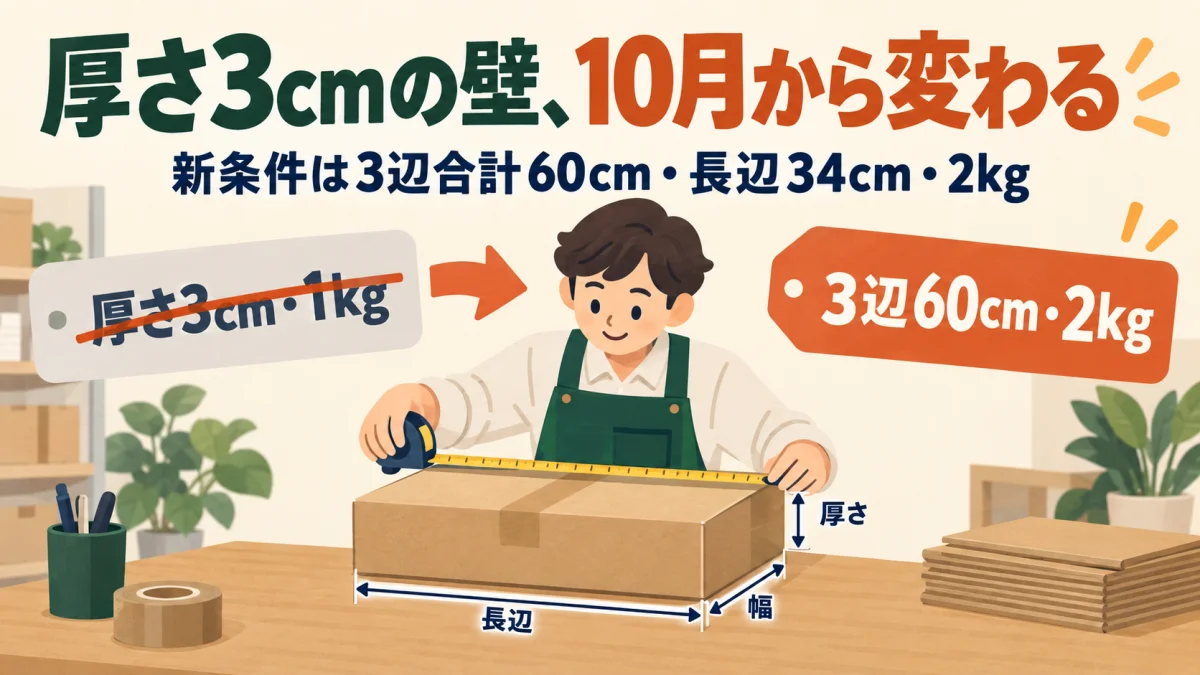
With the revision taking effect on October 1, 2026, Click Post's standalone "3 cm thickness" cap will be eliminated, transitioning to a new requirement: "three dimensions totaling 60 cm or less, longest side 34 cm or less, and must be able to be dropped into a postbox" (based on Japan Post's announcement; confirmed as of September 19, 2026, regarding upcoming changes).
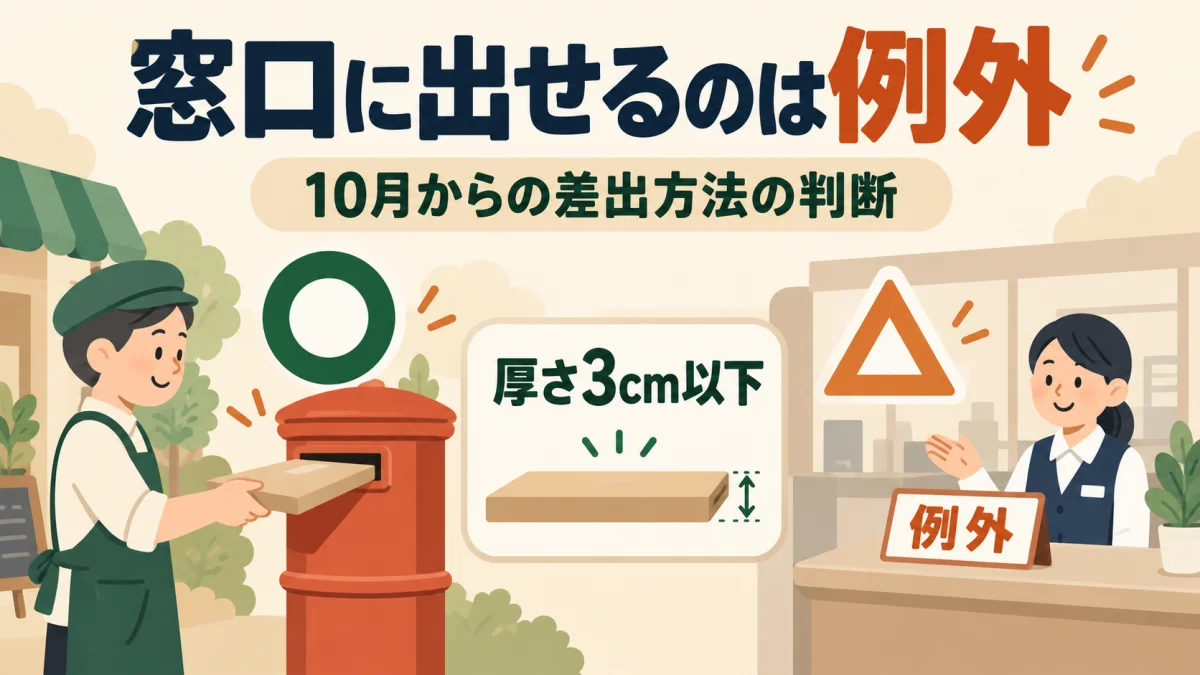
However, even with the standalone thickness cap removed, the physical requirement that packages must fit through a postbox drop slot remains in force, and post office counters will only accept drop-offs for packages 3 cm thick or less. Furthermore, boxes measuring 34 cm (length) × 25 cm (width) × 3 cm (thickness)—which barely fit under the current maximum dimensions—add up to 62 cm across all three dimensions, exceeding the new 60 cm limit. This means you will need to recheck boxes that you have relied on up to now.
Through September 30, the current requirements—longest side within 34 cm, short side within 25 cm, thickness within 3 cm, and weight up to 1 kg—remain in effect. In this article, I will clearly distinguish between the current and revised conditions and walk through the process of verifying your packages once fully packed.
Comparing Conditions Through September vs. From October Onward
First, let's compare the current rules with the announced new rules in a side-by-side table.
| Item | Through September 30 (Current) | From October 1 (Announced) |
|---|---|---|
| Postage | 185 yen (tax included, nationwide flat rate) | 240 yen (tax included, nationwide flat rate) |
| Size | Longest side 34 cm, short side 25 cm, thickness 3 cm | 3 dimensions total within 60 cm, longest side within 34 cm, and must be able to be dropped into a postbox |
| Weight | 1 kg | 2 kg |
| Mailing Method | Postbox drop-off or post office counter | Postbox drop-off in principle. Post office counter is limited to packages meeting exception criteria and measuring 3 cm thick or less |
| Cutoff for Old Postage Rate | — | Transactions where payment processing is completed by September 30 at 23:30 (scheduled) qualify for the old rate |
The details effective from October are based on Japan Post's announcements: the July 3 postage revision announcement, the August 21 guidance on mailing methods, and the September 16 notice on the official Click Post website (verified on September 19, 2026).
During the transition, the system will also go offline. According to official notices, service is scheduled to be suspended from September 30 at 23:30 until October 1 at 6:00, with the resumption time subject to change. For a step-by-step shipping workflow tailored to payment cutoffs and maintenance downtime, see the checklist for shipping preparations before and after the cutover date.
An easy detail to overlook under the new rules is that while the explicit "3 cm thickness" figure disappears, a physical condition—"must be able to be dropped into a postbox"—takes its place. Even if a parcel meets all numerical limits, it cannot be shipped if it does not fit into the slot, and post office counters will only accept parcels under strict exception criteria if they are 3 cm thick or less.
Measuring the Three Dimensions and Weight After Packing
When checking compliance with the new rules, you must measure the actual parcel after packing—not the standalone product or the printed box dimensions.
Outer Parcel Dimensions, Not Inner Box Dimensions
Measure outer dimensions only after adding cushioning material, inserting the item into its mailer or box, sealing it, and affixing the shipping label—not by the dimensions printed on the product packaging or the interior measurements of the box. Bubble mailers and poly bags frequently bulge or deform, adding noticeable bulk, which makes measuring the finished parcel essential.
For example, even if an item is 2 cm thick on its own, adding protective wrap and an envelope can easily increase the final thickness by several millimeters to 1 cm. The length and width can also expand due to envelope margins and flap folds, so always measure all three dimensions in their fully packed state.
Gross Weight Combining Product and Packing Materials
The weight limit applies to total gross weight—including the product, box, cushioning materials, and shipping label. While the announced revision expands the weight limit from 1 kg to 2 kg, the reality remains that packaging materials add weight beyond the product's catalog specs. When bundling multiple items into a single package, always verify the combined, fully packaged weight.
Checking Total Dimensions Even for Previously Usable Boxes
This is the most critical change to watch out for: boxes that pushed the limits under the current regulations may not comply with the new combined dimensional cap.
Adding up the current maximum dimensions—length 34 cm, width 25 cm, and thickness 3 cm—results in a total of 62 cm. Because the announced new upper limit requires the sum of all three dimensions to be 60 cm or less, this box falls outside the numerical requirements (this calculation illustrates the announced conditions and is not a report of physical inspections conducted by Japan Post on this specific box).
Here is a comparison illustrating hypothetical outer dimensions and gross weights after packing:
| Hypothetical Dimensions & Gross Weight After Packing | Total | Comparison with Current Numerical Limits | Comparison with New Numerical Limits |
|---|---|---|---|
| 31 × 22 × 3 cm, 1.0 kg | 56 cm | Within limits | Within limits. However, physical drop-off in your postbox must still be confirmed |
| 34 × 25 × 3 cm, 1.0 kg | 62 cm | Within limits | Exceeds total dimensional limit |
| 30 × 23 × 4 cm, 1.5 kg | 57 cm | Exceeds thickness & weight limits | Within numerical limits. However, postbox fit is required, and counter exceptions do not apply due to thickness |
| 34 × 24 × 3 cm, 1.0 kg | 61 cm | Within limits | Exceeds total dimensional limit |
| 30 × 20 × 3 cm, 2.001 kg | 53 cm | Exceeds weight limit | Exceeds weight limit |
Note that "Within limits" in this table refers strictly to a comparison against numerical maximum limits. It does not guarantee acceptance, which also depends on minimum dimensions, permitted contents, packaging regulations, and slot dimensions. Because official details on these fine-print rules could not be verified in my research at this time, do not assume a parcel can definitely be mailed simply because it satisfies the numerical limits.
Conversely, even if a package exceeds 3 cm in thickness, it can still fall within numerical requirements as long as the three dimensions total 60 cm or less and the longest side is 34 cm or less. However, verifying whether it actually fits into the postbox is a separate requirement, which I explain in the next section.
How to Evaluate Packages Thicker Than 3 cm
For packages thicker than 3 cm, you must evaluate both the announced numerical criteria and the physical drop-off step by step.
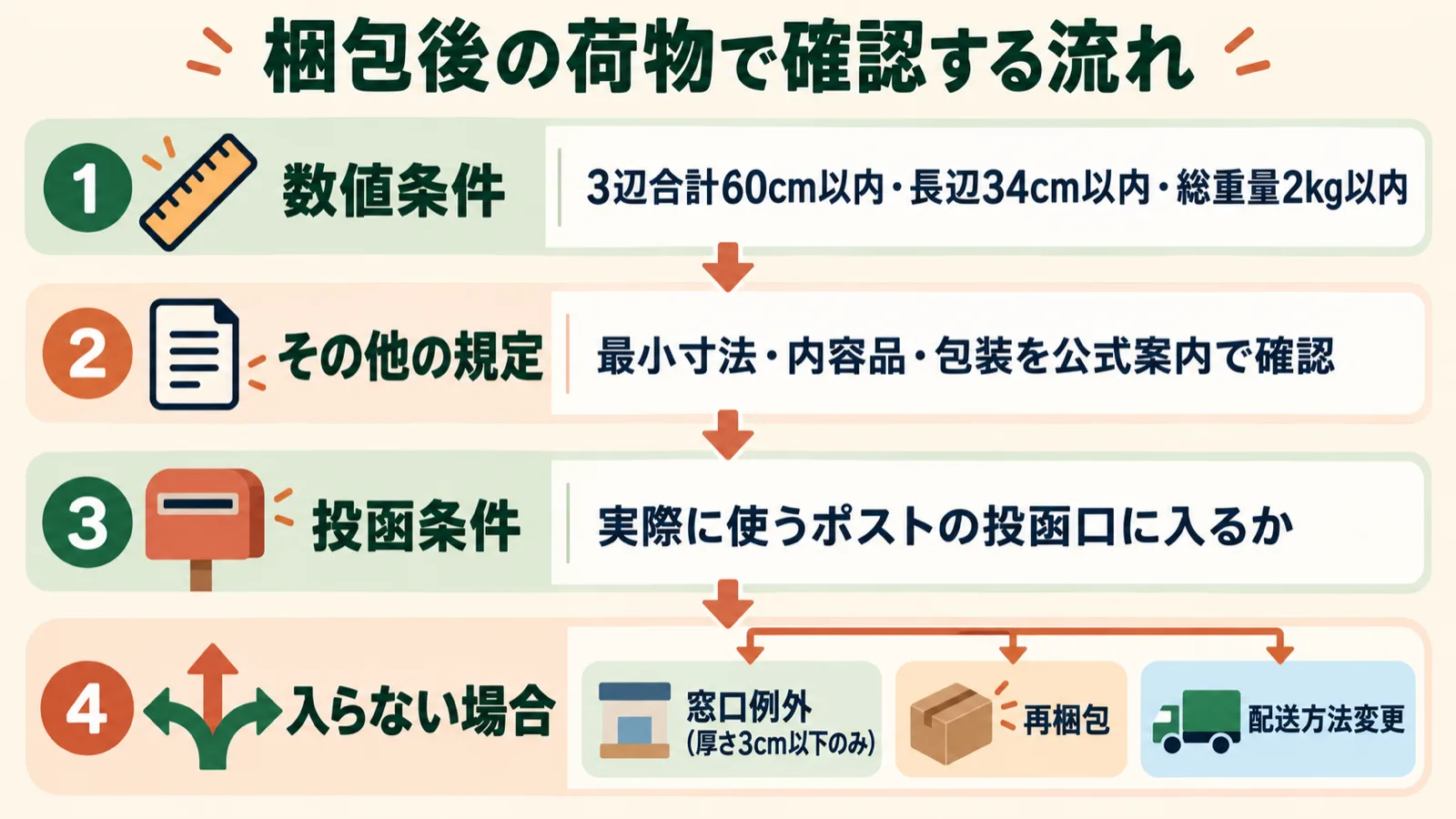
Here is the step-by-step verification order:
- Numerical limits: Does the package meet the criteria of three dimensions totaling 60 cm or less, longest side 34 cm or less, and gross weight up to 2 kg?
- Other regulations: Check current official guidelines for minimum dimensions, acceptable contents, and packaging standards.
- Postbox drop-off condition: Does the package physically fit into the slot of the specific postbox you plan to use?
- Counter drop-off exceptions: If it cannot be dropped into the box, does the reason match one of the three announced exception criteria, and is the package 3 cm thick or less?
Official specifications regarding slot dimensions and postbox model compatibility could not be verified in my research at this time. For that reason, I cannot assert that packages will fit in every postbox or specify an exact thickness limit that will always go through. Please test the physical slot of the postbox you actually intend to use.
If a package does not fit into the postbox slot, you have three options:
- Repack to reduce outer dimensions: Reevaluating your cushioning material or rearranging items inside the package can often trim outer dimensions.
- Check an alternative postbox: Drop slot dimensions and shapes can vary across different postbox models, so test whether the parcel fits into another nearby box.
- Switch shipping methods: If neither repacking nor trying another postbox solves the issue, consider switching to an alternative delivery service.
If you are considering bringing packages to a post office counter, the parcel must meet both an exception condition and the requirement of being 3 cm thick or less. For detailed criteria on drop-off exceptions and decisions based on why a package cannot be mailed via postbox, see the article on post office counter drop-off exceptions and postbox decisions.
If you need to switch shipping methods, here are official terms confirmed on the same date (each either taking effect on October 1, 2026, or having no announced changes):
| Shipping Method | Rate | Overview of Requirements |
|---|---|---|
| Yu-Packet | Flat rate of 360 yen (tax included; announced to unify standard rates on the same date) | Limited to packages within 3 cm thickness |
| Letter Pack Plus | 600 yen (no announced changes) | No thickness limit as long as the designated envelope can be sealed. Up to 4 kg, face-to-face delivery |
| Yu-Pack | Size 60, from 840 yen within the same prefecture | Rate varies based on distance to destination. Includes liability coverage |
For strategic guidance on choosing among these services, refer to the shipping method comparison article.
Packing Checks to Prevent Returns and Damaged Goods
Meeting numerical size requirements is entirely separate from ensuring packaging adequately protects your goods. Stripping away too much cushioning just to squeeze under size limits invites package damage during transit.
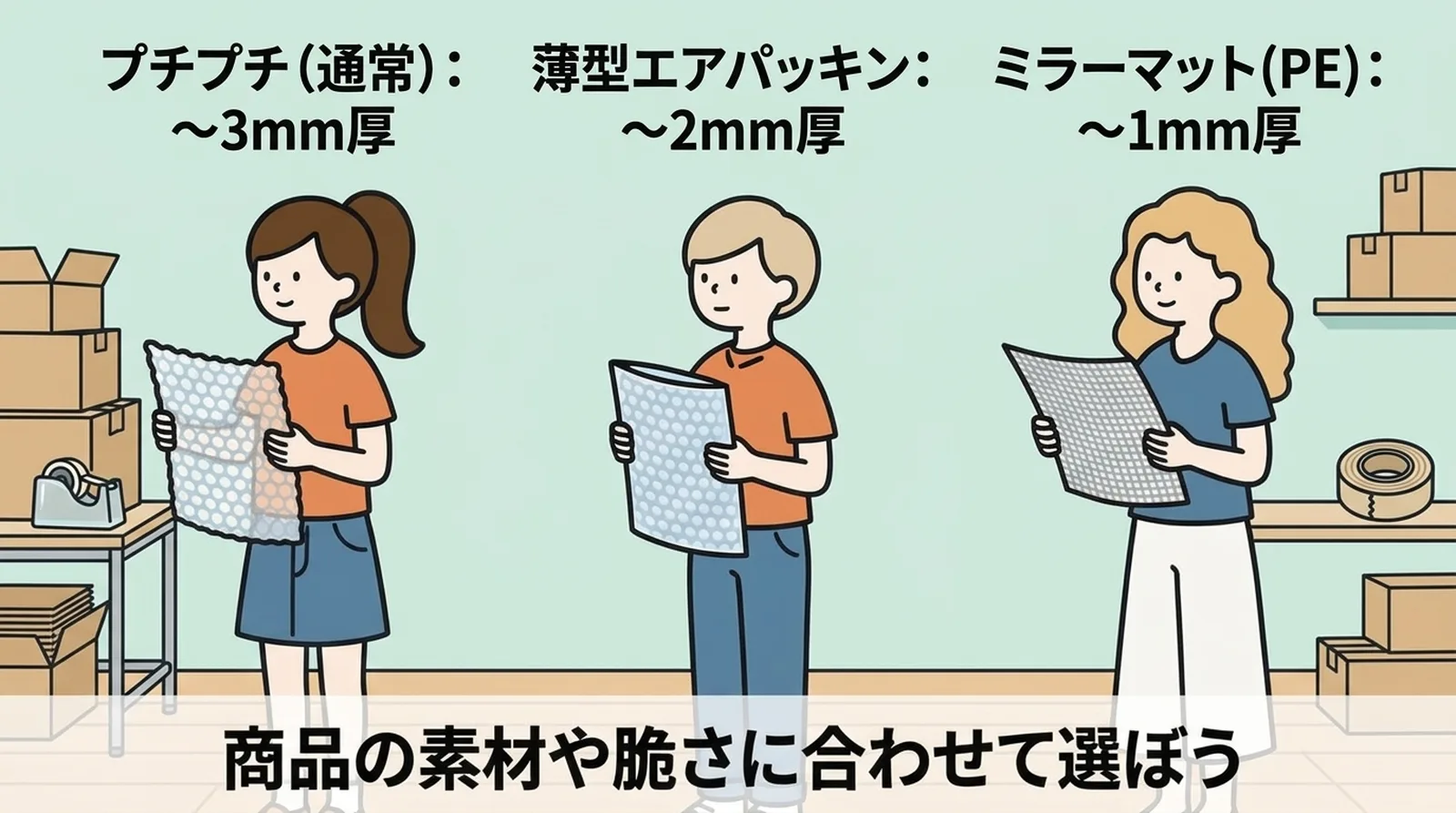
Below are rough guidelines for the thickness of common cushioning materials. Choose the right option based on your product's material and fragility:
| Cushioning Material | Approximate Thickness | Characteristics |
|---|---|---|
| Bubble wrap (single layer) | Approx. 3 mm | Standard choice, but tends to add noticeable bulk |
| Thin air cushions | Approx. 1.5–2 mm | Thinner than bubble wrap, with slightly less shock absorption |
| Tissue paper | Approx. 0.5 mm | Best for scratch prevention; minimal impact cushioning |
| Foam sheet (polyethylene foam) | Approx. 1 mm | Thin with high cushioning performance; ideal for small items |
Key packing considerations:
- Never force packages through: Forcing packages into a postbox slot or stripping away protective materials at the risk of damaging the merchandise is never a viable solution.
- Treat measuring tools strictly as guides: Thickness measurement rulers, calipers, and homemade cardboard gauges are simply tools to gauge outer dimensions; passing through a gauge does not guarantee acceptance.
- Leave a safety margin against returns: For packages right on the edge of numerical limits, build in a buffer to account for shifting or bulging during transit that could result in the parcel being deemed non-compliant.
- Handling of non-compliant packages: Click Post postage is announced to be finalized at the point when acceptance processing occurs at the post office. How postage is handled if a package is returned depends on the circumstances; rather than making assumptions based solely on announcement materials, verify directly through Japan Post guidelines should this occur.
Additionally, detailed regulations regarding minimum dimensions, permitted contents, and packaging standards could not be confirmed in official documentation during my research. Please verify all shipping requirements against the latest official announcements at the time of mailing.
Frequently Asked Questions
Q. Can I still use the 34 × 25 × 3 cm boxes I have been using after October?
This combination adds up to 62 cm across all three dimensions, exceeding the newly announced 60 cm limit and placing it outside the numerical requirements. If you cannot bring the total within 60 cm by adjusting your packaging or product placement, consider switching to slightly smaller boxes.
Q. How should I evaluate packages thicker than 3 cm after October?
As long as the sum of the three dimensions is 60 cm or less and the longest side is 34 cm or less, the package falls within numerical limits, but it must still physically fit through the postbox slot. Because post office counters are announced to accept drop-offs only for packages 3 cm thick or less, you should consider repacking or switching shipping methods if a parcel does not fit through the slot.
Q. Will I be able to send packages weighing over 1 kg?
According to the announcement, the weight limit will increase from 1 kg to 2 kg. Be sure to verify gross weight combining both the product and all packaging materials. Keep in mind that size requirements and physical postbox fit must still be checked separately.
Q. Will thickness measurement rulers still be useful?
They remain useful for gauging thickness after packing, but clearing the ruler slot does not guarantee that the package can be mailed. Under the new requirements, in addition to checking total dimensions, the longest side, and gross weight, you must also confirm that the package physically fits into the drop slot.
Q. If a package does not fit into a postbox, can I just bring it to a post office counter?
Counter drop-offs are strictly handled as exceptions. They are permitted only if a package meets one of three specific conditions—the postbox is full or out of order, the drop-off volume exceeds what can fit at one time, or the package complies with dimension rules but the slot width is insufficient—and the parcel must be 3 cm thick or less. Post office counters will not accept packages thicker than 3 cm even under these exceptions, so you should consider repacking, trying another postbox, or switching to an alternative delivery service.
Summary
Click Post's standalone 3 cm thickness limit is scheduled to be removed with the revision on October 1, 2026. Because it is being replaced by the requirement of "three dimensions totaling 60 cm or less, longest side 34 cm or less, and must be able to be dropped into a postbox," you should adapt your fulfillment operations to check outer dimensions after packing, gross weight, and physical postbox fit as an integrated checklist.
While boxes that barely fit under current limits may exceed the new total dimensions, packages thicker than 3 cm can now qualify under numerical rules. This revision offers a prime opportunity to review your shipping boxes and packing materials. For next steps and counter drop-off policies when a parcel does not fit in a postbox, see the article on post office counter drop-off exceptions.
Rates and terms verified as of September 19, 2026. Information regarding October and onward reflects scheduled changes based on Japan Post announcements. Please verify detailed shipping conditions against the latest official guidelines when mailing.
Related articles: Counter Drop-Off Rules and Decisions When Packages Don't Fit into Postboxes, Shipping Preparations Before and After the Cutover Date, Shipping Method Comparison, Shopify × Click Post Shipping Guide
While checking parcel dimensions and dropping packages into postboxes are physical tasks, if post-shipping administrative chores like organizing CSVs and fulfilling tracking numbers are weighing you down, Instant Shipping! for Click Post can help streamline your operations. Learn more about the app's features and installation process on this page.