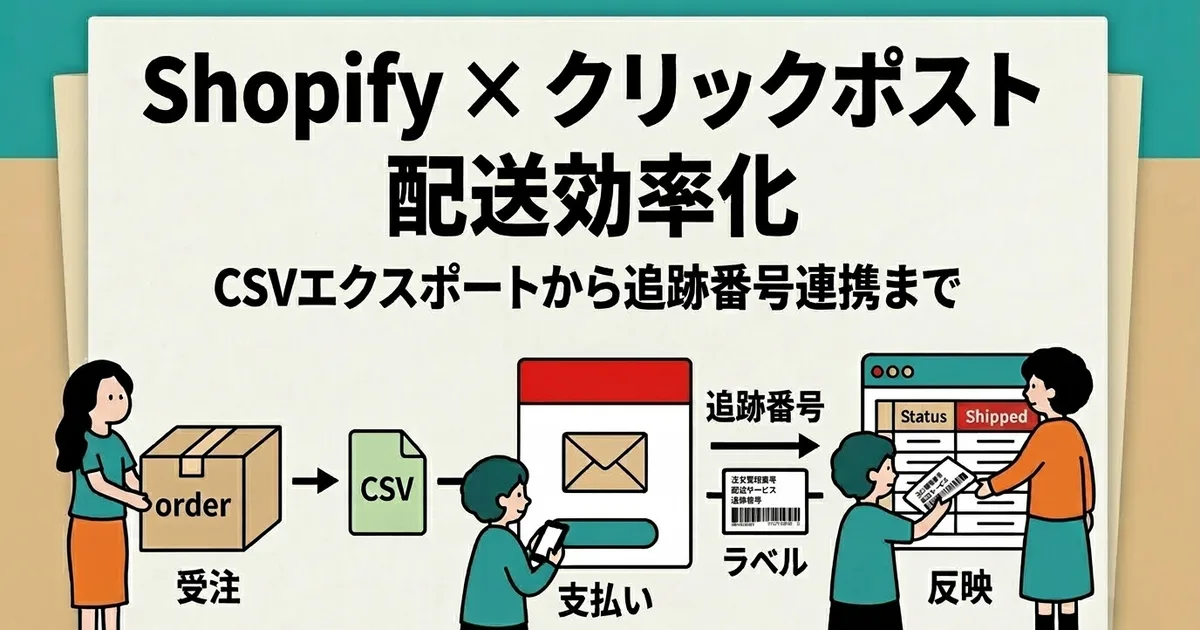

Shopify Shipping App Comparison: Which Is Best for Click Post Integration?
For merchants shipping via Click Post on Shopify, the day-to-day fulfillment workflow hinges heavily on the app you use—or whether you use one at all.
When you only have five orders, simple copy-pasting might be manageable. But once volume climbs to 20 or 50 orders, things change dramatically. Spending 30 minutes formatting CSV files and an hour transcribing tracking numbers is time you could have spent packing orders or planning your next campaign.
Having used Click Post for about three years, I felt the limits of manual operations firsthand—which ultimately led me to build my own app. In this article, I'll walk through the key factors to consider when choosing a Shopify shipping app for Click Post.
3 Essential Features for Click Post Integration
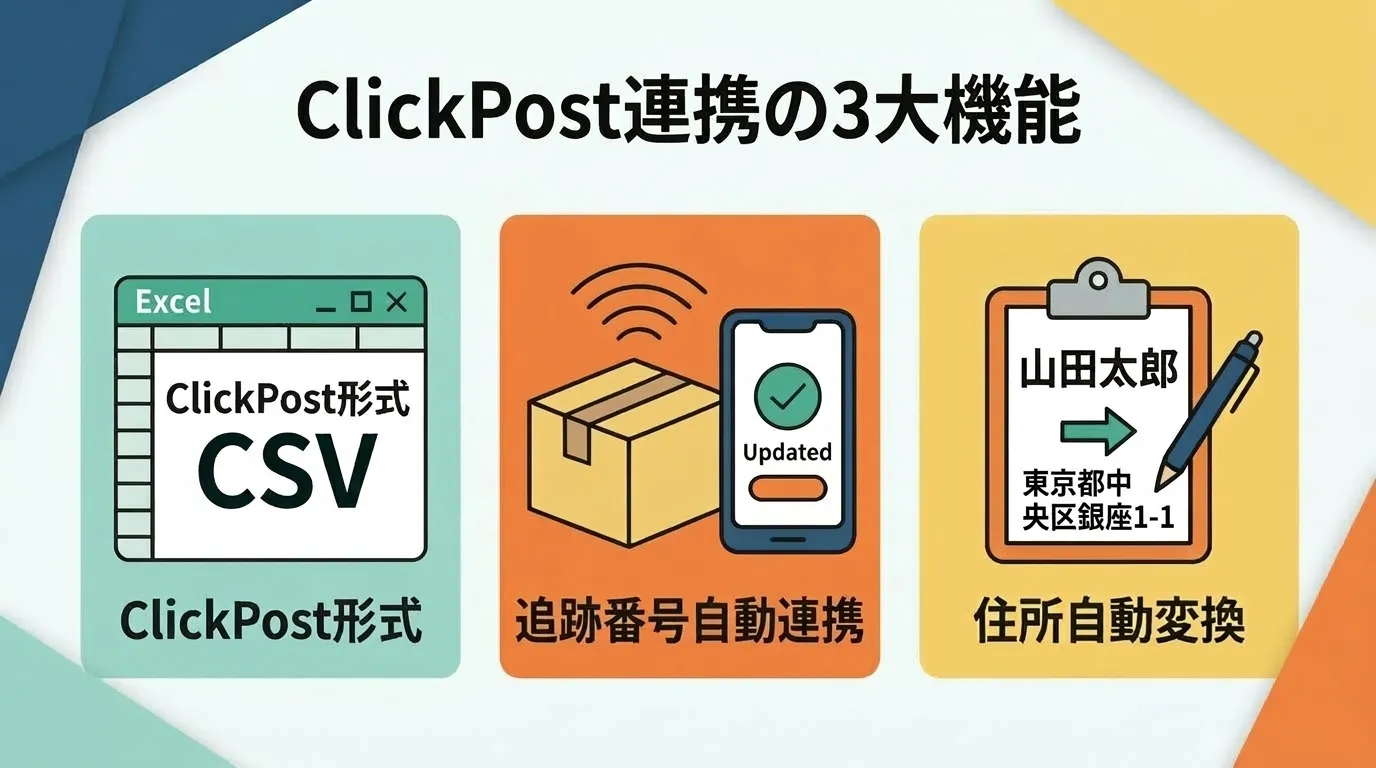
When shipping via Click Post from Shopify, there are three primary features you need in an app. If any one of them is missing, you inevitably end up stuck with manual work.
CSV Export (Formatting for Click Post)
Uploading a CSV file to Click Post's bulk application feature requires a file formatted to strict specifications. If you simply export raw order data from Shopify, neither the column order nor the header names will match, forcing you to rearrange and convert everything manually.
Whether your app handles this conversion automatically makes a massive difference in how much time each shipping run takes.
Automatic Tracking Number Sync
Creating shipping labels in Click Post generates tracking numbers, but Shopify offers no built-in way to sync them back automatically. To notify customers of their shipment status, you must manually update the Shopify order status to "Fulfilled" and attach the corresponding tracking number to each order.
Doing this manually means copying the tracking number from the Click Post portal, opening each Shopify order page, and pasting it in one by one.
Automatic Address Data Conversion
Click Post enforces character limits on address fields, as well as strict rules regarding full-width and half-width characters. Because Shopify order data reflects addresses exactly as entered by customers, upload errors due to character limits or format mismatches are surprisingly common.
Long building and apartment names, or inconsistent address formatting (such as mixing "1-2-3" with full-width or traditional block numbers), can quietly eat up a tremendous amount of time when corrected by hand.
What Happens Without an App (Manual Operations)
If you ship via Click Post from Shopify without an app, your workflow typically looks something like this:
- Export orders as a CSV from the Shopify admin
- Manually format the CSV in Excel or Google Sheets to match Click Post's format
- Upload the CSV to Click Post's bulk application feature
- Print shipping labels, package items, and drop them in the post
- Manually enter the issued tracking numbers into each Shopify order one by one
- Send shipping confirmation emails
The bottlenecks are steps 2 and 5. Formatting the CSV involves a barrage of tedious tasks: reordering columns, deleting unnecessary fields, adjusting address character lengths, and standardizing full-width and half-width characters. Meanwhile, manually entering tracking numbers scales directly with order volume.
In my experience, 10 orders take about 30 minutes, 50 orders take an hour and a half, and 100 orders can take nearly 3 hours. Having to repeat this every single day during peak seasons was frankly exhausting.
Key Criteria for Choosing a Shipping App
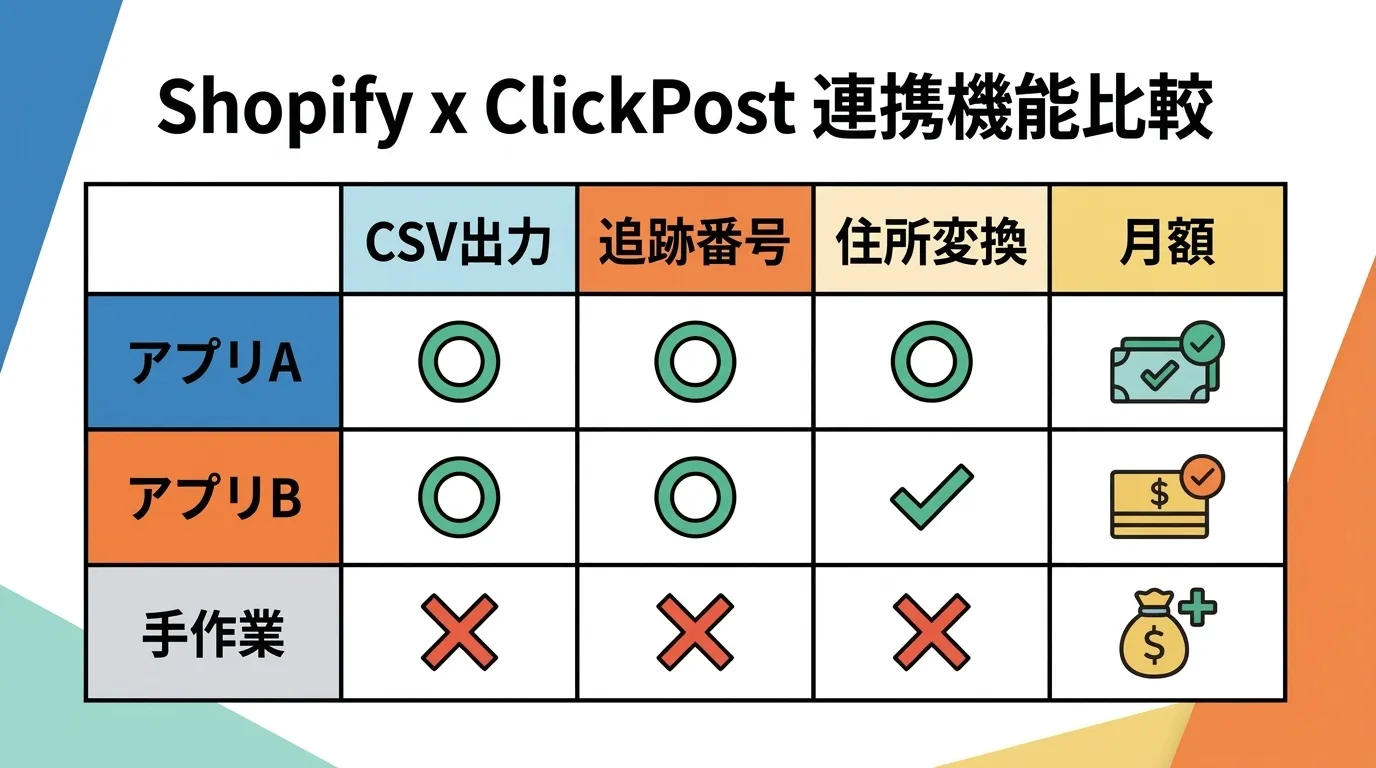
When comparing shipping apps that support Click Post, evaluating them against the following five criteria makes the decision much easier.
| Criteria | Why It Matters |
|---|---|
| CSV format compatibility | Whether it automatically converts data into Click Post's format dictates how much manual prep work is required |
| Tracking number sync method | Whether updates are manual or automated dramatically impacts the time spent per order |
| Address conversion capabilities | Whether it proactively prevents character limit and formatting errors |
| Monthly fee and pricing structure | Since this is a recurring fixed cost, whether it aligns with your monthly shipment volume |
| Support beyond Click Post | If you plan to use Yamato or Sagawa in the future, managing everything in a single app can be convenient |
With these criteria in mind, let's take a look at several available approaches.
The "Instant Shipping! for Click Post" Option
I feel a bit self-conscious talking about an app I developed myself, but the motivation behind creating it came directly from my own frustration: none of the existing tools combined all three of the features mentioned above in one place.
Instant Shipping! for Click Post is a fulfillment efficiency app designed specifically for Click Post.
Key Features:
- Automatically converts and exports Shopify order data into Click Post's CSV format
- Automatically syncs tracking numbers back to Shopify after shipping (and updates order status to "Fulfilled")
- Automatically converts full-width/half-width characters and handles address character limits
Over three years of using Click Post as an active merchant, I pinpointed every friction point where things felt tedious or errors kept happening—and resolved them one by one.
A Free plan is available (free up to 5 shipments per month), so you can test it with a few orders first to see if it fits your workflow.
Comparing Other Approaches
There are several other ways to streamline your Click Post fulfillment. Each approach has different strengths, so consider which best matches your store's specific needs.
Ship&co
A shipping management app supporting multiple carriers (including Yamato Transport, Sagawa Express, and Japan Post). It is ideal if you want a centralized dashboard to manage various shipping methods alongside Click Post. Because it incurs a monthly fee, it is best evaluated in light of your monthly shipping volume.
Plus Shipping
A shipping app centered around integrations with Yamato Transport and Sagawa Express. This can be a viable option for stores that primarily rely on standard courier parcel services and only use Click Post as a secondary method.
Manual Operation (No App)
If you only ship a few orders a month, running fulfillment manually without installing an app is a perfectly realistic choice. While it costs nothing upfront, you need to be prepared for the escalating time cost as your order volume grows.
Every tool has its pros and cons, so there is no single "right" answer. The ideal solution depends entirely on whether Click Post is your primary shipping method or whether you juggle multiple carriers.
Recommendations by Store Scale
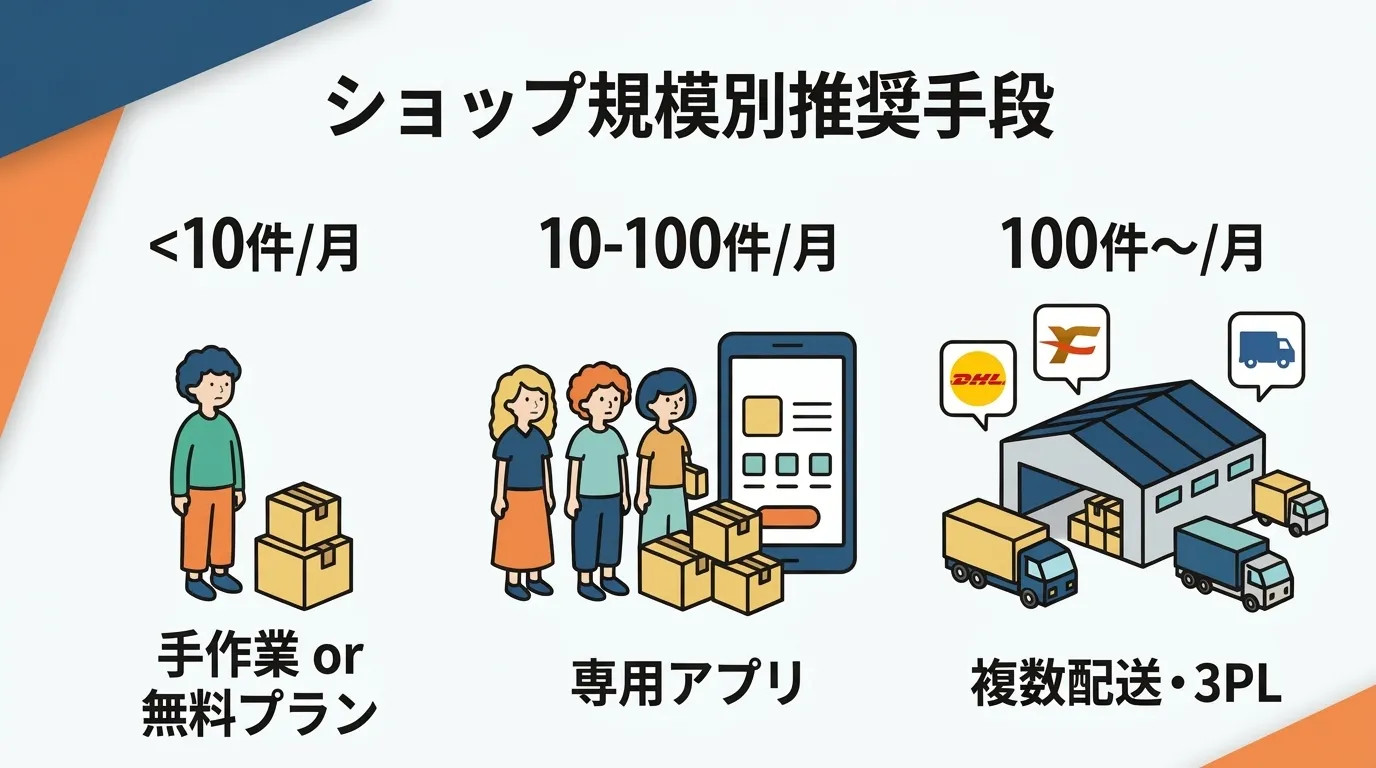
The optimal fulfillment setup varies depending on your order volume. Here is a breakdown across three typical shipment scales as a rule of thumb.
10 or Fewer Shipments per Month: Manual or a Free Plan Is Plenty
When order volume is low, manual workflows are still manageable. Once you get a feel for how CSV formatting works, it is a great time to experiment with apps that offer a free plan. At this stage, the priority is evaluating whether paying a monthly app fee makes financial sense.
10 to 100 Shipments per Month: Automated CSV Export and Tracking Sync Are Essential
In this range, manual tracking number entry and CSV formatting become glaring bottlenecks. Adopting an app that automates CSV export and tracking sync can save dozens of minutes per shipping run. If Click Post is your primary shipping method, using a dedicated app keeps operations simple and efficient.
Over 100 Shipments per Month: Multi-Carrier Support or 3PL Consideration
Once monthly shipments surpass 100, many merchants find themselves combining Click Post with other carriers like Yamato or Sagawa. At this point, consolidating orders with a multi-carrier app or outsourcing fulfillment altogether to a 3PL (third-party logistics) provider becomes a realistic consideration.
For a detailed comparison between in-house fulfillment and 3PL, see our article on In-House Shipping vs. 3PL Comparison.
Frequently Asked Questions
Q. Are there any free shipping apps that support Click Post?
Yes. "Instant Shipping! for Click Post" offers a Free plan (free up to 5 shipments per month), allowing you to use both CSV export and automatic tracking updates at no cost for low-volume shipping. A sensible way to start is trying out the free plan and upgrading to a paid tier as your order volume grows.
Q. Can I manage other shipping methods besides Click Post in a single app?
It depends on the app. Multi-carrier apps like Ship&co let you centrally manage shipments across multiple providers, including Yamato Transport and Sagawa Express. On the other hand, apps dedicated specifically to Click Post, such as Instant Shipping! for Click Post, provide deeper, more tailored functionality for Click Post workflows. The best choice depends on your overall shipping mix.
Q. Will installing an app reduce shipping mistakes?
Yes, it cuts down on errors caused by manual handling, such as exceeding address character limits or miskeying tracking numbers. However, an app cannot prevent physical mistakes like packing the wrong item or forgetting an inclusion. Think of the app as a tool designed to streamline and safeguard the data exchange portion of fulfillment.
Summary
The fastest way to streamline Click Post shipping on Shopify is to choose an app that combines all three core capabilities: CSV export, automatic tracking updates, and address conversion.
- Manual fulfillment works for just a few orders a month, but time costs skyrocket as order volume grows
- For stores primarily shipping via Click Post, a purpose-built app is usually the best fit
- If you use multiple carriers, consider an all-in-one shipping management app or outsourcing to a 3PL
As a merchant myself, I built the tool I wished I had. If you find your Click Post fulfillment taking too much time, give Instant Shipping! for Click Post a try. You can start right away with the Free plan.
Related Articles
- Streamlining Shopify & Click Post Shipping — For those looking to understand the fundamentals of integrating Shopify with Click Post
- Step-by-Step Click Post CSV Export Guide — For those looking for specific instructions on exporting CSV files
- In-House Shipping vs. 3PL Comparison — For growing stores considering fulfillment outsourcing